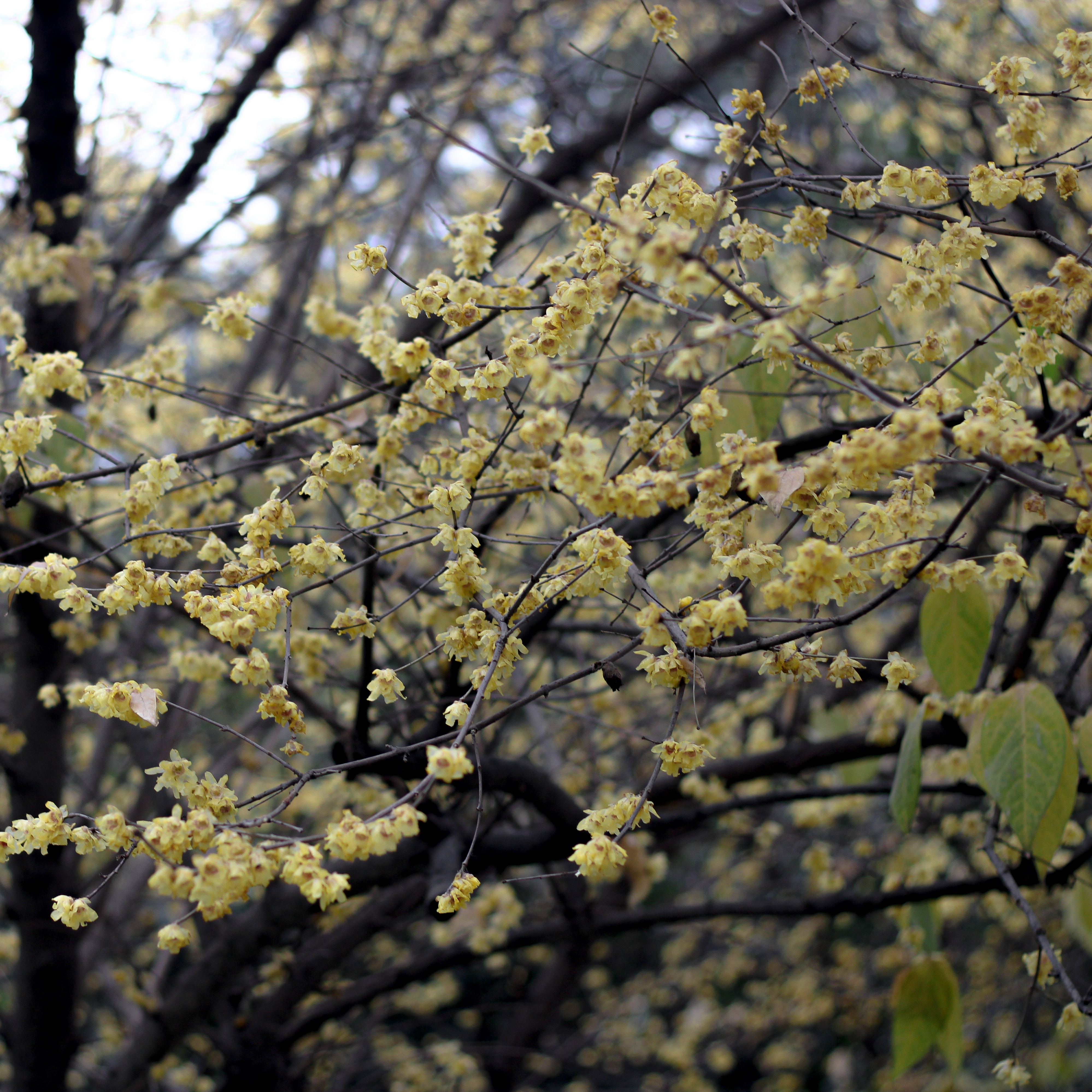
Chimonanthus (wintersweet) is a genus of flowering plants in the family Calycanthaceae, order Laurales, native to China. These are erect deciduous or evergreen shrubs or small trees reaching 2–13 m in height. The leaves are opposite, entire, papery or subleathery, 7–20 cm long and 3–7 cm broad, with the upper surface ranging from smooth to scabrous. Flowers are axillary, subsessile, and intensely fragrant, appearing in late winter or early spring before the new leaves. Each flower is 2–3 cm wide with numerous spirally-arranged yellow or white tepals, sometimes marked with purple at the base. The genus has 5–8 stamens arranged on a cuplike receptacle and 5–15 distinct carpels. The fruit is a pubescent pseudocarp (an urceolate to campanulate receptacle enclosing achenes) 3–4 cm long containing the true fruits. Six species are accepted by the Flora of China, though taxonomic debate continues over whether the group comprises six distinct species or as few as two with intermediate forms. The most famous member, Chimonanthus praecox (wintersweet), is widely cultivated for its spicily scented winter blooms and has a rich horticultural history spanning from Song-dynasty China to modern gardens worldwide.
Etymology
The genus name Chimonanthus derives from Greek, meaning "winter flower" (from χεῖμα / cheima, "winter," and ἄνθος / anthos, "flower"), referring to the plants' distinctive habit of blooming in late winter when few other woody plants are in flower.
Distribution
All six species of Chimonanthus are endemic to China. The genus is also cultivated elsewhere in Asia (notably Iran and Japan), as well as in Europe and North America, where Chimonanthus praecox has been grown as an ornamental since the 18th century.
Taxonomy
The genus includes three to six species depending on taxonomic interpretation. Six are accepted by the Flora of China: C. campanulatus, C. grammatus, C. nitens, C. praecox, C. salicifolius, and C. zhejiangensis. Molecular phylogenetic work by Zhou et al. (2006) distinguishes all six species but groups C. campanulatus and C. praecox separately from the other four with 100% bootstrap support. Some taxonomists (notably Bartholomew, a Flora of China co-author) argue there may be only two biological species — C. praecox and C. nitens — with the remaining names representing variants or introgressions. The species are estimated to have diverged as recently as 1–2 million years ago. GBIF's backbone taxonomy recognizes the genus with 6 descendant species, consistent with the Flora of China treatment.
Cultivation
Chimonanthus praecox is the only species widely grown as an ornamental. It prefers medium sunlight to high dappled shade and a fresh climate, hardy to USDA Zone 7. The ideal soil is soft, acidic, and permeable, never waterlogged in winter. A protected south-facing wall encourages the earliest flowering. Space must be allowed for its spread to about 3 m (10 ft); untimely summer pruning sacrifices the following winter's bloom. After flowering, the shrub is thinned and pruned similarly to Forsythia: partly heading back younger wood while removing a few thick old stems at the ground. Plants are subject to aphids, mites, and leaf beetles. A larger-flowered but less fragrant cultivar 'grandiflorus' was known in cultivation before 1819, and a yellow-flowered form (luteus) was noted by 1814.
Cultural Uses
In China, Chimonanthus has been cultivated since the Song dynasty (11th century) and its winter blooms coincide with Chinese New Year, when flowering sprigs are worn as hair ornaments. Dried prunings are kept in linen cupboards as a natural perfume. The fragrant flowers are edible and can be used to flavor tea. Cut flowering branches are also used in floristry and can be forced into early bloom indoors, much like Forsythia.
History
Chimonanthus was domesticated in China during the Song dynasty and was the subject of courtly poetry from the 11th century. It was introduced from China to Japanese gardens in the early Edo period (probably 1611–1629). Its first recorded European introduction came from Japan to England in 1766, when a specimen was grown under glass for the sixth Earl of Coventry at Croome Court, Worcestershire. By 1799 that shrub had reached 16 feet (4.9 m) in height and 10 feet (3 m) in width, and outdoor trials had proven it hardy in southern England. Cuttings were distributed among nurserymen, cementing its place in European horticulture. The genus reached North America by 1811, when it first appeared in an American nursery catalogue. It has proven hardy at least as far north as New York City, where frosts may interrupt but not stop the flowering.










