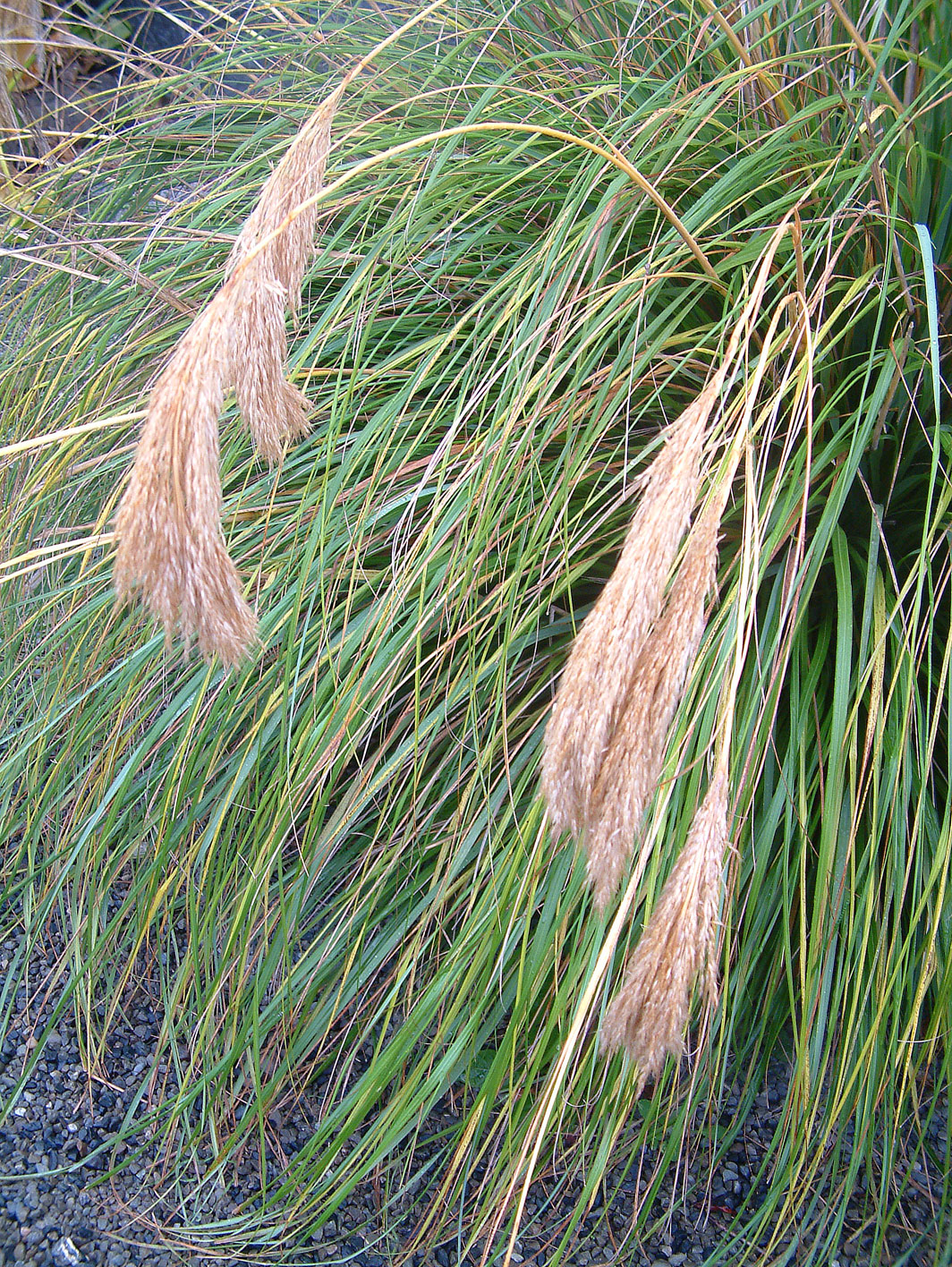
Chionochloa is a genus of perennial tussock grasses in the family Poaceae (order Poales), comprising around 23 species, almost all endemic to New Zealand, with one species extending to New Guinea and another to Lord Howe Island off eastern Australia. The genus was established by the New Zealand botanist Victor Zotov in 1963 and is the subject of a comprehensive 1991 monograph by H.E. Connor in the New Zealand Journal of Botany.
Plants form solitary or sward-like tussocks, typically 0.5–1.5 m tall, though culms can reach 2 m. The leaf-sheaths are long-persistent, clothing the base of each shoot in a distinctive fibrous skirt of old leaf bases that is ecologically important as insulation. Leaf-blades are 5 cm to 1.5 m long, glaucous, flat to V-shaped or needle-like (junceous) in some species; ligules are reduced to a ring of hairs about 1 mm long. The inflorescence is an open or compact panicle, often with long, silky hairs at the branch axils. Spikelets bear several bisexual florets; the lemma is 9-nerved with a characteristic central awn that is straight or reflexed from a twisting column, and lateral lobes that are awned or sharply acute. The caryopsis (grain) is free, obovate, and smooth to rugose.
Species are commonly known as snow tussock or snowgrass, and they dominate the subalpine and alpine grasslands of New Zealand above the treeline. Red tussock (C. rubra) is particularly prominent, forming tall tussock grasslands on the volcanic mountains of the North Island and on parts of the northern South Island. Multiple snow tussock species occur at higher elevations alongside other alpine plants. The genus plays a fundamental ecological role in New Zealand's high-country landscapes, providing habitat and food for native invertebrates, birds, and lizards, as well as buffering soils against erosion.
Etymology
The genus name Chionochloa derives from the Greek chion (snow) and chloe (grass), reflecting the alpine and subalpine habitats of most species and their common names snow tussock and snowgrass. The genus was formally described by Victor D. Zotov in 1963.
Distribution
Chionochloa is native almost entirely to New Zealand, where 23 endemic species occur across both the North and South Islands, from subalpine zones to above the treeline. One species extends to New Guinea and one to Lord Howe Island (Australia). Red tussock (C. rubra) dominates tall tussock grasslands on the volcanic mountains of the North Island and parts of the northern South Island; snow tussock species dominate the higher alpine zones of the South Island.
Ecology
Chionochloa species are the dominant ground-cover plants of New Zealand's subalpine and alpine grasslands. Their long-persistent leaf-sheaths form a dense fibrous base that insulates the growing point against frost and retains moisture in exposed high-country environments. Snow tussock grasslands provide critical habitat for native invertebrates, lizards (skinks and geckos), and birds, and their deep root systems stabilise steep, often rocky soils against erosion and surface run-off. The genus is a keystone component of New Zealand's high-altitude ecosystems.
Taxonomy Notes
Chionochloa was established by Victor Zotov in 1963 within the subfamily Arundinoideae; it is now placed in the family Poaceae, order Poales (GBIF). The genus was comprehensively monographed by H.E. Connor in 1991 (New Zealand Journal of Botany 29: 219–283). The species Chionochloa pallida has been transferred to Rytidosperma pallidum. The Flora of New Zealand (Edgar & Connor 2000, Vol. V) remains the authoritative account for the NZ species.

