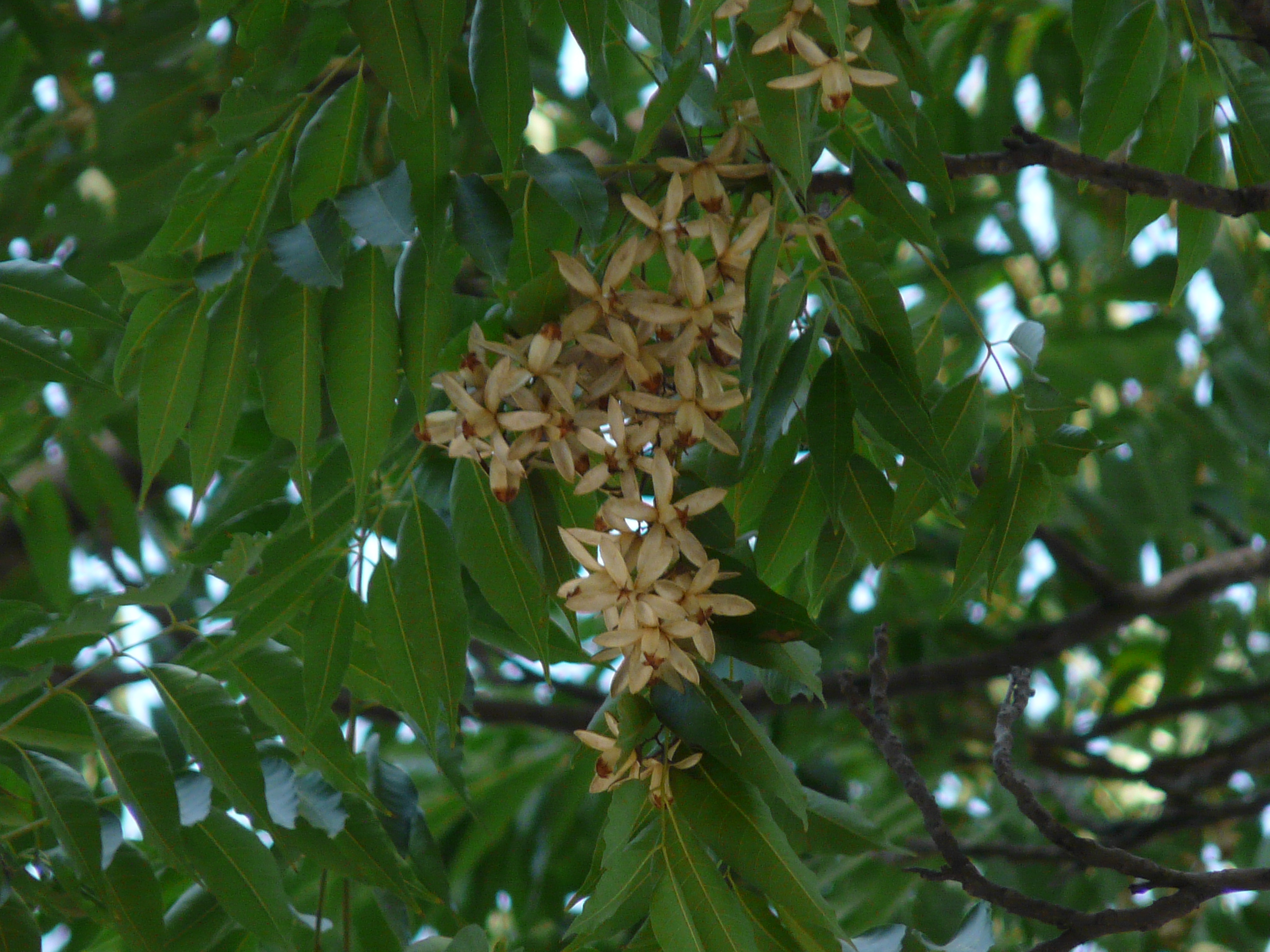
Chukrasia is a monotypic genus of deciduous trees in the mahogany family (Meliaceae, order Sapindales). Its sole species, Chukrasia tabularis — commonly known as Indian mahogany, chickrassy, or bastard cedar — is one of the largest trees of South Asia and the East Indies, reaching heights of up to 65 metres with a tall cylindrical bole, spreading crown, and branchless trunk for up to 25 metres. Leaves are abruptly pinnate or bipinnate with alternate to subopposite leaflets; flowers are erect, oblong, and rather large, borne in terminal panicles with four to five petals. Fruits are septifragally three- to five-valved capsules.
A dominant canopy tree of lowland evergreen and deciduous forests at 300–800 metres altitude, Chukrasia acts as a pioneer species and coloniser of disturbed land. It is widely exploited for its highly prized reddish-brown timber, used in high-grade cabinetwork, musical instruments, veneer, and construction, and is grown in plantations outside its native range. The bark, leaves, and roots have traditional medicinal uses including treatment of diarrhoea, fever, and malaria, and the tree holds cultural significance as the provincial flower and tree of Phrae Province, Thailand.
Distribution
Chukrasia tabularis is native to a broad range across South and Southeast Asia, including the Andaman Islands, Bangladesh, Cambodia, China, India, Indonesia, Laos, Malaysia, Myanmar, Sri Lanka, Thailand, and Vietnam. It has been widely introduced outside its native range as a plantation and ornamental tree, with established populations in Cameroon, Costa Rica, Nigeria, Puerto Rico, South Africa, and the United States.
Taxonomy
Chukrasia is a monotypic genus in the family Meliaceae. Previously recognised species — including C. velutina, C. chickrassa, and C. trilocularis — are now treated as synonyms of the single accepted species, Chukrasia tabularis A.Juss. The genus was historically also spelled Chickrassia in early botanical literature, with synonyms including Chickrassia nimmonii and Chickrassia tabularis.
Ecology
Chukrasia is a dominant, scattered canopy tree of lowland evergreen and deciduous tropical forests, typically occurring at altitudes of 300–800 metres. It is regarded as a pioneer species, commonly colonising areas where shifting cultivation has been practised, and occasionally establishes on bare ground including road cuttings. The species is frequently found on limestone-derived soils and is wind-tolerant. It is deciduous or semi-evergreen depending on environmental conditions.
Cultivation
Chukrasia tabularis is widely cultivated as a plantation timber tree across the tropics. It thrives in lowland tropical climates with mean annual temperatures of 20–25°C (absolute minimum 5–10°C) and grows best where annual rainfall is 1,400–4,000 mm, failing to reach its full potential below 2,000 mm. It prefers full sun but tolerates light shade, and succeeds on well-drained soils with a pH of 5.5–6.5, avoiding heavy, wet ground. The tree is wind-tolerant, coppices and pollards well, and its self-pruning habit makes it suitable for agroforestry systems interplanted with banana, citrus, and guava. Seedling growth is moderately fast, reaching about 5.5 m after six years. It is also grown as a shade tree in coffee plantations.
Conservation
On the IUCN Red List, Chukrasia tabularis is classified as Least Concern (2011) at the international level. However, heavy timber exploitation in Vietnam has caused such severe population declines that the species qualifies as critically endangered at the national level.
Cultural Uses
Chukrasia tabularis is the provincial flower and tree of Phrae Province, Thailand, and is widely used in Ayurvedic medicine. The bark is employed as an astringent for treating diarrhoea and fever, while leaf extracts exhibit antimalarial, antibacterial, and antifungal properties. The tree is also the source of a highly valued timber — reddish-brown, moderately hard, with a lustrous satiny sheen — prized worldwide for high-grade cabinetwork, decorative panelling, musical instruments (including pianos), veneer, and boat building. Additional products include a yellow gum from the trunk, tannin from leaves and bark, and dyes from the flowers.










