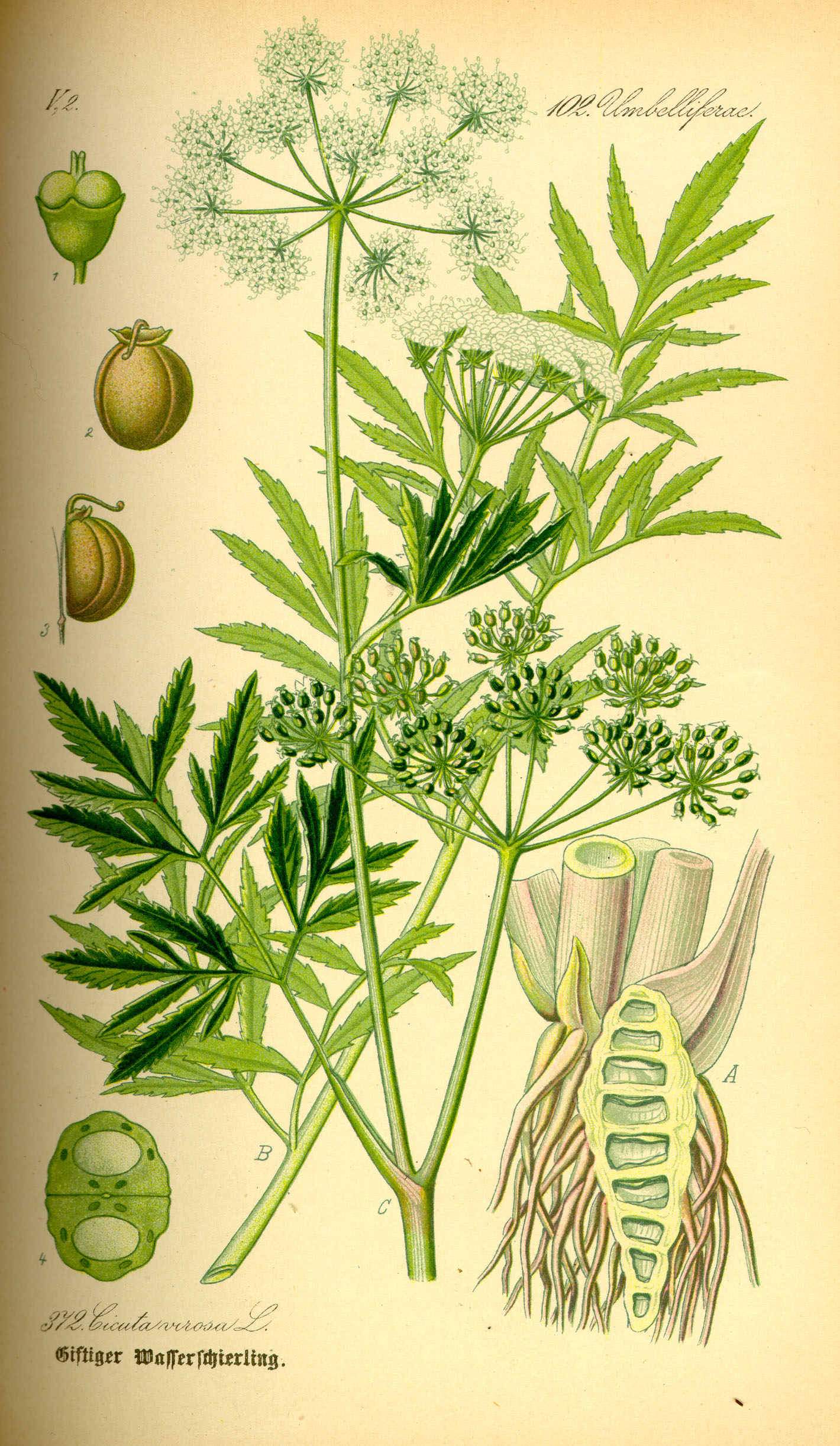
Cicuta, commonly known as water hemlock, is a genus of four species of highly poisonous perennial herbaceous plants in the family Apiaceae (order Apiales). Native to temperate regions of the Northern Hemisphere — primarily North America and Europe — these plants inhabit wet meadows, streambanks, marshes, and swamps, and are among the most acutely toxic plants in the northern temperate world.
Plants grow up to 2.5 metres tall with branching, hollow, smooth stems that are sometimes purple-striped or mottled. The base of the stem connects to a distinctive chambered tuberous rootstock containing a yellowish oily liquid that turns reddish-brown on exposure to air and smells strongly of raw parsnip. The alternate leaves are two or three times pinnately compound, reaching 30–90 cm in length, with lanceolate, sharply serrate leaflets. Flowers are small, white or pale green, and arranged in the umbrella-shaped umbels (5–10 cm across) characteristic of Apiaceae. The fruit is cylindrical, 4–6 mm long, and produced in large numbers.
The genus contains four accepted species: Cicuta virosa (the type species, found in Europe and northern Eurasia), Cicuta maculata (the most widespread, occurring across most of North America), Cicuta bulbifera (northern North America), and Cicuta douglasii (northwestern North America). The genus was formally described by Carl Linnaeus in 1753, though in Europe it had not been clearly distinguished from the related genus Conium before 1500.
All Cicuta species contain cicutoxin — an unsaturated aliphatic alcohol that acts as a non-competitive GABA-receptor antagonist, blocking chloride channels and triggering uncontrolled neuronal depolarization and seizures. The rootstocks are the most toxic part, particularly in early spring. Cicutoxin is present throughout the plant at all growth stages, and ingestion of even small quantities can be fatal to humans and livestock. The genus is sometimes called cowbane, poison parsnip, or beaver poison, and has been responsible for fatal poisonings in humans and livestock since at least 1670.
Etymology
The Latin name Cicuta was used in classical antiquity as a name for hemlock-like plants in the carrot family. The genus shares its common name "water hemlock" and the vernacular "hemlock" with the unrelated Conium maculatum (poison hemlock), a source of frequent confusion; before 1500, European botanists did not consistently distinguish Cicuta from Conium.
Distribution
Cicuta species are distributed across temperate regions of the Northern Hemisphere. Cicuta maculata has the broadest range, spanning most of North America; C. bulbifera occupies northern North America; C. douglasii is restricted to the northwestern corner of North America; and C. virosa ranges through central and northern Europe (including the British Isles), northern Eurasia, and the far north of North America.
Ecology
Water hemlocks are obligate wetland plants, growing in wet meadows, along streambanks, in marshes and swamps, and in areas that are at least seasonally inundated. In Great Britain they are commonly found along canals. Their resemblance to edible plants such as wild celery, wild parsnip, and water parsnip — same habitat, similar umbel flowers — makes misidentification a recurring hazard for foragers and livestock.
Taxonomy
The genus belongs to Apiaceae (Umbelliferae), order Apiales. Linnaeus formally described three species in 1753; the type species is Cicuta virosa. Several older names (e.g., C. bolanderi, C. californica, C. curtissii) are now treated as varieties of C. maculata, which itself comprises four varieties: var. maculata, var. angustifolia, var. victorinii, and var. bolanderi. Phylogenetic analysis of nuclear ribosomal ITS sequences suggests C. bulbifera and C. virosa are monophyletic, while C. douglasii may not be.

