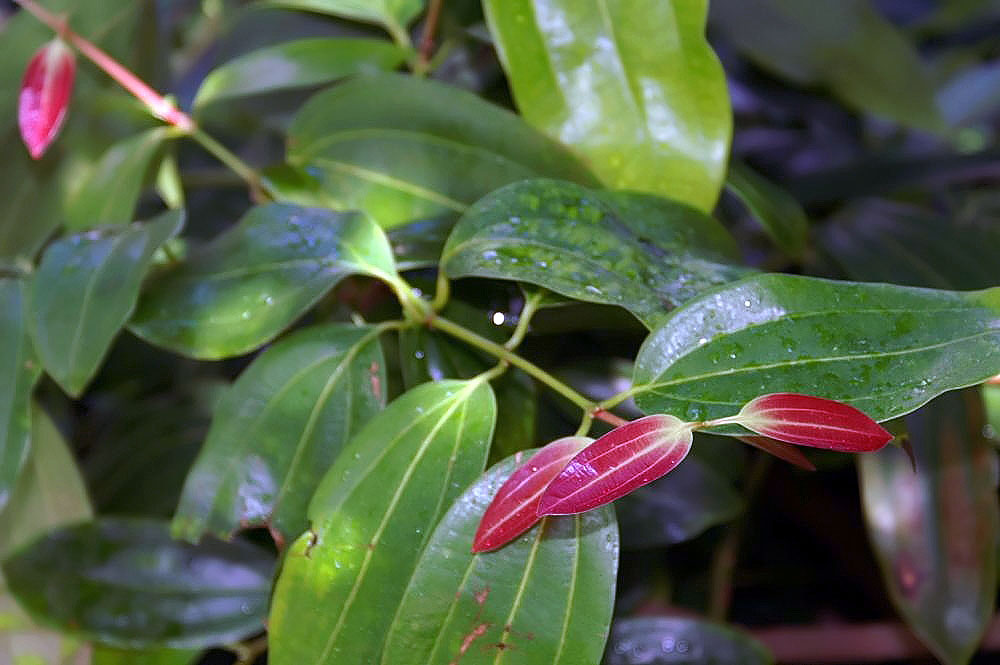
Cinnamomum is a genus of approximately 227 species of evergreen aromatic trees and shrubs in the family Lauraceae, order Laurales. Native to tropical and subtropical regions of South Asia, Southeast Asia, East Asia, and Oceania, these plants are among the most economically significant members of the laurel family — principally as the source of cinnamon, one of the world's oldest and most widely traded spices.
The genus is immediately recognizable by its aromatic bark and foliage. Leaves are thick, leathery, and dark green, conforming to the lauroid form: glossy with a waxy surface, narrowly oval, and equipped with an apical drip tip that sheds water in humid montane conditions. Most species have leaves that are triplinerved, with a conspicuous midrib on both surfaces and bullate axil pockets. Young leaves are often reddish-brown or yellowish-red, maturing to deep glossy green. All species tested are diploid, with a chromosome count of 24.
Flowers are small, hermaphrodite, and borne in axillary panicles 3.5–7 cm long. Petals range from greenish-white to yellow. The fruit is a purplish-black drupe, ovate to subglobose, seated in a cupuliform perianth-cup. The genus is monoecious.
The inner bark of several species — most notably Cinnamomum verum (true cinnamon) and C. cassia — yields the familiar spice. C. tamala is harvested for its leaves, used as the herb malabathrum (tejpat or Indian bay leaf). The genus has a fossil record extending to the Cretaceous, and diversity peaked during the Eocene.
Taxonomically, a 2017 molecular study demonstrated that tropical American species long placed in Cinnamomum are not closely related to the Asian and Australasian core of the genus; those species have been reclassified into the genus Aiouea. Similarly, camphora-producing species have been segregated into Camphora. As of 2025, Plants of the World Online accepts 227 species within the genus.
Etymology
The genus name Cinnamomum derives from the Latin cinnamomum (also cinnamum), itself borrowed from the Greek κιννάμωμον (kinnamomon), which is thought to trace back through Phoenician or Hebrew (qinnamon) to a Malay or other Southeast Asian source — reflecting the ancient spice trade routes along which cinnamon traveled to the Mediterranean world.
Distribution
Cinnamomum is distributed across tropical and subtropical South Asia, Southeast Asia, East Asia, and Oceania/Australasia. Within this range, species occupy diverse habitats including the Himalayas and other highland areas, tropical and subtropical montane rainforests, river valleys, and mixed coniferous–broadleaved forests. The center of diversity lies in southern China, India, and Southeast Asia.
Cultural Uses
Cinnamon obtained from the bark of Cinnamomum verum and related species (C. cassia, C. burmannii, C. loureiroi) has been used as a flavoring, preservative, and medicine for thousands of years, appearing in ancient Egyptian, Chinese, and South Asian records. C. tamala leaves (tejpat, Indian bay leaf) are a staple herb in South Asian cuisines. Camphor, historically extracted from C. camphora (now Camphora officinarum), was used in medicine, rituals, and as an insect repellent across Asia and Europe.
Taxonomy Notes
A 2017 molecular phylogenetic study demonstrated that Cinnamomum as traditionally circumscribed was not monophyletic: the tropical American species are not closely related to the Asian and Australasian majority and have been transferred to Aiouea. Camphor-producing species have been segregated into the resurrected genus Camphora. The authorship of Cinnamomum is attributed to Schaeffer (1760), published in Bot. Exped. 268, 269. GBIF recognizes 455 descendant taxa in the backbone.










