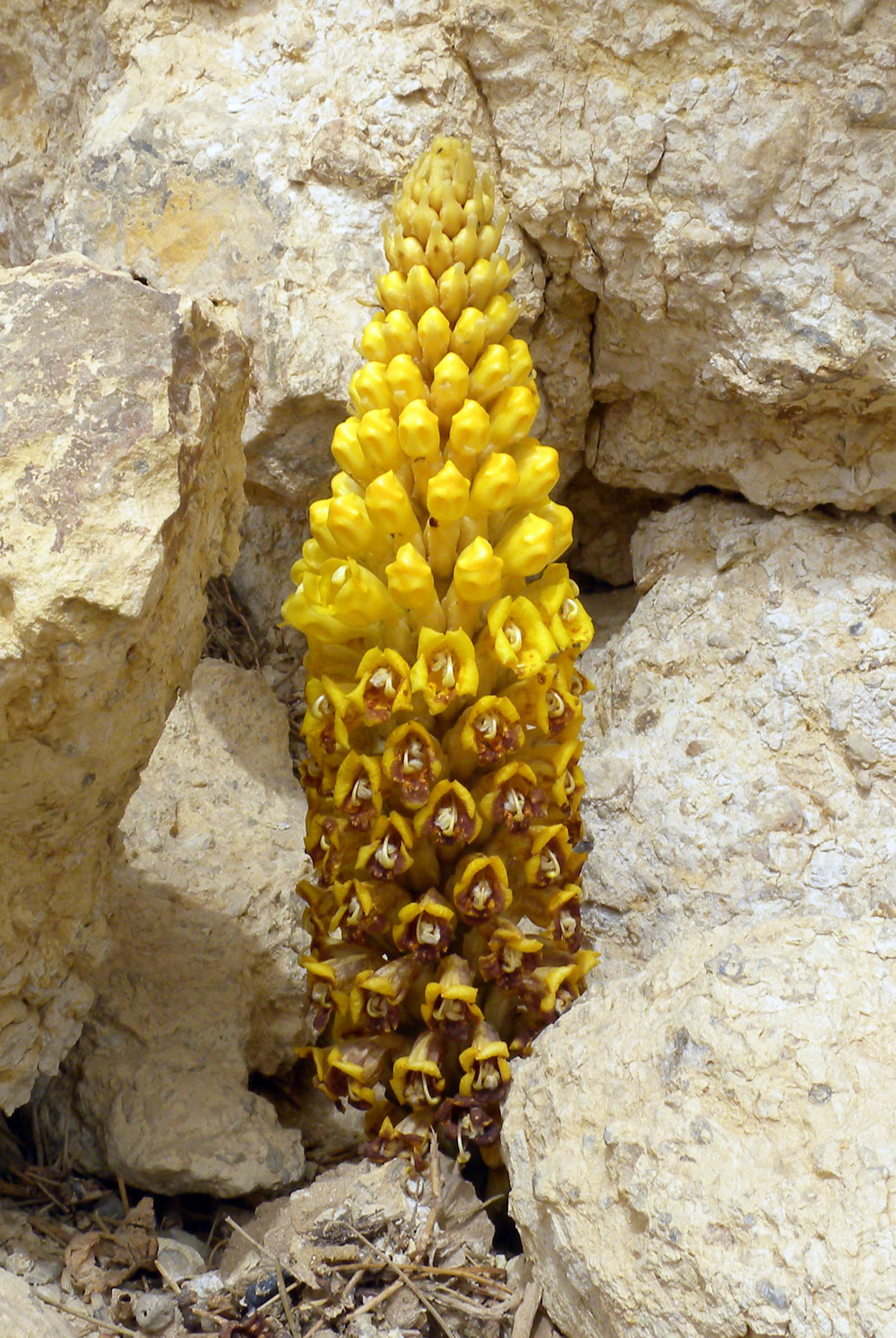
Cistanche is a genus of holoparasitic flowering plants in the family Orobanchaceae, order Lamiales, comprising between 20 and 30 species distributed across Eurasia and Africa. Unlike most plants, members of Cistanche possess no chlorophyll and are entirely dependent on host plants for survival: they attach to the underground roots of desert shrubs and tap directly into their vascular system to extract water and minerals.
The plants are adapted to arid and semi-arid environments, growing from the Mediterranean basin and North Africa eastward through the Middle East and Central Asia to China. They are commonly known as desert hyacinths, a name that reflects the showy, spike-like flower clusters — typically yellow, white, or purple — that emerge dramatically from sandy or rocky desert soils, often appearing to rise from bare ground since the bulk of the plant body remains underground as a fleshy, scale-covered tuber attached to a host root.
The genus was formally described in 1809 by Hoffmannsegg and Link in their Flora Portugaise, placed in the tribe Orobancheae. Taxonomy within the genus is considered difficult because the flower characters most useful for distinguishing species are often degraded in dried herbarium specimens.
Several species hold significant economic and cultural importance. Cistanche deserticola and C. salsa are the primary sources of the Chinese herbal medicine known as cistanche (肉苁蓉, ròucōngróng), used in traditional medicine for centuries. As demand has grown, C. deserticola has been listed on CITES Appendix 2, indicating that its trade requires international monitoring. Population declines have been accelerated not only by over-harvesting but also by the destruction of its principal host, the saxaul tree (Haloxylon ammodendron).
Etymology
The genus name Cistanche was coined by Hoffmannsegg and Link in 1809. No etymology is stated in the protologue; scholars have linked the name to the Greek words kisthos (κίσθος, rockrose) and anchein (ἄγχειν, to strangle or throttle), referencing the parasitic habit of the plant strangling the roots of its hosts.
Distribution
Cistanche occurs across arid and semi-arid zones from the Mediterranean region and North Africa, through the Middle East and Central Asia, to northwestern China. The range spans desert and steppe habitats where suitable host plants are present.
Ecology
Cistanche species are obligate holoparasites — they produce no photosynthetic tissue and depend entirely on host plants throughout their life cycle. Species connections are to the roots of specific desert shrubs; C. deserticola and C. salsa parasitize Haloxylon ammodendron (saxaul), while other species target different chenopods and tamarisks. The plants spend most of their existence as underground tubers, emerging above ground only to flower and set seed.
Cultural Uses
The fleshy stems of Cistanche deserticola and C. salsa have been used in traditional Chinese medicine for centuries under the name ròucōngróng (肉苁蓉). The drug is harvested in spring before the plant shoots emerge, by slicing the stems. C. tubulosa and C. sinensis are secondary sources. Cistanche preparations are classified as a tonic in the Chinese materia medica and are among the more commercially traded wild plant medicines in East Asia.
Conservation
Cistanche deserticola is listed on CITES Appendix 2, meaning international trade is subject to monitoring permits. The species has declined due to two compounding pressures: direct over-collection for the herbal medicine trade, and the destruction of its obligate host plant Haloxylon ammodendron, which is harvested for firewood across Central Asia. As host populations shrink, C. deserticola has fewer sites where it can establish, causing its range to contract further.
Taxonomy Notes
The genus Cistanche was erected by Hoffmannsegg and Link (1809) in Flora Portugaise; the synonym Haemodoron Rchb. (1828) has been reduced to it. The genus belongs to tribe Orobancheae within Orobanchaceae. No type species was formally designated in the protologue; by tradition C. phelypaea (as the illegitimate C. lutea) anchors the concept. Species delimitation is complicated by the poor preservation of diagnostic floral features in dried specimens; the number of accepted species is variously estimated at 20–30.










