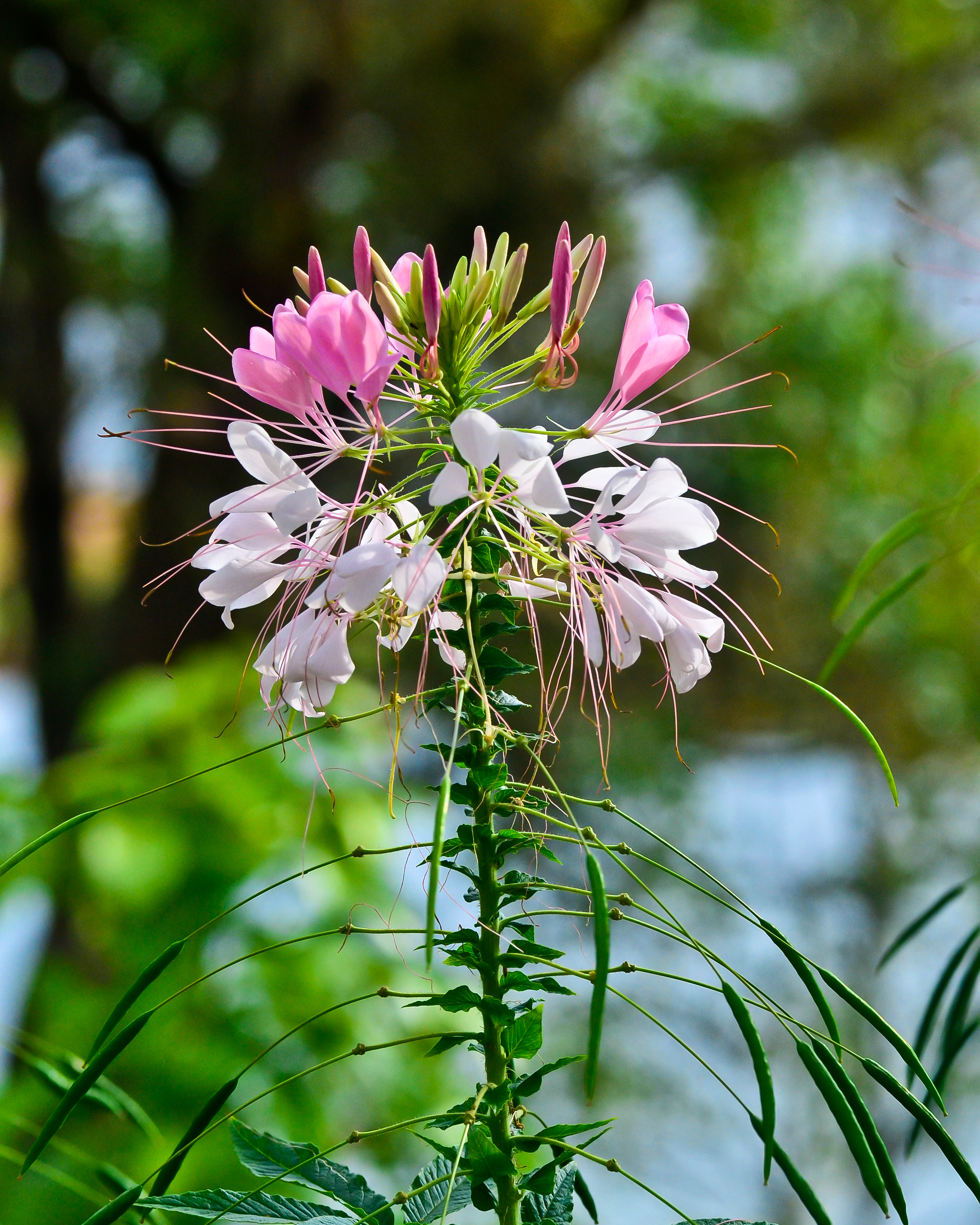
Cleome is a genus of flowering plants in the family Cleomaceae (order Brassicales), widely known by the common names spider flower, spider plant, spider weed, and bee plant. The genus was formerly placed in Capparaceae, but molecular DNA studies revealed that Cleomaceae genera are more closely related to the Brassicaceae — the mustard and cabbage family — than to the capers, prompting the reclassification that stands today.
In its strict sense (sensu stricto), Cleome comprises approximately 170 species of herbaceous annuals, perennial herbs, and shrubs. A broader circumscription (sensu lato), supported by phylogenetic work showing that Podandrogyne and Polanisia cannot be separated from Cleome on genetic grounds, expands the genus to around 275 species — the vast majority of the entire Cleomaceae family. The genus enjoys a subcosmopolitan distribution across tropical and warm temperate regions worldwide.
Cleome is of particular scientific interest because it contains species at every stage of the evolutionary transition from C3 to C4 photosynthesis — the more efficient carbon-fixation pathway found in many crops and grasses. Because Cleome sits close to Arabidopsis thaliana (the principal model plant for genetics research) on the plant family tree, it serves as an especially useful system for studying how C4 photosynthesis evolved. Three Cleome species independently acquired the full C4 pathway; others are C3–C4 intermediates or C4-like. Species such as C. gynandra produce the specialized proteins required for C4 carbon fixation, while C3 species tend to have leaves with more veins and larger bundle sheath cells.
Beyond research, the genus has practical uses: Cleome gynandra is cultivated as a leafy vegetable in parts of Africa and Asia, while C. houtteana (spider flower) is a popular garden ornamental grown for its showy purple, pink, or white blooms with conspicuous long stamens — the feature responsible for the "spider" common names.
Etymology
The common names — spider flower, spider plant, and spider weed — refer to the long, protruding stamens and slender seed pods that give the flowers and fruiting plants a spidery appearance. The genus name Cleome is of ancient Greek derivation, though the precise original meaning is not recorded in the sources consulted.
Distribution
Cleome has a subcosmopolitan distribution, occurring throughout tropical and warm temperate regions of the world. The genus is found across Africa, Asia, the Americas, and parts of Europe, with highest diversity in tropical zones.
Cultivation
Cleome gynandra is grown as a leafy vegetable in parts of Africa and Asia. Cleome houtteana (spider flower) is a widely grown garden ornamental valued for its tall stems bearing clusters of purple, pink, or white flowers with prominent long stamens; it is typically grown as a half-hardy annual in temperate gardens, flowering from late spring through early autumn.
Taxonomy Notes
Cleome was traditionally placed in Capparaceae alongside capers and their relatives. Following molecular phylogenetic studies, it was transferred to the segregate family Cleomaceae, which DNA evidence shows to be sister to Brassicaceae rather than to Capparaceae. The generic boundaries of Cleome remain debated: sensu stricto the genus holds ~170 species, but some taxonomists treat Podandrogyne and Polanisia as synonyms of Cleome (sensu lato, ~275 species). GBIF currently accepts Cleome under Cleomaceae in the order Brassicales.

