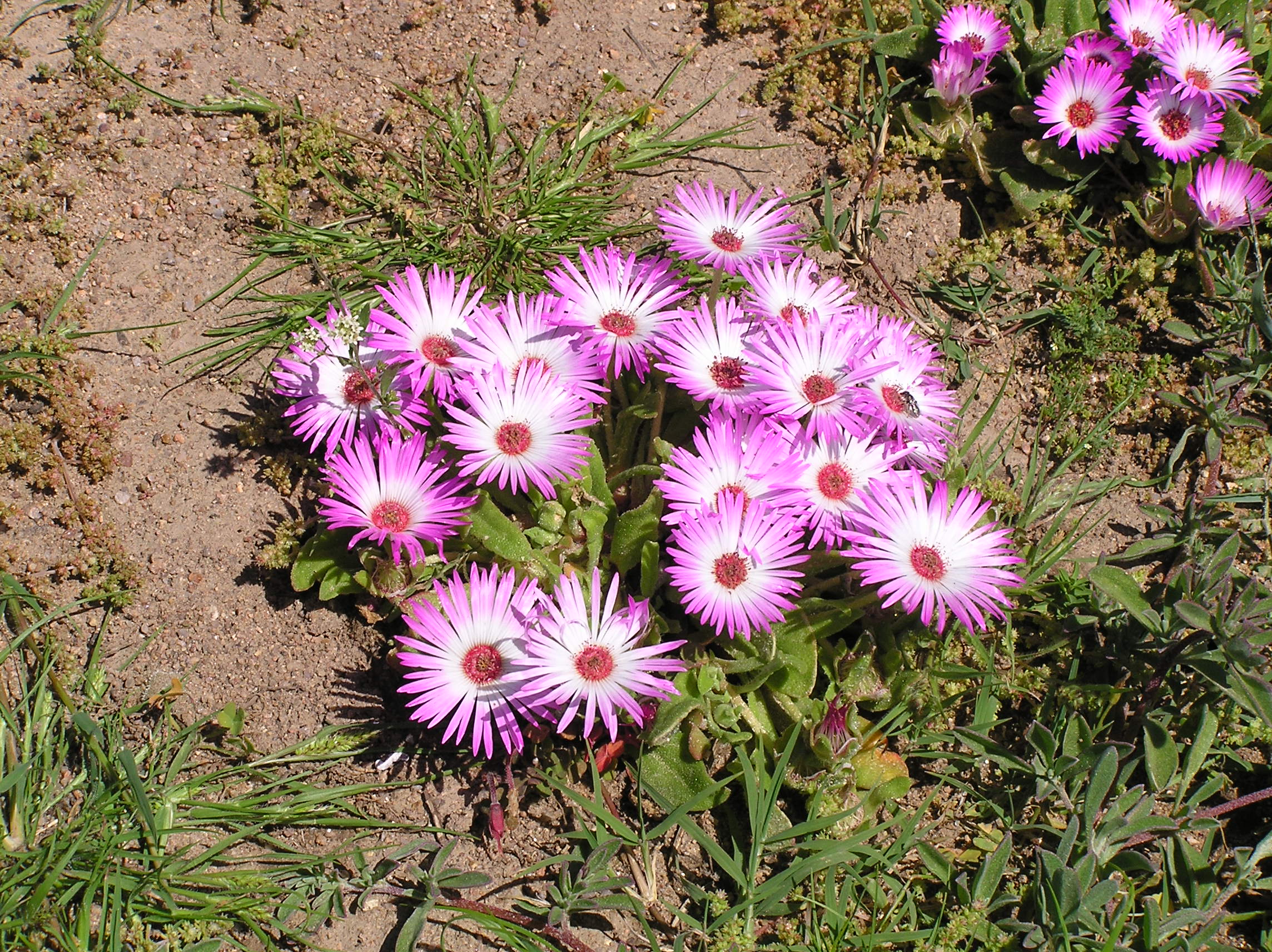
Cleretum is a genus of succulent annuals in the family Aizoaceae (order Caryophyllales), endemic to the winter rainfall region of South Africa. The genus comprises 14 species and is the sole member of tribe Dorotheantheae, having absorbed the formerly separate genera Dorotheanthus and Aethephyllum following a 2012 molecular phylogeny by Klak and Bruyns. Plants are low-growing, mat-forming groundcovers with spreading branches bearing tongue- or spoon-shaped leaves covered in raised, bladder-like epidermal cells that store water and glisten in sunlight. The large, solitary, daisy-like flowers are 20–30 mm in diameter and open widely in bright sun. Petal colour is exceptionally variable, ranging from white and cream through yellow, salmon, orange, pink, mauve, magenta, and red, often with contrasting basal markings. Stamens are clustered in the centre in two to four rows with maroon filaments and purple or yellow anthers. The fruit is a flattened, five-compartment capsule with expanding membranes that bend outward when wet, forcefully ejecting seeds via rain-drop activation (ombrohydrochory). The most familiar and widely cultivated species is Cleretum bellidiforme (formerly Dorotheanthus bellidiformis), known as the Livingstone daisy or bokbaaivygie, grown worldwide as a spring-flowering ornamental.
Etymology
The genus name Cleretum was coined by N.E. Brown in 1925, derived from the Greek kleros — a pebble, potsherd, or piece of wood used in Spartan land-allotment — and the Latin ending -etum, meaning a place dominated by a given plant. The meaning of the name is unclear. The common name "bokbaaivygie" commemorates the farm Bokbaai (Buck Bay) near Darling on the Cape west coast, where Cleretum bellidiforme occurs commonly. The specific epithet bellidiforme refers to the flowers' resemblance to those of the European daisy genus Bellis.
Distribution
Cleretum is endemic to South Africa, distributed across the Fynbos and Succulent Karoo Biomes in the winter rainfall area of the Western and Northern Cape provinces. Its range extends from Namaqualand south to the Cape Peninsula, eastwards to Riversdale in the southern Cape, and inland to Laingsburg and Calvinia along the western and southern fringes of the Great Karoo. The genus has two main centres of diversity: the Kamiesberg in southcentral Namaqualand and the coastal southwestern Western Cape. Plants occur on open sandy flats, gravelly clay slopes, limestone ridges, and humus-rich soil on granite outcrops, across numerous vegetation types.
Ecology
Cleretum species are winter-growing annuals adapted to cool, moist winters and hot, dry summers. Seeds germinate after the first autumn rains and plants complete rapid vegetative growth through winter, flowering from early to late spring (August to mid-October, peaking in September). The succulent leaves with bladder-like epidermal cells store water for dry periods. Flowers open fully only on warm, sunny days and remain closed in cold or wet weather. They are self-fertile but attract numerous pollen-feeding insects, including monkey beetles, honey bees, drone flies, and bee-flies. Seed dispersal is ombrohydrochorous: rain drops strike the capsule membranes, causing them to bend outward and forcefully eject seeds — an adaptation that times germination with autumn rains and protects seeds from summer predators. Only a portion of seeds are released per rainfall event, preserving a soil seed bank.
Cultivation
Cleretum species are easy-to-grow spring-flowering annuals ideal for mass displays, rock gardens, slopes, borders, and containers on sunny patios. They require full sun but tolerate full morning or afternoon sun. Grow in any well-drained soil, preferably with well-rotted compost for best performance. Sow seed directly in early to mid-autumn (March to April in the Southern Hemisphere); germination occurs within 7–14 days. Cover seeds lightly and keep well watered until established, then water only occasionally. Space seedlings about 15 cm apart. Plants tolerate light frost for a few hours and often self-seed in ideal conditions. They are suited to low-humidity, frost-free environments. Watch for European brown garden snails on leaves and avoid poorly drained soil to prevent fungal root rot.
Taxonomy
Cleretum was erected by Nicholas Edward Brown in 1925 in The Gardener's Chronicle, but the original publication was problematic — Brown based his diagnosis on a mixed herbarium sheet without designating a type, causing decades of confusion over the genus's validity. It was established in 1985 that Cleretum was validly published, with Micropterum as a later synonym and C. papulosum as the type species. For many years the well-known name Dorotheanthus was used for most species, but a 2012 molecular phylogeny by Cornelia Klak and Peter Bruyns (University of Cape Town) showed that all genera previously separated in tribe Dorotheantheae — including Dorotheanthus and Aethephyllum — did not differ sufficiently to be recognized, and they were merged into Cleretum, making it the sole genus in the tribe. The genus now comprises 14 species of succulent annuals, of which eight have large, showy flowers (including the widely cultivated C. bellidiforme) and six have small, inconspicuous flowers.










