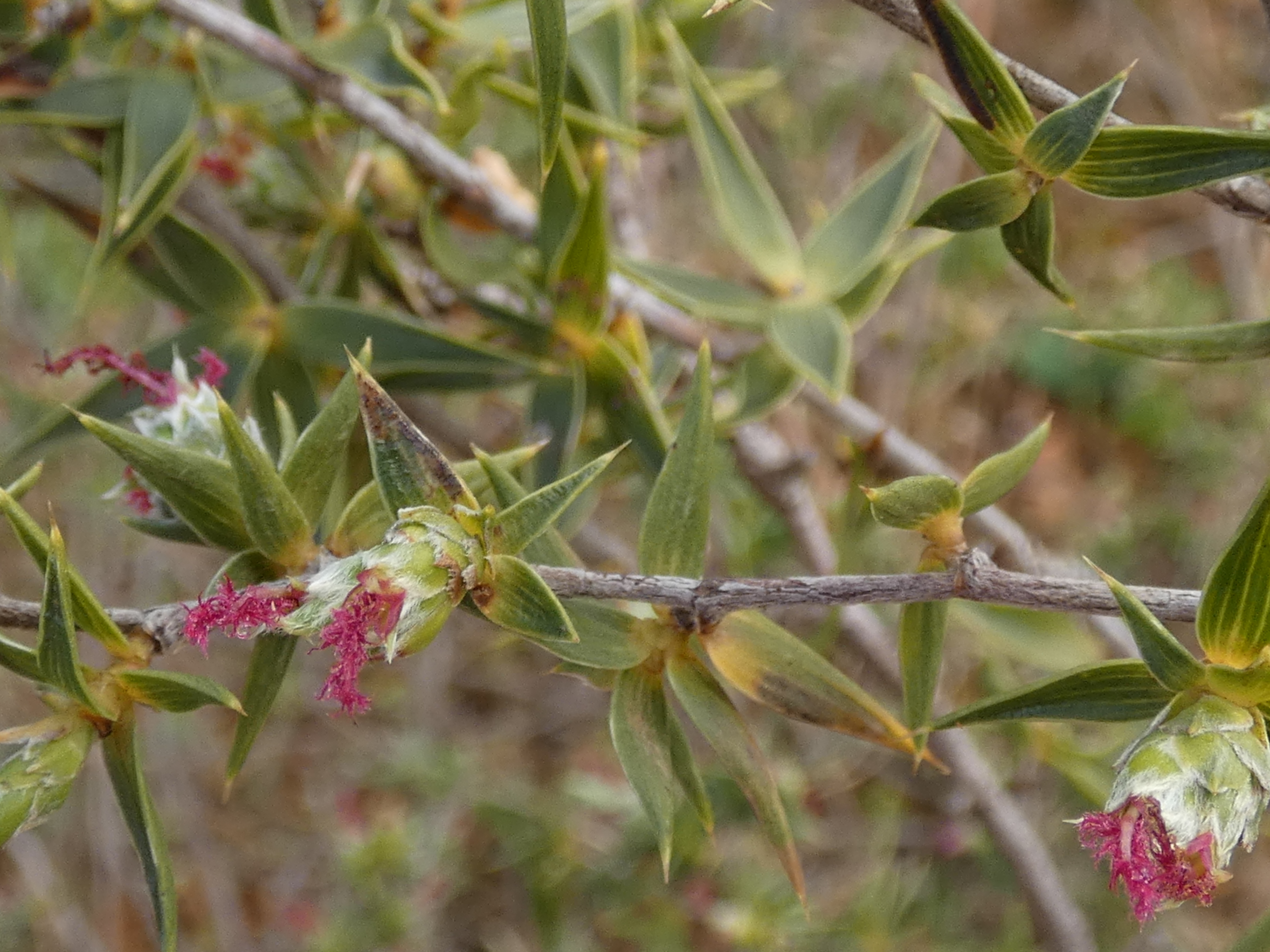
Cliffortia, commonly called Caperose, is a genus of approximately 132 species of flowering shrubs and small trees in the rose family (Rosaceae), belonging to subfamily Rosoidea and tribe Sanguisorbeae. The genus is overwhelmingly concentrated in the Cape Floristic Region (CFR) of South Africa, where 124 species occur and 109 are endemic — making it one of the most species-rich genera unique to that biodiversity hotspot.
Most Cliffortia species are ericoid shrubs, though some develop into small trees up to 5 metres tall and a few form low herbaceous groundcover. The leaves are alternately arranged, with stipules fused to the leaf base to form a distinctive sheath around the stem. Leaflets number one to three per leaf and range from needle-shaped to broad, with margins either serrate or entire. A diagnostic feature of the genus is the complete absence of petals: all flowers are wind-pollinated, apetalous, and unisexual. Species may bear male and female flowers on the same plant (monoecious) or on separate plants (dioecious). The fruit is a small achene enclosed within the persistent, inflating calyx tube.
The genus was formally established by Carl Linnaeus in his landmark 1753 work Species Plantarum, where he described four founding species. It was named in honour of George Clifford III, the Dutch banker and East India Company director whose botanical garden at Hartekamp provided material for Linnaeus's earlier Hortus Cliffortianus (1737). Phylogenetic studies place Cliffortia as closely related to Sanguisorba or the Gondwanan genus Acaena, and recognise four monophyletic subgenera: Arborea, Cliffortia, Eriocephalina, and Graminea. Reticulate evolution through hybridisation is considered widespread within the genus, accounting for considerable morphological complexity.
Outside the CFR, additional species extend through Afromontane heathlands from Mount Kenya in the north to the southern Drakensberg, with isolated occurrences in the Eastern Cape and KwaZulu-Natal.
Etymology
The genus name Cliffortia honours George Clifford III (1685–1760), a wealthy Dutch banker and director of the Dutch East India Company. Clifford maintained a celebrated botanical garden at his Hartekamp estate near Haarlem, which provided the plant material that enabled Carl Linnaeus to write his Hortus Cliffortianus in 1737.
Distribution
Cliffortia is concentrated in the Cape Floristic Region (CFR) of South Africa, where 124 of its ~132 species occur and 109 are endemic. Within the CFR it grows almost exclusively in fynbos vegetation and transition zones with the Karoo and Albany thickets, spanning habitats from high mountain peaks to coastal sand flats on both nutrient-poor acidic sands and, for a few species, alkaline limestone soils. Beyond the CFR, additional species occur in Afromontane heathlands stretching from Mount Kenya southward to the southern Drakensberg.
Ecology
Cliffortia species show three distinct fire-response strategies reflecting the fire-prone nature of fynbos: the majority resprout from underground rootstocks after fire; many others rely on myrmecochory, with ant-collected seeds surviving in underground nests; and a minority resprout from the crown, a strategy limited to plants growing on sites insulated from intense fire by bare rock, persistent wetness, or montane grassland conditions.
Taxonomy Notes
Linnaeus first described four Cliffortia species in Species Plantarum (1753); earlier mentions by Leonard Plukenet (1696) predate valid binomial nomenclature. Attempts by Necker (1808, genus Morilandia) and Presl (1849, Monographidium) to subdivide the genus were not accepted. Molecular phylogenetics place Cliffortia within the monophyletic subfamily Rosoidea, tribe Sanguisorbeae, as sister to either the holarctic Sanguisorba or the Gondwanan Acaena. Four monophyletic subgenera are recognised (Arborea, Cliffortia, Eriocephalina, Graminea); extensive reticulate evolution through hybridisation is inferred from conflicting nuclear and chloroplast phylogenies.










