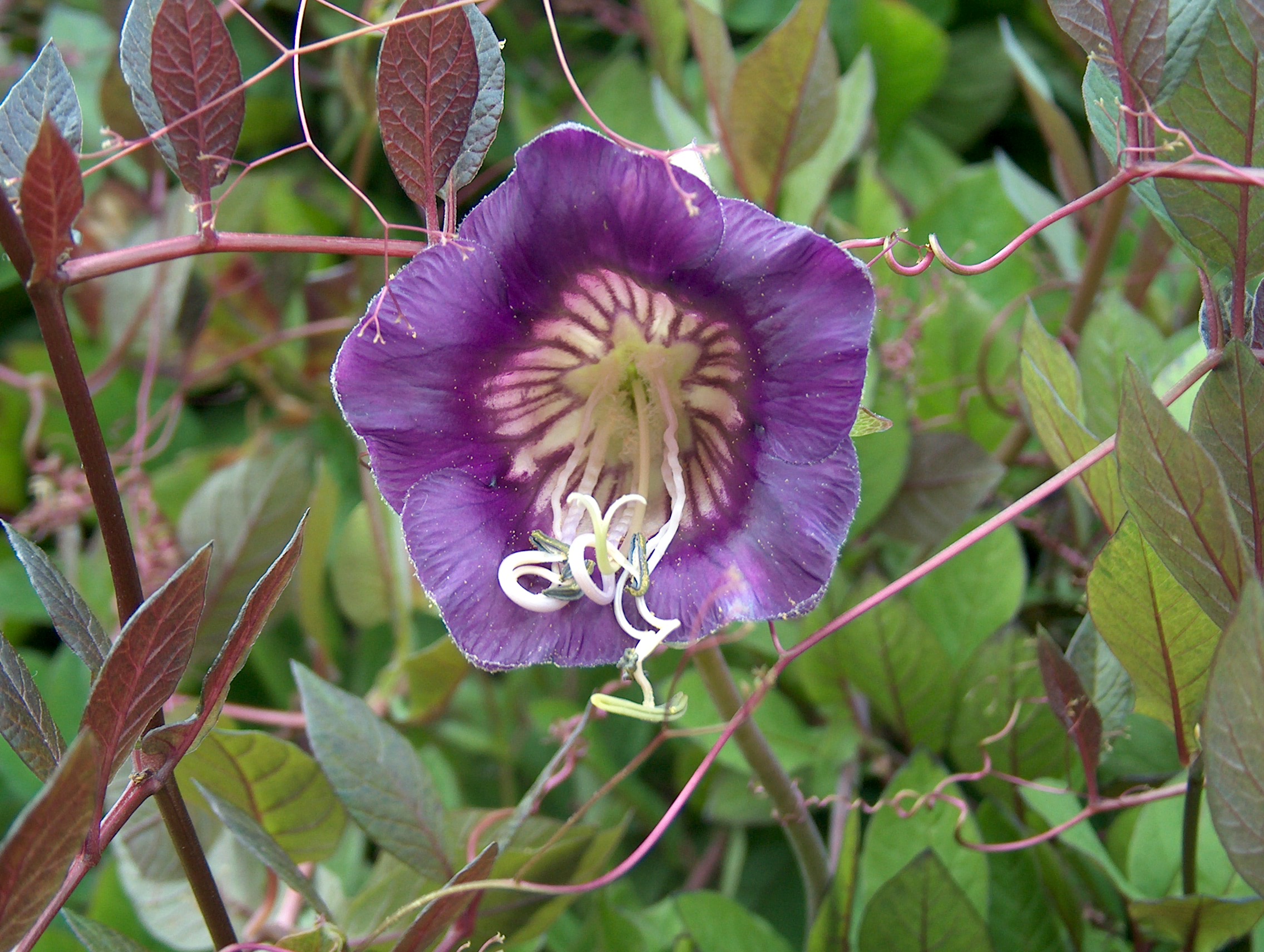
Cobaea is a genus of flowering plants in the family Convolvulaceae (order Solanales), comprising about 20 species of rapid-growing, ornamental climbers. The woody stems can reach 20 feet (6 meters) in height, with alternate, lobed leaves arranged in opposite pairs that bear tendrils. From late summer through early spring, large bell-shaped flowers in shades of bright green, violet, or purple appear profusely and singly along the stems. The most widely known species is Cobaea scandens, commonly called cathedral bells or cup and saucer vine, grown as an ornamental climber in gardens worldwide. The genus was named in honor of Father Bernabé Cobo, a 17th-century Spanish Jesuit and naturalist who spent many years in the Americas. While prized horticulturally for its vigorous growth and showy blooms, Cobaea can escape cultivation and become invasive in favorable climates, notably establishing as a common weed in New Zealand.
Etymology
The genus Cobaea was named in honor of Father Bernabé Cobo (1582–1657), a Spanish Jesuit missionary, naturalist, and chronicler who spent many years in the Americas. Cobo wrote extensively on the natural history of the New World, and the genus was erected to commemorate his contributions to botany and exploration.
Distribution
Cobaea is native to tropical and subtropical regions of the Americas, with its natural range extending from Mexico through Central America to Peru. Several species, particularly Cobaea scandens, have been widely introduced as ornamentals and have naturalized beyond their native range. In New Zealand, Cobaea is considered a common weed and can become invasive in favorable climates.
Cultivation
Cobaea species, especially Cobaea scandens (cathedral bells or cup and saucer vine), are grown as rapid-growing ornamental climbers. They are valued for their vigorous growth—woody stems can reach 20 feet (6 meters)—and large, bell-shaped flowers that bloom from late summer through early spring in shades of green, violet, and purple. The plants climb using tendrils on their opposite, lobed leaves and are well-suited to trellises, walls, and arbors in temperate and subtropical gardens. Gardeners should be mindful of their potential to escape cultivation and become invasive in suitable climates.
Taxonomy Notes
GBIF records only a single accepted descendant species for Cobaea, while Wikipedia lists 17 accepted species—a significant discrepancy likely reflecting incomplete data ingestion at GBIF rather than genuine taxonomic disagreement. The genus is placed in the Convolvulaceae (morning glory) family within the order Solanales. GBIF does not record an authorship attribution for the genus itself, though individual species authorities (e.g., Cav., Brand, Hemsl.) are well documented.










