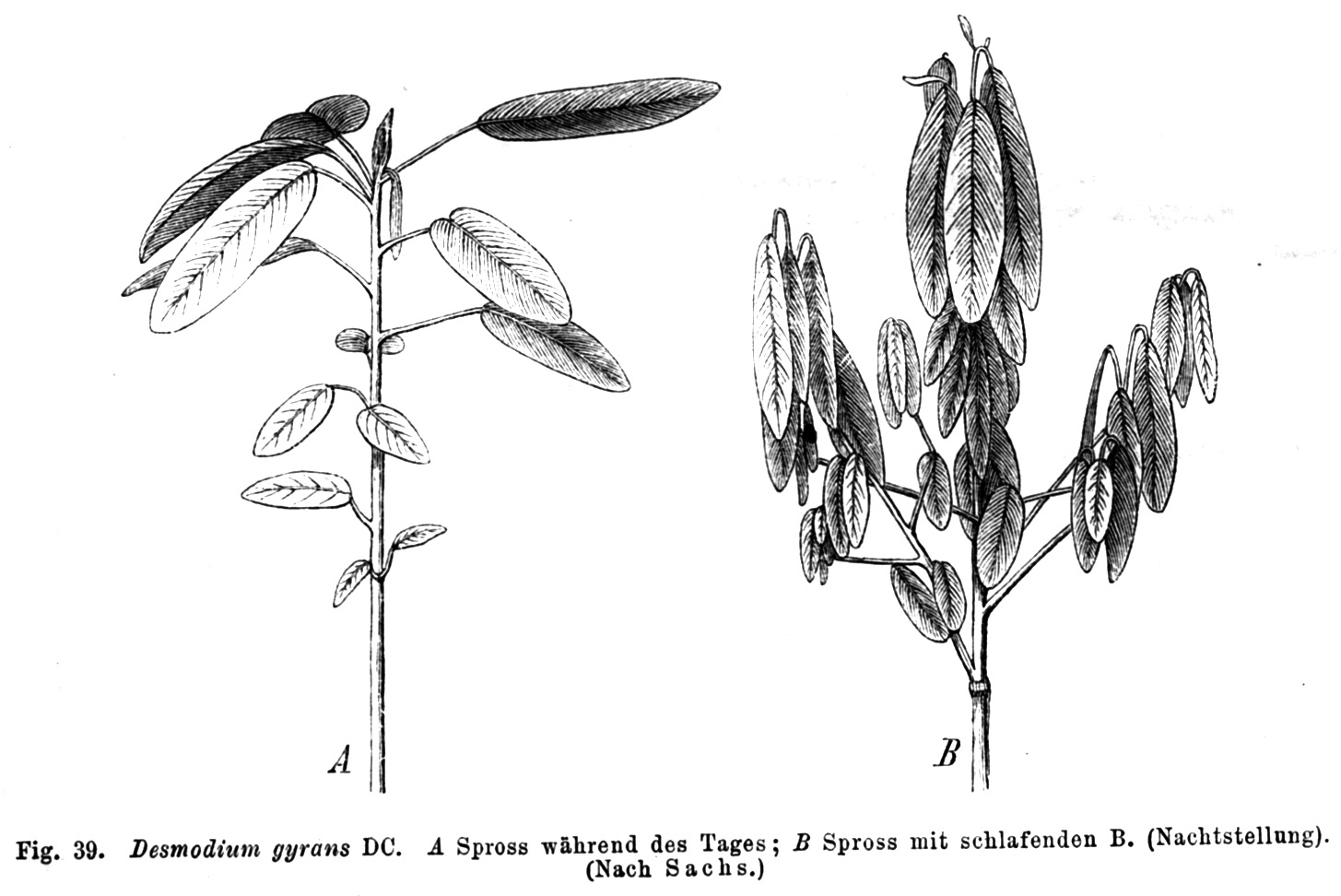
Codariocalyx is a genus of flowering plants in the legume family (Fabaceae), subfamily Faboideae. The genus contains two species — though its circumscription has been debated with the closely related genus Desmodium, under which its members are sometimes placed. Plants are shrubs or perennials native to tropical and subtropical Asia, ranging from the Indian Subcontinent and Tibet through Indochina, southern China, and Malesia to New Guinea and the Society Islands.
The most notable — and best-known — member is Codariocalyx motorius, the telegraph plant (also called dancing plant or semaphore plant). It is one of the few plants capable of rapid, visible movement: small lateral leaflets at the base of each large leaf rotate continuously along an elliptical path in 3–5 minute cycles. This behavior, active in daylight above 22° C, is thought to optimize light capture by directing the larger leaf toward the brightest area. Alternative hypotheses suggest the movements deter predators or mimic butterflies to discourage oviposition. Charles Darwin documented the plant in his 1880 work The Power of Movement in Plants.
Plants produce small purple flowers that mature to orange. Codariocalyx motorius has also drawn interest for containing trace tryptamine alkaloids (DMT and 5-MeO-DMT) in its leaves, stems, and roots.
Distribution
The genus is native to tropical and subtropical Asia, spanning the Indian Subcontinent, Tibet, Indochina, southern China, Taiwan, and Malesia. Codariocalyx motorius is widely distributed across Bangladesh, Bhutan, Cambodia, China, India, Indonesia, Laos, Malaysia, Myanmar, Nepal, Pakistan, Sri Lanka, Thailand, and Vietnam, with an outlying presence on the Society Islands in the South Pacific.
Ecology
Codariocalyx motorius exhibits one of the most striking examples of rapid plant movement. During daylight hours (above 22° C), two small lateral leaflets at the base of each compound leaf rotate continuously in an elliptical path, cycling every 3–5 minutes — fast enough to be seen with the naked eye. The leading hypothesis is that this motion optimizes photosynthesis: the leaflets sample sunlight intensity across an arc, and the plant redirects the larger terminal leaflet toward the brightest patch. Alternative hypotheses suggest the movement deters herbivores or mimics the wing-flutter of butterflies to discourage egg-laying on the leaves.
History
The telegraph plant earned its common name from the rotation of its lateral leaflets, which cycle with a 3–5 minute period — a motion likened to the pivoting paddles of a semaphore telegraph tower. Charles Darwin studied and described the plant's movements in detail in his 1880 book The Power of Movement in Plants, cementing its place in the botanical literature on plant motion.
Taxonomy Notes
The genus Codariocalyx has been the subject of ongoing taxonomic debate with Desmodium. Some authorities treat Codariocalyx as a distinct genus (as recognized by GBIF, which lists it as ACCEPTED with 4 descendant taxa), while others merge its species into Desmodium. Wikipedia's own coverage of C. motorius notes it is "though often placed in Desmodium." The two accepted species per Wikipedia are C. motorius and C. gyroides.










