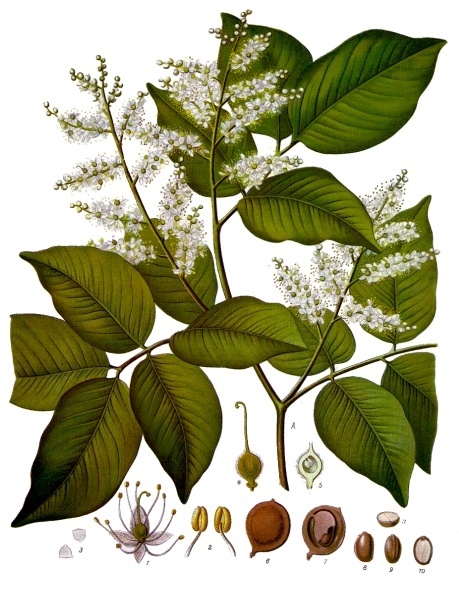
Copaifera is a genus of tropical trees and shrubs in the legume family Fabaceae (order Fabales), comprising approximately 40 accepted species. The genus is native to the tropical Americas — from Nicaragua south to northeastern Argentina — as well as west and central tropical Africa, and Borneo, making it one of the few plant genera with a truly pan-tropical distribution spanning both the New World and Old World tropics.
Members of the genus are medium to large evergreen trees, many of which yield a thick, oleoresinous balsam known as copaiba oil, obtained by tapping the trunk. This resin is rich in sesquiterpenes and has been used medicinally for centuries, and is now studied as a source of antimycobacterial compounds. Several species also produce high-quality timber prized in construction and furniture-making.
Among the most economically significant members is Copaifera langsdorffii, known as the diesel tree or kerosene tree, whose stem oil is of sufficient quality to be used directly as biodiesel fuel with minimal processing. Copaifera multijuga and Copaifera officinalis are also important commercial sources of copaiba resin. The genus as a whole is ecologically and economically valued across Amazonia and the broader Neotropics, though several species face pressure from deforestation throughout their range.
Etymology
The genus name Copaifera derives from the Tupi word copaíba (the vernacular name for the resin-yielding trees) combined with the Latin -fera ("bearer"), meaning "copaiba-bearer" or "copal-bearer." The name reflects the genus's most distinctive economic trait: the production of aromatic oleoresins tapped from the trunks of living trees.
Distribution
Copaifera is distributed across the wet tropics in three disjunct regions: the tropical Americas from Nicaragua south to northeastern Argentina (with the greatest diversity in Amazonian Brazil), west and central tropical Africa, and Borneo. This intercontinental distribution is unusual within Fabaceae and has been the subject of biogeographic study.
Ecology
Copaifera species are predominantly components of lowland tropical rainforests and dry forests. The genus is best known ecologically for its oleoresin production, which may serve as a defense against herbivores and pathogens. The resin-filled ducts in the wood make these trees important resources not only for human use but also for the biodiversity that depends on the forest habitats they occupy. Several species are considered threatened primarily by deforestation. Oil extracts from the genus are of particular interest to researchers as a source of antimycobacterial agents.
Cultural Uses
Copaiba oil, extracted by boring into the trunks of several Copaifera species, has been used in traditional medicine throughout South America for centuries, applied as an anti-inflammatory, wound-healing agent, and treatment for respiratory conditions. The resin is also used in varnishes, cosmetics, and as a fixative in perfumery. Copaifera langsdorffii in particular has attracted modern attention as a source of renewable biodiesel: its stem oil can be used directly as fuel with minimal refining. The timber of various species is harvested across the Neotropics for construction and furniture.










