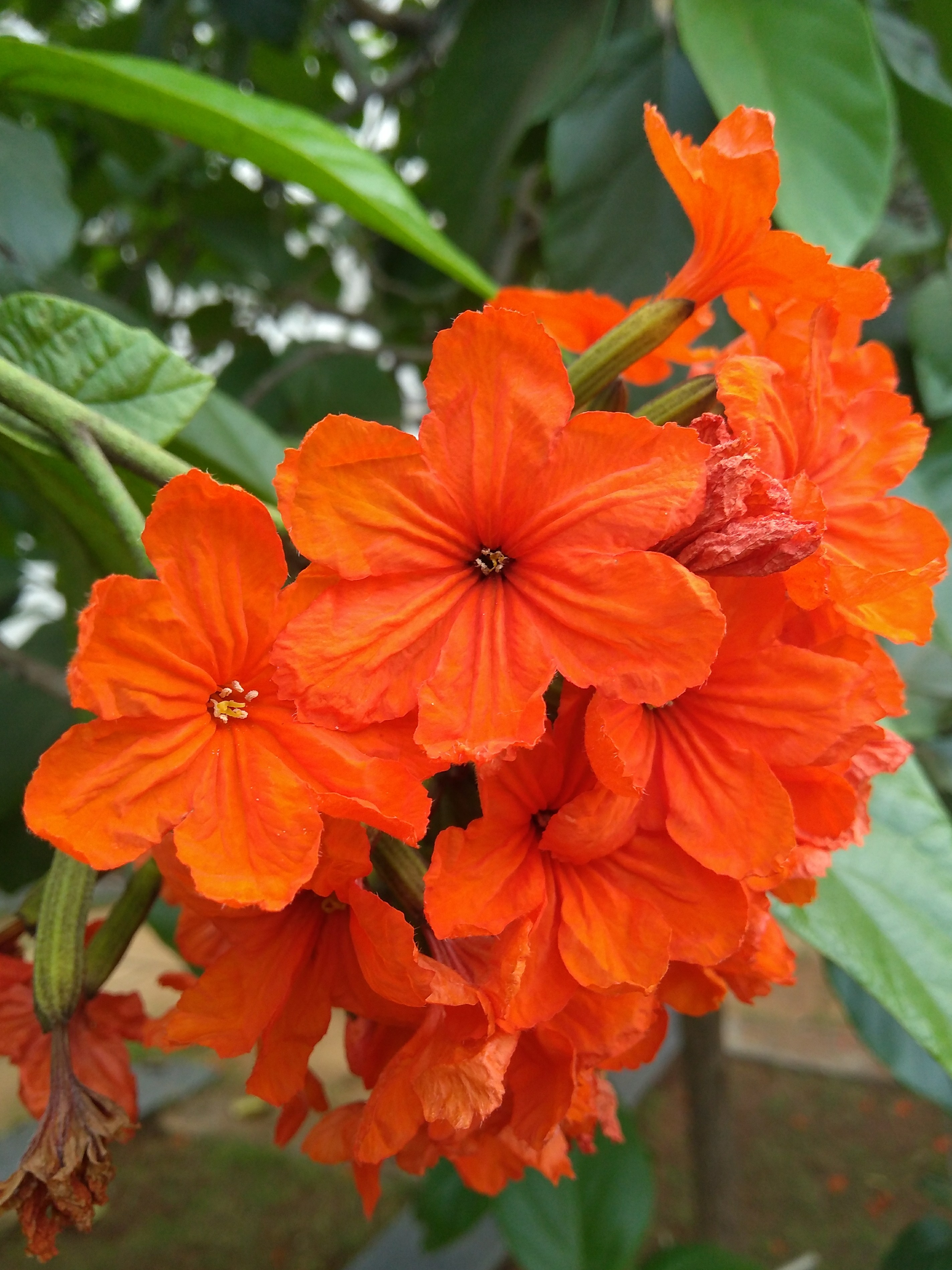
Cordia is a sizable genus of flowering shrubs and trees, comprising roughly 228 species distributed throughout the tropics and subtropics of both hemispheres. Modern taxonomy places the genus in the family Cordiaceae within the order Boraginales, although older treatments and some regional databases still list it under Boraginaceae sensu lato. The genus was named by Linnaeus in honor of the German Renaissance botanist and pharmacist Valerius Cordus (1515–1544), and it has long served as the type genus for the cordia line of borage relatives.
Most members are shrubs to medium or large trees, often bearing the trichomes (fine hairs) characteristic of the broader Boraginales order. Foliage tends to be simple and alternate, while the flowers — frequently the most ornamental feature of the genus — are tubular to funnel-shaped and gathered into terminal cymes. Across the genus they range from pure white through cream and yellow to the brilliant orange-red of the Geiger tree (Cordia sebestena), whose 5 cm wide flared blooms are produced almost year-round in tropical climates. Fruits are typically drupes with a sweet, mucilaginous pulp surrounding a hard stone; in many species they are edible and have historically been eaten fresh, cooked, or preserved.
Ecologically the genus is a mainstay of tropical lowland and dry-forest habitats. Fast-growing pioneer species such as Cordia alliodora colonize bare ground readily, develop strong taproots, and tolerate a wide range of rainfall regimes (from around 750 mm up to well over 2,000 mm annually), making them important components of secondary forests and agroforestry systems. Several species are planted as shade trees over coffee and cocoa, valued for their light, self-pruning canopies and durable wood.
The genus also has substantial economic and cultural importance. Tropical fruits known variously as clammy cherries, glue berries, or sebesten are used raw, cooked, or preserved, particularly in Indian and Middle Eastern cuisines, while the sticky fruit pulp has been used historically as a vegetable glue. Several species yield highly figured cabinet timbers — bocote and ziricote are sought after for furniture, doors, gun stocks, and acoustic guitar components. Showy-flowered species, especially C. sebestena and the Texas olive (C. boissieri), are popular ornamentals in warm-climate landscaping, where they tolerate heat, drought, and coastal salt spray.
Cordia is, however, taxonomically challenging. Authors note that the genus is morphologically variable within species and that many type specimens are poorly preserved, leading to a long history of name changes and ongoing revision of species circumscriptions.
Etymology
The genus name commemorates Valerius Cordus (1515–1544), a German botanist and pharmacist of the Renaissance period whose herbal and pharmacological writings were influential in early European botany. Linnaeus adopted the name when he formally described the genus, and Cordia L. has remained the accepted authority ever since.
Distribution
Cordia is broadly pantropical, with native species across the warm regions of the Americas, Africa, Asia, and the Pacific. In the New World it ranges from the southwestern United States (Arizona, New Mexico, southern Texas, and Florida) through Mexico, Central America, the Caribbean, and into much of tropical South America. African species occur from sub-Saharan savannas into the Mediterranean fringe, while Asian species reach from the Middle East across India and southern China to Southeast Asia. Many species occupy lowland tropical or seasonally dry environments.
Ecology
Most Cordia species are plants of warm, lowland or seasonally dry habitats. They are often important pioneer trees that readily colonize cleared ground or disturbed soils, where strong taproots and rapid growth give them a competitive edge. The genus tolerates a remarkably wide rainfall range — from around 750 mm up to well above 2,000 mm annually in the wettest tropics — and members are noted for wind tolerance and self-pruning habit, making them ecologically resilient in storm-prone tropical lowlands.
Cultivation
Ornamental Cordia species are grown for their fragrant, showy flowers, but they are not especially cold-hardy and are largely confined to tropical and subtropical climates. They prefer full sun, moist but well-drained soils, and warm mean temperatures around 24°C. Species such as the Geiger tree (Cordia sebestena) and Texas olive (C. boissieri) are widely planted as street trees, shade trees, and seaside ornamentals because they tolerate heat, drought, and salt spray; faster-growing timber species like C. alliodora are used as shade canopies in coffee and cocoa plantations.
Cultural Uses
The genus is economically important for fruit, timber, and traditional uses. The sweet, mucilaginous drupes of several species — called clammy cherries, glue berries, or sebesten — are eaten raw, cooked, or preserved, particularly in Indian and Middle Eastern cuisines, and the sticky fruit pulp has historically been used as a vegetable glue. Several Cordia species supply prized cabinet timbers: bocote and ziricote are used for furniture, doors, gun stocks, and high-end acoustic guitar components. Bark, leaves, and seeds of various species enter local medicine as stimulants, stomachics, and treatments for skin conditions and respiratory complaints, and the wood is broadly used in tropical countries for construction and fuel.
Taxonomy Notes
Cordia L. is the type genus of Cordiaceae, the family treated under the order Boraginales in modern classifications. Some regional databases (SEINet, for example) continue to file it under a broadly defined Boraginaceae, reflecting the older treatment in which Cordiaceae was nested as a subfamily. The genus is widely acknowledged to be taxonomically difficult: species are morphologically variable, intermediates between named taxa are common, and many type specimens were poorly preserved, leaving species delimitations to be revisited as molecular work continues. The GBIF Backbone currently recognizes Cordia L. (usage key 2900865) as an accepted plant genus.










