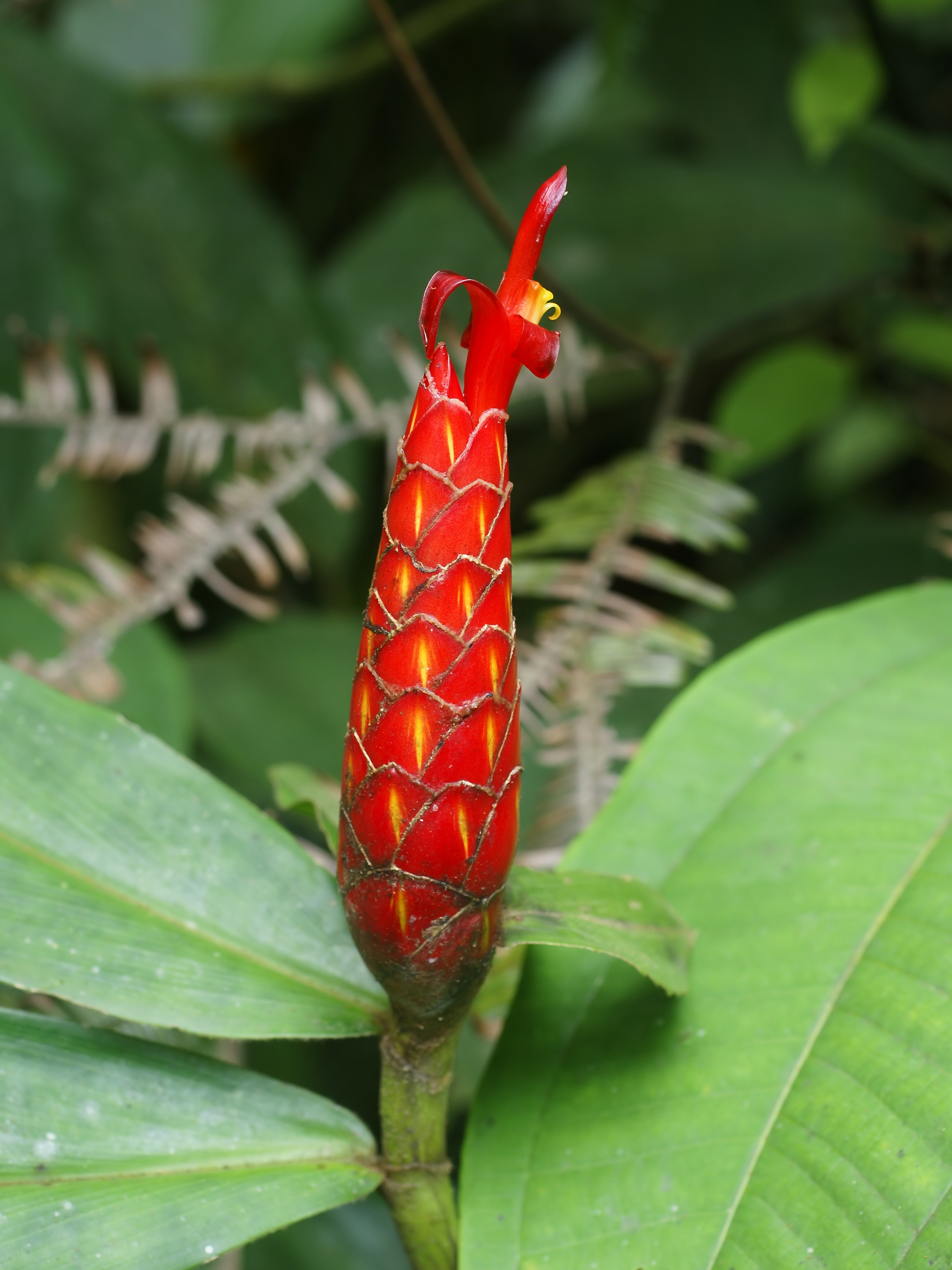
Costus is a genus of herbaceous perennial plants in the family Costaceae (order Zingiberales), described by Carl Linnaeus in Species Plantarum in 1753. Its members are best known for the strikingly spiralled arrangement of their leaves along the stem, a feature that immediately distinguishes them from the true gingers (Zingiberaceae) with which they are often confused. From this growth habit comes their common name, the spiral gingers, though that label is sometimes attached specifically to Costus barbatus.
The genus is pantropical, occurring throughout the warm parts of Asia, Africa, and the Americas, with the greatest species richness in the Neotropics. Plants typically form clumps of unbranched, leafy canes that twist as they grow, topped in season by dense, cone-like inflorescences with brightly coloured bracts in reds, oranges, pinks, and yellows. Individual flowers, often white or pastel with a flared labellum, emerge from between the bracts and are usually pollinated by hummingbirds, bees, or other long-tongued visitors.
Estimates of species number vary by source. As of mid-2024, Plants of the World Online recognised 115 accepted species in Costus, while the GBIF taxonomic backbone lists around 175 names as descendants of the genus, and the underlying IPNI catalogue contains close to 283 published epithets — most of which have since been synonymised or transferred. Beyond their botanical interest, Costus species feature in everyday life across their range: Costus spectabilis is Nigeria's national flower and appears on its coat of arms, several species have edible flowers, and others figure in traditional medicine and ethnoveterinary practice. The plants are also notable for an ecological partnership in which extrafloral nectar attracts ants that defend the foliage against herbivorous insects.
Taxonomy
Costus L. was published by Linnaeus in Species Plantarum 1: 2 in 1753 and is the type genus of the family Costaceae in the order Zingiberales. Although historically lumped with the true gingers (Zingiberaceae), the spirally arranged leaves and other vegetative and floral characters place Costus and its relatives in their own family. Species counts depend on the authority consulted: Plants of the World Online recognises about 115 accepted species (as of June 2024), GBIF's taxonomic backbone reports 175 descendant species, and the IPNI dataset records 283 — the gap reflecting historical names later moved into other Costaceae genera or sunk into synonymy. SEInet catalogues more than fifty species with herbarium records, including C. afer, C. arabicus, C. barbatus, and C. igneus. The genus name Costus is distinct from the Ancient Roman herb of the same common name, which is now treated as Saussurea costus.
Distribution
Costus is widespread across tropical and subtropical regions of Asia, Africa, and the Americas, occupying lowland and montane habitats throughout the wet tropics. Individual species can have restricted ranges within this broad distribution; for example, Costus afer — one of the most familiar African members — is native to tropical Africa from Senegal east to Tanzania.
Ecology
A notable ecological trait of the genus is its relationship with ants. Costus plants produce extrafloral nectar that attracts nectar-feeding ants, which in turn patrol the foliage and deter or remove herbivorous insects — a mutualism that supplements the plants' chemical and physical defences.
Cultivation
Costus species are warm-climate ornamentals, suited in cultivation to USDA hardiness zones 10–12 and to fertile, moist but well-drained acidic soils in part shade — conditions reflecting the genus's tropical forest origins. Plants establish quickly: representative species such as C. afer are evergreen perennials capable of reaching around 4 m tall and wide at a fast rate. Costus species naturally hybridise, and a number of commercial hybrids have been developed for the horticultural trade.
Propagation
Costus species are readily propagated by several methods: by seed, by division of rhizomes into roughly 2.5 cm pieces, by stem cuttings, and by bulbils that form on the fruiting heads.
Cultural uses
Several Costus species are entwined with human use. Costus spectabilis is the national flower of Nigeria and is depicted on the country's coat of arms. Costus productus and C. guanaiensis have edible flowers, while Costus afer contributes acidic-tasting leaves used as a flavouring, a rhizome occasionally employed as a spice, and tough stems used to make baskets, mats, paper, and elements of house construction. In Trinidad and Tobago, Costus scaber features in traditional veterinary medicine for dogs bitten by snakes, and the genus more broadly has a long history of traditional medicinal use across its range.
Conservation
The Global Invasive Species Database currently holds no record for the genus Costus, indicating that no member has been formally listed as a problem invasive in the GISD archive at the time of writing.
History
The name Costus in modern botany dates to Linnaeus's 1753 Species Plantarum, but the word itself has older roots in classical antiquity: in Ancient Rome a fragrant herb called "costus" was prized, and that plant is today placed in Saussurea costus, not the Costaceae. The transfer is a frequent source of confusion in older literature, where references to "costus" may mean either the Linnaean genus or the unrelated Asian Saussurea.










