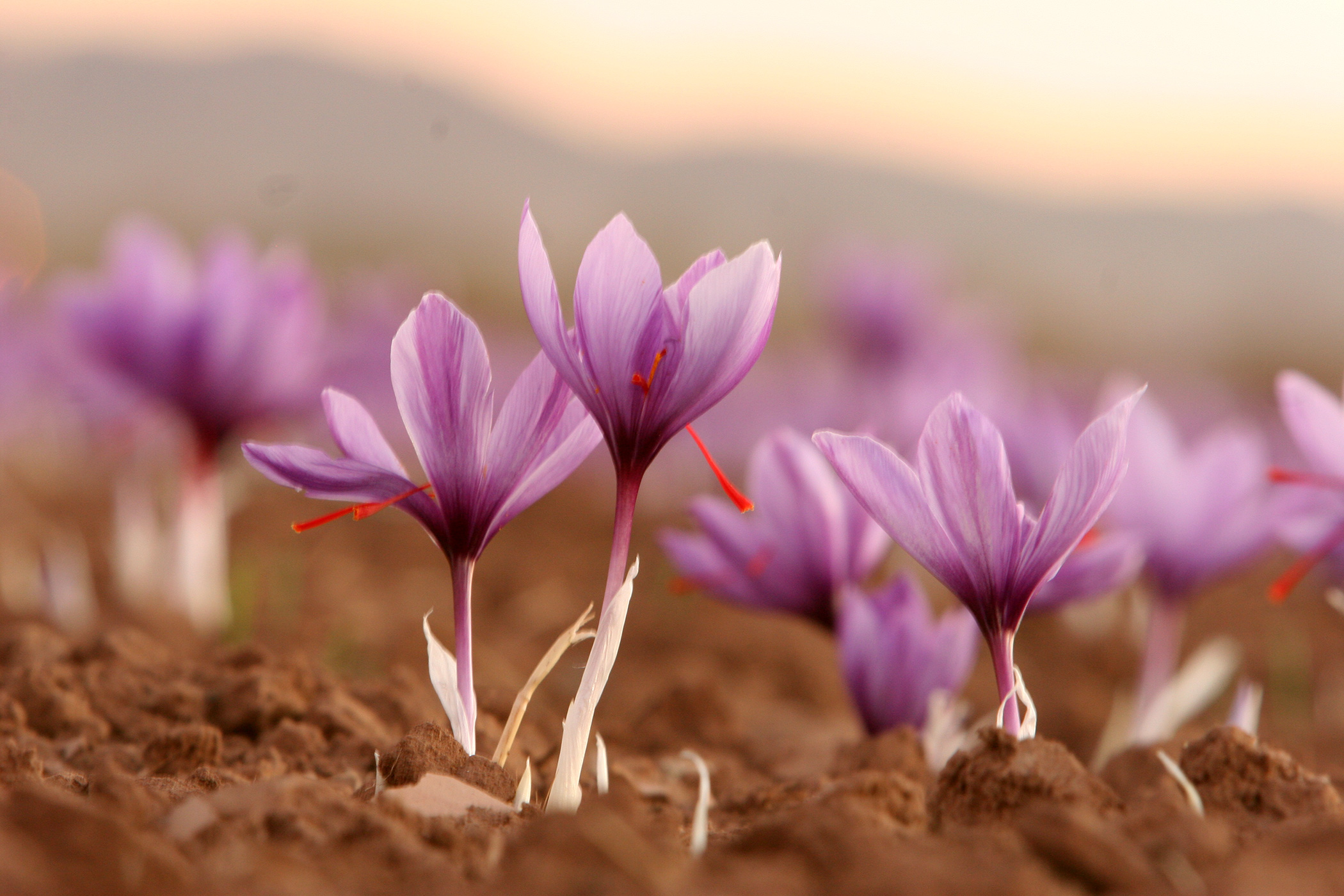
Crocus is a genus of about 100 low-growing perennial flowering plants in the iris family (Iridaceae), with broader estimates running to at least 200 species. All members grow from underground corms and are technically geophytes rather than true bulbs. Plants are acaulescent — the visible "stem" is in fact a tubular floral structure rising directly from the corm — and seldom exceed 15 cm in height. Slender, grass-like leaves with a characteristic pale central stripe emerge with or shortly after the flowers and persist for several weeks while the corm recharges for the following season.
The flowers are the genus's signature feature: goblet- or chalice-shaped, with six tepals fused into a long perianth tube, three stamens, and a single style that emerges and divides into three (or, in saffron crocus, many more) brightly coloured stigmatic branches. Blooms come in shades of white, yellow, orange, lilac, mauve, and deep purple, often with darker veining or contrasting throats, and they close in the evening and during overcast weather. The flowering season splits the genus into two broad groups: spring crocuses, which open in February and March as the soil warms, and autumn crocuses such as the cultivated saffron Crocus sativus and the wild C. banaticus, which flower from September into November.
The genus is native to a band stretching from the western Mediterranean and North Africa across southern Europe, the Aegean and Middle East, and through the Caucasus and Central Asia as far east as Xinjiang in western China. The Balkan Peninsula is the genus's centre of diversity, with at least 31 native species. Most crocuses inhabit well-drained, stony ground on mountain slopes, in alpine and subalpine meadows, in open woodland, or on rocky steppe, from sea level up to subalpine altitudes. Cold winters and dry summers — a Mediterranean or continental rhythm — suit the corm's annual cycle of dormancy and renewal.
Crocus has been cultivated for both ornament and economy for millennia. Crocus sativus yields saffron, the world's most expensive spice by weight, harvested from its dried red stigmas; Iran alone accounts for about 65 percent of global production. As a garden plant, crocus ranks among the most important ornamental geophytes worldwide, sixth in Dutch commercial bulb production, with cultivars derived chiefly from C. vernus, C. chrysanthus, C. tommasinianus, C. sieberi, and C. flavus.
Etymology
The name Crocus comes to English via Latin from the Greek krokos, itself almost certainly a loan from a Semitic root — compare Hebrew karkōm and Arabic kurkum, both meaning saffron. The word entered Late Middle English in the fourteenth century and was formally applied as the genus name by Linnaeus in 1753 in Species Plantarum, with Crocus sativus as the type species. The shared root with Indo-Iranian and Semitic words for the dyestuff reflects how thoroughly the saffron crocus had moved between cultures along trade routes long before the genus received its modern scientific name.
Distribution
The natural range of Crocus stretches from the western Mediterranean and North Africa across southern Europe and the Aegean, through Anatolia, the Levant, and the Caucasus, and across Central Asia as far east as Xinjiang in western China. The Balkan Peninsula is the centre of diversity, with at least 31 species recorded there. In Switzerland, InfoFlora lists six species, of which C. albiflorus is the familiar native alpine spring crocus, while C. sativus, C. chrysanthus, C. tommasinianus, C. biflorus, and C. flavus occur as garden escapes or cultivated populations. Throughout temperate Europe and North America the genus is now widely naturalized in lawns, churchyards, and woodlands well beyond its native range.
Ecology
Crocuses are corm geophytes adapted to climates with cold or dry seasons: the plant survives unfavourable months below ground and concentrates active growth into a short window of moderate temperatures. Habitats range from sea-level Mediterranean garrigue to subalpine meadows, with most species favouring well-drained stony soils on mountain slopes, open woodland edges, or rocky steppe. Spring-flowering species rely on early bees and other emerging insects for pollination, while autumn-flowering taxa such as C. sativus and C. banaticus exploit a second pollinator window before winter dormancy. Corms are a known target for rodents and squirrels, which dig up and eat freshly planted bulbs — a significant constraint in gardens and a natural pressure in the wild.
Cultivation
Crocus is a low-maintenance staple of temperate gardens. The corms are planted in autumn, set about 2.5 inches (6 cm) deep and 2 inches (5 cm) apart, in well-drained gritty soil — sandy loam enriched with composted organic matter is ideal. Most species tolerate USDA hardiness zones 3a–8b and grow best in full sun to partial shade. Spring crocuses are favourites for naturalizing in lawns, rock gardens, woodland edges, borders, and along pathways, where dense mass plantings produce sheets of early colour in February and March. Foliage should be left undisturbed for at least six weeks after flowering so the corm can recharge for the following season. The genus ranks sixth in Dutch commercial bulb production, reflecting its global importance as an ornamental geophyte.
Propagation
Crocus is propagated chiefly by division of the cormlets that form around the parent corm. NCSU Extension recommends lifting and dividing established clumps approximately every four years to maintain vigour and flower production. Many species also self-seed readily where conditions suit them, producing flowering-size corms after three to four years from seed.
Conservation
Wild Crocus populations face pressure from urbanization, industrial development, agricultural land conversion, uncontrolled wild collection of corms for the horticultural trade, and overgrazing by livestock. No Crocus species is currently recorded in the Global Invasive Species Database, so the genus presents no documented invasion risk outside its native range. Conservation status for individual species varies and should be checked on national red lists such as IUCN regional assessments.
Cultural uses
The cultural prominence of Crocus rests almost entirely on one species, Crocus sativus, whose dried red stigmas yield saffron — the most valuable spice in the world by weight, used as a culinary seasoning, a textile dye, and a cosmetic colourant since at least the Bronze Age. Iran today accounts for roughly 65 percent of global saffron production, with significant additional output from Spain, Morocco, Kashmir, and Greece. As an ornamental, Crocus ranks sixth in Dutch bulb production and is one of the world's most important garden geophytes, with spring-flowering cultivars derived chiefly from C. vernus, C. chrysanthus, C. tommasinianus, C. sieberi, and C. flavus.
History
Crocuses appear in human art and trade earlier than almost any other ornamental geophyte. Saffron-harvest scenes are painted on the walls of the Minoan settlement at Akrotiri on Santorini from around 1600 BC, and Greek mythology preserves the story of a mortal youth named Crocus transformed into the flower. The species was formally described and named by Carl Linnaeus in 1753 with Crocus sativus as the type. Cultivation of saffron spread from the eastern Mediterranean and Iran through the Arab world and into medieval Europe, while the ornamental garden crocuses of the modern era were developed from the eighteenth century onwards out of wild species collected across the Balkans, Anatolia, and the Caucasus.
Taxonomy notes
Crocus L. is a genus in the family Iridaceae (order Asparagales) erected by Carl Linnaeus in Species Plantarum (1753). The type species is Crocus sativus. Estimates of species number vary: Wikipedia gives "about 100 species" but notes recent treatments recognizing at least 200; GBIF records 566 descendant names under the genus, a figure that includes accepted species, infraspecific taxa, and synonyms. The Balkan Peninsula is the centre of diversity, with at least 31 species native to that region. Modern molecular work has reshuffled species and section boundaries considerably, and the precise species count continues to fluctuate with ongoing revisions.










