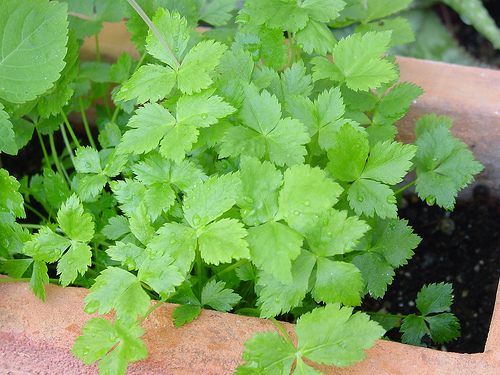
Cryptotaenia, commonly known as honewort, is a genus of herbaceous perennial plants in the carrot family (Apiaceae, order Apiales). The genus is native to moist, shaded habitats across a wide but disjunct range: eastern and central North America, eastern Asia (Japan, Korea, and China), and parts of Africa (Gabon and Tanzania), with one species from the Republic of Georgia.
Plants in the genus are typically erect perennials reaching 30–100 cm in height. The leaves are petiolate and compound, with triangular to ovate, serrated leaflets that vaguely resemble parsley or celery foliage. Flowers are small and white, borne in compound umbels characteristic of the Apiaceae family, and the fruits are schizocarps. The plants favour moist, shady conditions — forest understories, roadsides, and ditches — and will often self-sow where happy.
As of 2025, Plants of the World Online recognises six species. The taxonomy of the genus has been debated: proposals have been made to transfer the African and Canary Island species to other genera, and to absorb the Italian endemic Lereschia thomasii into Cryptotaenia. In 2016 the Canary Islands species C. elegans was formally transferred to Daucus.
The two most familiar species are Cryptotaenia canadensis, native to eastern North America, and Cryptotaenia japonica (mitsuba or Japanese honewort), native to Japan, Korea, and China. Mitsuba is an important culinary herb in Japan, used as a garnish in soups, as a sushi ingredient, and eaten raw in salads; its blanched white stems are compared in flavour to coriander or celery. The species is also cultivated across East Asia and in Western herb gardens as an attractive shade-tolerant edible perennial.
Etymology
The name Cryptotaenia derives from the Greek kryptos (hidden) and tainia (band or fillet), likely referring to the obscure or inconspicuous ribs on the fruit — a morphological feature typical of naming conventions in Apiaceae. The common name "honewort" is of English origin and was applied historically to the North American species C. canadensis.
Distribution
Cryptotaenia has a disjunct natural distribution spanning eastern and central North America (C. canadensis), Japan, Korea, and China (C. japonica), Gabon and Tanzania (C. africana, C. calycina, C. polygama), and the Republic of Georgia (C. flahaultii). All species favour moist, shaded habitats such as forest understories, stream margins, and damp roadsides.
Ecology
Species of Cryptotaenia are adapted to moist, shaded environments and tolerate a range of soil types from sandy to clay. C. japonica grows well in full to partial shade and prefers consistently moist soil; in full sun the foliage tends to yellow. Plants are frost-tolerant to around −10 °C (UK zone 5) and commonly self-sow where conditions suit them.
Cultural Uses
Cryptotaenia japonica (mitsuba, "three-leaved") is a significant culinary herb in Japan, used fresh or lightly cooked as a garnish in soups, on rice and noodle dishes, and in sushi. The leaves are eaten raw in salads; the blanched white stems are used as a celery-like vegetable. The seed is used as a seasoning. Two regional cultivated varieties exist in Japan: the green Kansai type and the white Kantō type. In traditional East Asian medicine, the plant has been used as a febrifuge and general tonic. C. canadensis was also used medicinally by Indigenous peoples of North America.
Taxonomy Notes
The circumscription of Cryptotaenia has been unstable. Plants of the World Online (as of February 2025) recognises six species, but molecular and morphological studies have suggested that the African and Canary Island species are better placed in other genera. The Italian endemic Lereschia thomasii has been proposed for inclusion in Cryptotaenia. In 2016, the Canary Islands endemic C. elegans was transferred to Daucus as Daucus elegans. Some authorities treat C. japonica as a subspecies of C. canadensis (C. canadensis subsp. japonica), given their close morphological similarity.










