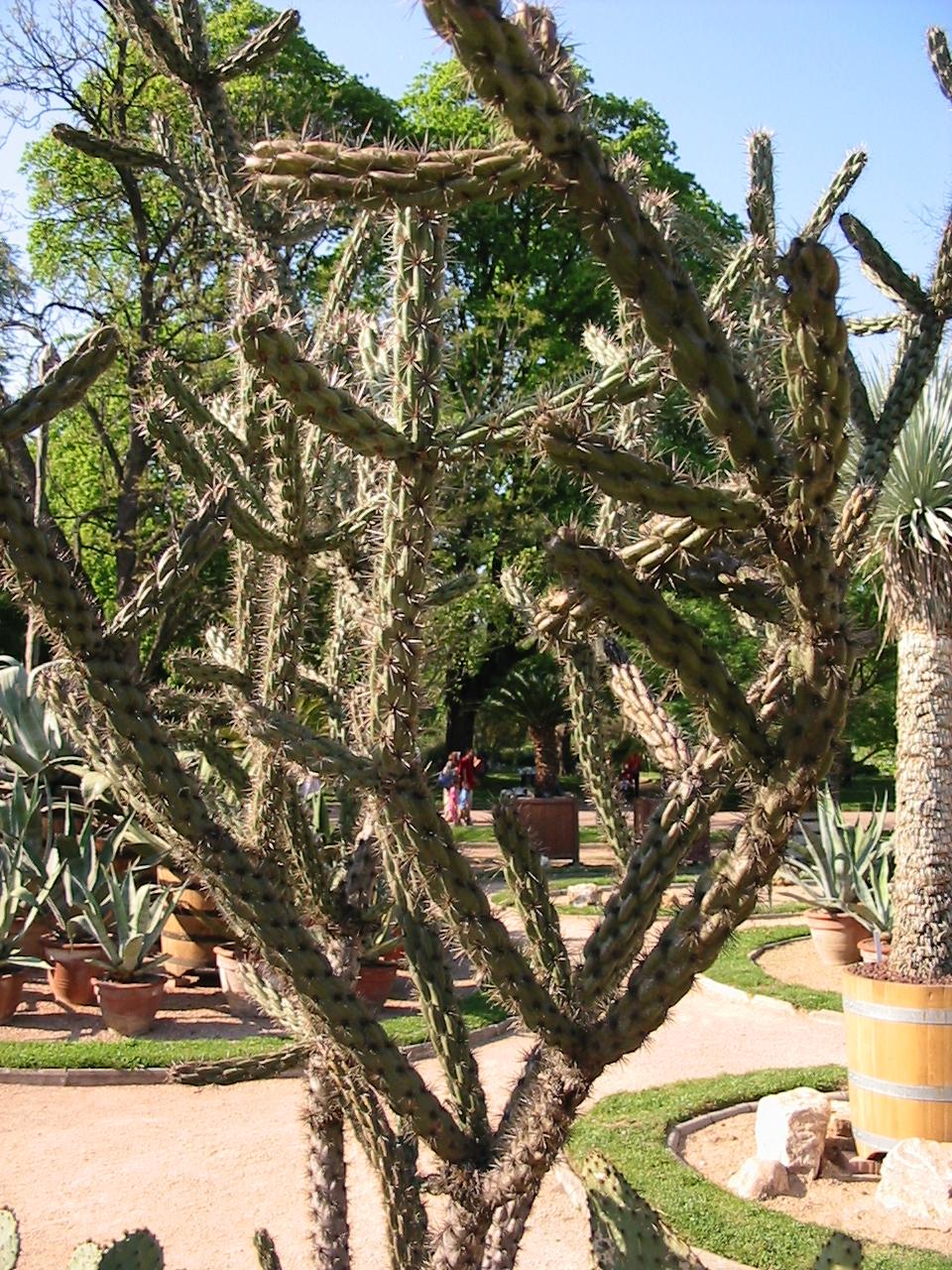
Cylindropuntia is a genus of cacti in the family Cactaceae, subfamily Opuntioideae, commonly known as chollas. The roughly 32–35 recognized species are concentrated in the deserts of northern Mexico and the southwestern United States, with the Flora of North America treatment by Donald J. Pinkava accepting 22 species and recording multiple interspecific hybrids. The genus was segregated from Opuntia in 1935 by Frič & Schelle ex Kreuz. on two clear morphological grounds: cholla stems are cylindrical rather than flattened into pads, and their spines are enclosed in a deciduous papery sheath that Opuntia spines never develop.
Chollas grow as erect shrubs or small trees that are usually many-branched, occasionally forming low mats. Each stem segment is studded with tubercles bearing areoles that produce both long, barbed spines and tufts of fine glochid bristles — features that make the plants notorious for snagging skin, fur, and clothing. Flowers are produced near the tips of mature joints and range from yellow-green through pink to deep red-magenta. The fruits may be fleshy or dry, spiny or spineless, and typically contain flattened to nearly spherical seeds with one to four conspicuous depressions; the chromosome base number is x = 11 and pollen is of the spinulo-punctate "cylindropuntioid" type.
Chollas occupy the Chihuahuan, Mohave, and Sonoran Deserts and adjacent semiarid grasslands, with a few species reaching the Caribbean and others now naturalized in Chile, Ecuador, Peru, South Africa, and parts of Europe. Many species also reproduce clonally: stem joints detach with the slightest disturbance, root where they fall, and gradually build the dense, even-aged stands called cholla gardens, whose individuals frequently share an identical genotype with the parent plant. The genus includes several of the most familiar Southwestern cacti, among them the jumping cholla (C. fulgida), the teddy-bear cholla (C. bigelovii), and the cane or walking-stick cholla (C. imbricata).
Etymology
The genus name Cylindropuntia is built from the Latin/Greek root cylindro-, meaning "cylinder," combined with Opuntia, the related pad-cactus genus from which Cylindropuntia was separated. The name directly references the cylindrical stem segments that distinguish chollas from their flat-padded relatives. The genus was formally established in 1935 by Frič & Schelle ex Kreuz. in Verzeichnis der Sukkulenten mit revidiertem System der Kakteen. The English common name "cholla" (pronounced CHOY-ə) is a borrowing from Mexican Spanish.
Distribution
Cylindropuntia is centered on the warm deserts of North America. The genus is native to northern Mexico and the southwestern United States, where its species are major components of the Chihuahuan, Mohave, and Sonoran Desert floras; a few species extend into the Caribbean. Chollas have also been introduced and become naturalized outside their native range — most prominently in South America (Chile, Ecuador, Peru) and South Africa. In Europe, the genus is treated as a neophyte; the Swiss flora catalogues only Cylindropuntia imbricata, listed under introduced/naturalized species.
Ecology
Chollas are keystone elements of warm-desert plant communities, both as habitat and as a food source. Dense stands known as "cholla gardens" form when stem joints detach and root in place, producing colonies in which most individuals are genetically identical clones of an original plant. The barbed spines that make chollas notorious also provide nesting protection: cactus wrens, for example, regularly build nests inside Cylindropuntia fulgida. Fruits persist on the plants well into winter and are consumed by pronghorn, desert bighorn sheep, and mule deer — an important water and energy source during drought when little else is available.
Cultivation
Chollas are sun-loving xerophytes that thrive in full sun with minimal water, fast-draining mineral soils, and low humidity. They tolerate extreme heat and drought but cannot grow in shade, and overwatering quickly causes stem rot and structural collapse. Hardiness depends on species, with most falling in roughly USDA zones 7–11 (teddy-bear cholla is more cold-sensitive at zones 8–11). Because the barbed glochids and detachable joints embed painfully in skin and clothing, chollas are poorly suited to areas with foot traffic and are best sited away from paths and play areas.
Propagation
Vegetative propagation is the easiest and most effective method for nearly all chollas: detached stem joints root readily in dry, well-drained soil. This trait is so pronounced that the plants disperse themselves in the wild, with stem fragments adhering to passing animals and clothing and rooting where they fall — the same mechanism that produces clonal cholla gardens. Seed propagation is rarely used in cultivation because the hard seed coats germinate slowly and unevenly.
Conservation & Invasiveness
While many Cylindropuntia species are stable within their native deserts, several have become aggressive invasive plants where they have been introduced. Cane cholla (C. imbricata) is a declared noxious weed in New South Wales and infests old mining sites and watercourses across Australia (Queensland, Northern Territory, Victoria, and South Australia), where it is called "devil's rope cactus" or "devil's rope pear." Chollas are also naturalized in Chile, Ecuador, Peru, South Africa, and parts of Europe; the Swiss flora lists Cylindropuntia imbricata as a neophyte.
Cultural & Human Uses
Several chollas have long-standing uses by Indigenous peoples of the American Southwest. Native communities in Arizona and New Mexico historically ate the fruits of Cylindropuntia imbricata, described as dry and bland, and the Zuni people use the species ceremonially; Roman Catholic Penitentes of New Mexico likewise used fresh stems of cane cholla in Holy Week processions. Across the genus more broadly, flower buds (harvested in spring) and to a lesser extent fruits and tender joints are eaten after the glochids and spines are carefully removed. In contemporary commerce, dried Cylindropuntia stems are marketed as "cholla wood" and widely sold for aquariums and reptile terrariums, where the porous, hollow structure provides cover and climbing surfaces.
Taxonomic History
The genus was published in 1935 by Frič and Schelle ex Kreuzinger in Verzeichnis der Sukkulenten mit revidiertem System der Kakteen, segregating the cylindrical-stemmed, sheath-spined cacti from Opuntia sensu lato. The Flora of North America treatment by Donald J. Pinkava (volume 4) remains the standard modern monograph for the North American species, recognizing 22 species plus numerous documented interspecific hybrids.
Taxonomy Notes
Cylindropuntia sits in family Cactaceae (order Caryophyllales), subfamily Opuntioideae, tribe Cylindropuntieae. It was carved out of Opuntia on two characters: cylindrical (rather than flattened) stem segments and the presence of a papery, deciduous epidermal sheath enclosing each spine — a feature absent in Opuntia. The chromosome base number is x = 11; pollen is spinulo-punctate (the cylindropuntioid type); and seeds are flattened to subspheric with one to four conspicuous depressions. Species counts vary by treatment: roughly 32–35 species are generally recognized, with the Flora of North America accepting 22 species and numerous interspecific hybrids.










