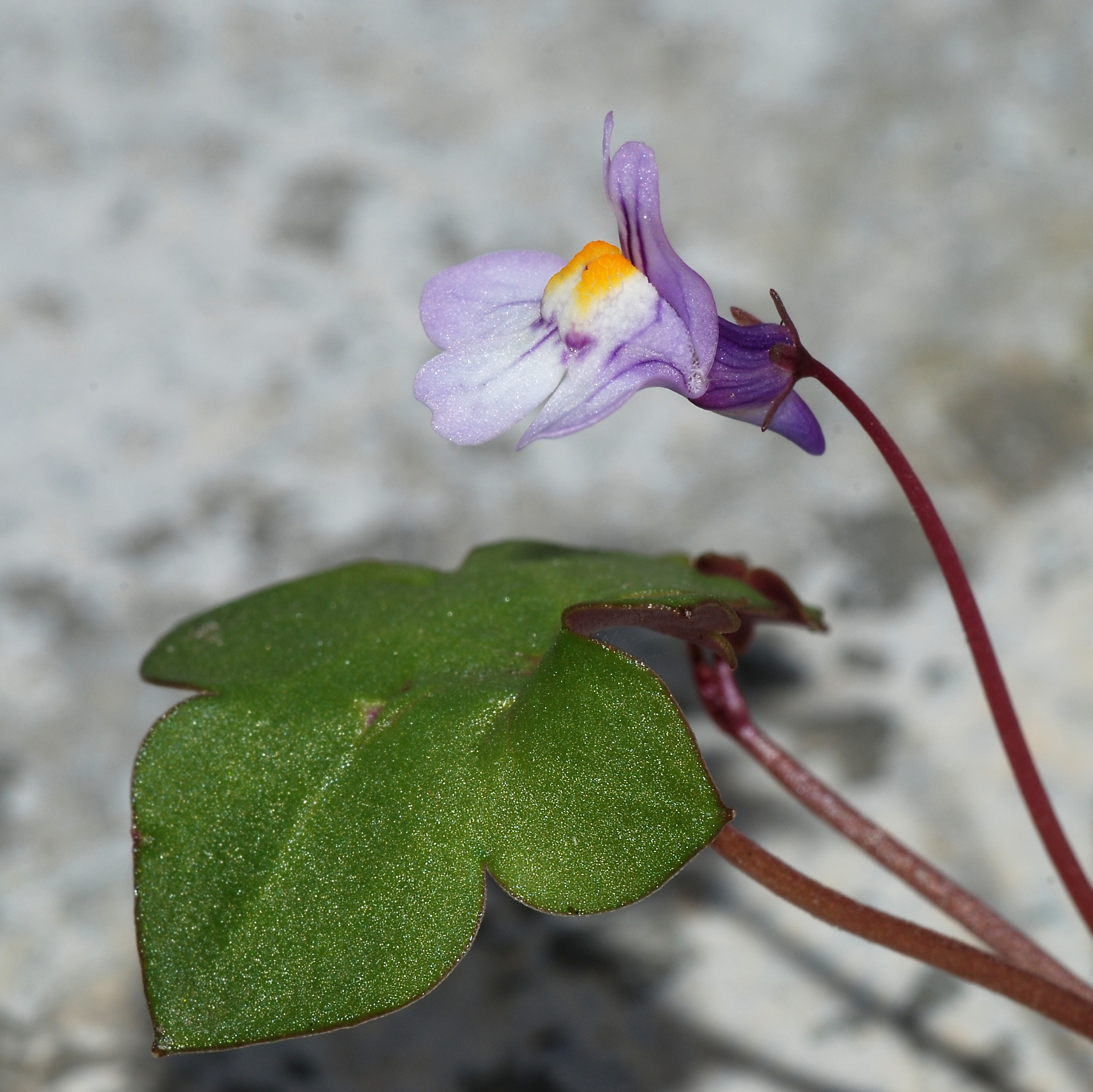
Cymbalaria is a genus of approximately 10 species of herbaceous perennial plants in the family Plantaginaceae (order Lamiales), described by English botanist John Hill in 1756. The genus was long placed in Scrophulariaceae but genetic research has shown it belongs to the much-enlarged Plantaginaceae, alongside relatives such as plantains, snapdragons, and speedwells.
Native to southern Europe, Cymbalaria species are low-growing perennials with a characteristically creeping or trailing habit. They are closely related to the toadflaxes (Linaria) and snapdragons (Antirrhinum), from which they differ in producing solitary flowers along trailing stems rather than clustered in dense upright spikes. The leaves are somewhat rounded and palmately lobed — the cymbal-like shape that gives the genus its name.
The genus shares the common name "toadflax" with Linaria and related genera. By far the best-known member is Cymbalaria muralis, commonly called ivy-leaved toadflax or Kenilworth ivy, native to southwest Europe. It is widely naturalised across temperate regions of the world and is a familiar sight on stone walls, rocky crevices, and garden pathways, where its trailing stems can reach up to 1 metre in length. Other accepted species include C. aequitriloba, C. hepaticifolia, C. longipes, C. microcalyx, and C. muelleri, all restricted to the Mediterranean region.
Etymology
The genus name Cymbalaria derives from the Latin cymbalum (cymbal), referring to the rounded, somewhat cymbal-shaped leaves characteristic of the plants in this group.
Distribution
Cymbalaria is native to southern Europe, centred on the Mediterranean basin. The most widespread species, Cymbalaria muralis, has naturalised extensively in temperate regions worldwide, frequently colonising stone walls, rocky outcrops, and scree.
Ecology
Species of Cymbalaria favour sheltered crevices in walls, rocks, and scree, forming trailing or scrambling growth. Cymbalaria muralis is particularly noted for its wall-dwelling habit, exploiting thin substrates in masonry and natural rock faces across its naturalised range.
Taxonomy Notes
Cymbalaria was described by English botanist John Hill in 1756 (published in Brit. Herb. 113). The genus was traditionally placed in Scrophulariaceae but molecular phylogenetic studies have established it within the greatly enlarged Plantaginaceae, order Lamiales. It sits close to Linaria and Antirrhinum within that family.










