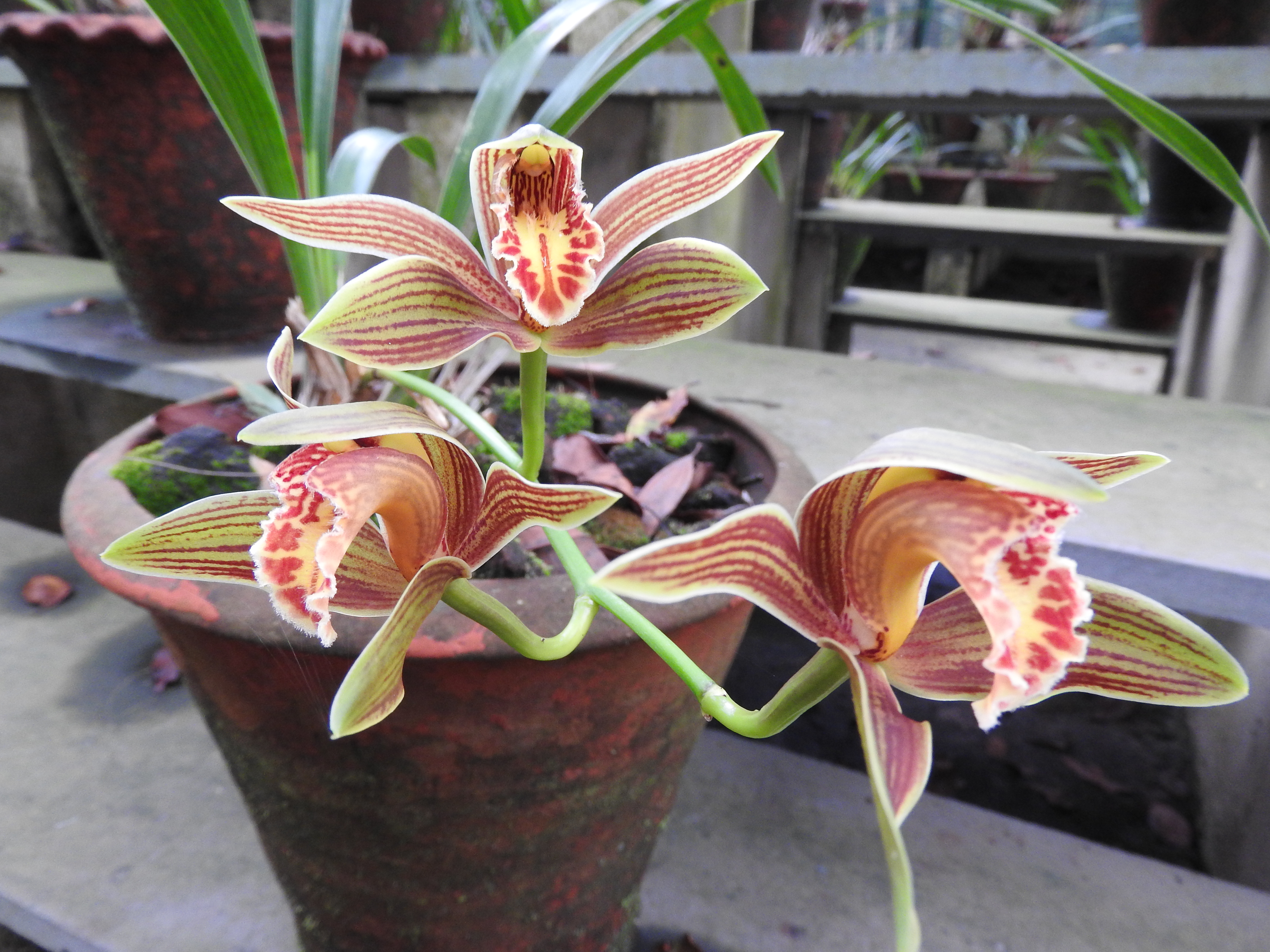
Cymbidium, commonly known as the boat orchids, is a genus of evergreen flowering plants in the orchid family Orchidaceae. The genus was formally described by the Swedish botanist Olof Swartz in 1799, and modern treatments place it in tribe Cymbidieae (subfamily Epidendroideae). Estimates of species number vary by author: Wikipedia and other recent treatments recognize about 55 species, while the American Orchid Society cites 44; GBIF's taxonomic backbone records 255 descendant names once subspecies and synonyms are counted.
Cymbidiums grow as epiphytes, lithophytes, terrestrial herbs, or rarely as leafless saprophytes, all with a sympodial habit and conspicuous pseudobulbs or thickened leaf bases. Plants produce arching, strap-shaped leaves and erect to pendent flower spikes of showy, often fragrant blooms. Each flower carries three sepals and three petals, with the third petal modified into a distinctly boat-shaped lip (labellum) flanked by an elongated column — the feature that gives the genus its name. The genus name itself derives from the Greek kymbes, meaning a boat-shaped cup, a reference to that characteristic lip.
The natural range stretches across tropical and subtropical Asia and reaches into Australia, with species recorded from the northwestern Himalaya and northern India through China, Japan, Malaysia, the Philippines, Borneo, New Guinea, and on into Australia. Within that range plants partition themselves by altitude: larger-flowered species tend to occupy lower elevations, while smaller, narrow-leaved taxa dominate cooler, higher-elevation rocks and tree trunks. This altitudinal split is mirrored in cultivation, where the larger, "standard" hybrids require a cool, near-freezing autumn chill to initiate flowering, and tropical lowland species prefer steadier warmth.
Cymbidiums are among the most popular orchids in cultivation and are widely grown as cut flowers, corsages, and houseplants. The genus has been cultivated in East Asia for nearly two millennia — references appear in a Jin-dynasty manuscript from around the 200s CE and in writings attributed to Confucius — and modern horticulture has produced an enormous catalogue of named hybrids and award-winning cultivars.
Etymology
The genus name Cymbidium derives from the Greek kymbes, meaning a boat-shaped cup, and refers to the characteristic shape of the labellum (the third petal of the flower, modified into a lip). Wikipedia gives the gloss as "little boat-shape" with the same reference to the labellum, while the American Orchid Society traces the same root directly to the Greek term for a boat-shaped cup. Olof Swartz coined the name when he formally established the genus in 1799.
Distribution
The genus is distributed across tropical and subtropical Asia and the western Pacific, with a southern outlier in Australia. The American Orchid Society describes the range as extending from the Northwest Himalaya to Japan and south through the Philippines, New Guinea, and Australia, while Wikipedia lists northern India, China, Japan, Malaysia, the Philippines, and Borneo alongside Australia as core countries of occurrence. Species are partitioned by elevation: large-flowered species tend to occur at low altitudes, whereas short-leaved species are typically high-altitude lithophytes and epiphytes.
Ecology
Cymbidium species occupy three principal habits — epiphytic (growing on tree trunks and branches), lithophytic (growing on rocks), and terrestrial — with rare leafless, saprophytic exceptions. All are evergreen with a sympodial growth pattern, building successive pseudobulbs or thickened leaf bases along a creeping rhizome. The American Orchid Society notes that the flowers are showy, often fragrant, and structurally distinguished by a three-lobed lip and an elongated column. Wikipedia adds that the genus partitions itself altitudinally, with low-altitude habitats dominated by large-flowered species and higher, cooler ridges occupied by short-leaved lithophytes and epiphytes.
Cultivation
Cymbidiums are widely regarded as among the least demanding orchids for indoor and conservatory growing, but they are exacting on one point: they need a marked drop in night-time temperature in late summer and early autumn to set flower buds. NCSU Extension specifies daytime temperatures of 75–85°F paired with 50–60°F nights for standard cymbidiums, calling a 25-degree day/night swing "essential" for flowering; the RHS gives a year-round optimum of 10–24°C (50–75°F), with summer maxima kept below 30°C and winter minima of 10–14°C. The American Orchid Society adds that large-flowered species need several weeks below 12°C (54°F) to initiate bloom and that intermediate temperatures suit most of the genus better than steady warmth.
Light should be bright but diffuse: NCSU recommends bright indirect sun, the RHS calls for good light year round (especially in winter) with shade from harsh summer sun, and the AOS likewise prescribes bright, diffuse light. Humidity is best held between 40–60%. Plants are grown in a bark-based or coarse, organic-matter-rich orchid mix; NCSU specifies a medium labeled for cymbidiums, the RHS suggests bark-based orchid compost repotted every two years, and the AOS calls for a medium-grade potting mix. Water heavily through spring and summer, allowing only a slight drying between applications, and ease back in winter to roughly weekly or fortnightly watering; the AOS warns that the root system should never fully dry out. The RHS recommends rainwater or filtered water in hard-water areas. Cymbidiums are heavy feeders during active growth, and the RHS notes that moving plants outdoors from mid-summer through mid-September supplies the natural temperature swings that trigger flowering. Common problems across all three sources include aphids, mealybugs, scale insects, red spider mites, and slugs or snails outdoors, plus root rot from overwatering, sunburn from direct light, and cymbidium mosaic virus.
Propagation
Division is the standard propagation method for Cymbidium. NCSU Extension lists division as the recommended technique, and the RHS provides the practical detail: divide mature clumps during spring repotting, sawing them into sections that retain at least five pseudobulbs each. Divisions typically need two to three years to flower again.
History
Cymbidiums have one of the longest documented histories of any orchid in cultivation. Wikipedia notes that the genus is mentioned in a manuscript from the Jin dynasty (c. 200s CE) and in writings attributed to Confucius, and that long-running East Asian horticultural tradition has been compounded by modern Western breeding to produce an extensive catalogue of named hybrids and cultivars. Olof Swartz's 1799 protologue in Nova Acta Regiae Societatis Scientiarum Upsaliensis formally established the genus in Linnaean taxonomy.
Cultural uses
Beyond their dominance as cut flowers, corsages, and houseplants noted by NCSU Extension, cymbidiums have specific regional traditions. Wikipedia records that Cymbidium hookerianum is treated as a delicacy in Bhutan, where its flower buds are cooked in a spicy curry or stew called "olatshe" or "olachoto". In Western horticulture the genus is heavily represented in the RHS Award of Garden Merit list, with selections such as Cymbidium erythraeum, C. Dorothy Stockstill, C. Sarah Jean 'Ice Cascade', and C. Tiger Tail singled out as reliable garden and conservatory plants.
Taxonomy
Cymbidium Sw. was published by Olof Swartz in Nova Acta Regiae Soc. Sci. Upsal. 6: 70 (1799) and is an accepted genus in Orchidaceae (order Asparagales, class Liliopsida) according to the GBIF taxonomic backbone, which records 255 descendant names under the genus once species, subspecies, and synonyms are included. Within Orchidaceae the genus sits in subfamily Epidendroideae, tribe Cymbidieae, and (per the American Orchid Society) subtribe Cyrtopodiinae. Wikipedia divides the genus into three subgenera — Cymbidium, Cyperorchis, and Jensoa. Estimates of accepted species number differ between secondary sources: Wikipedia gives roughly 55 species, while the American Orchid Society cites 44.










