Cyrtocarpa is a small genus of trees in the subfamily Spondiadoideae of the family Anacardiaceae — the cashew and sumac family, which also includes mango, poison ivy, and pistachio. The genus belongs to the order Sapindales and contains approximately five accepted species. These trees are native to Mexico and northern South America, where they inhabit dry forests and open arid landscapes.
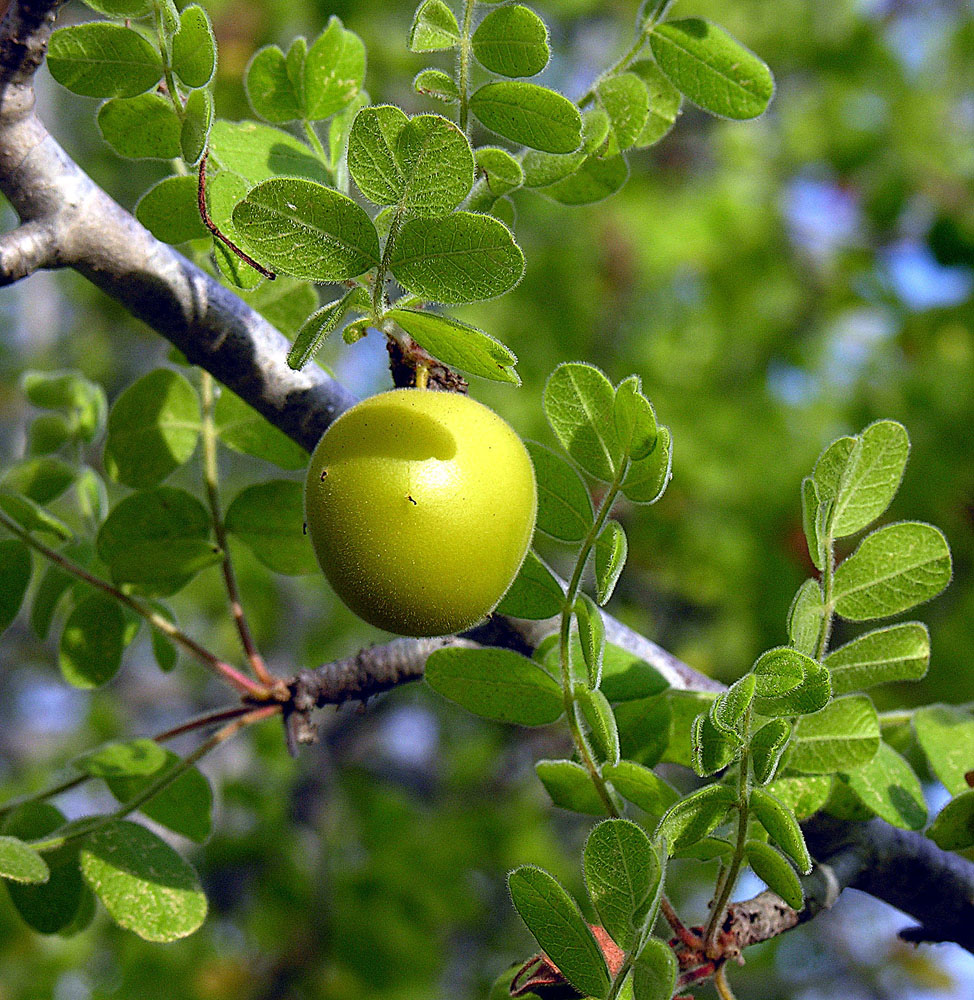
The most distinctive feature of several Cyrtocarpa species is their sarcocaulescent growth form — thick, fleshy, water-storing stems and trunks that allow the plants to thrive in arid and semi-arid environments. The best-studied species, Cyrtocarpa edulis (Cimarrón plum or Cape wild-plum), is endemic to the Cape Region of Baja California Sur and exemplifies this habit: its trunk can reach two-thirds of a metre in diameter with smooth, light-grey bark, and its twisted branches give the plant a distinctive silhouette. Plants growing on sand dunes may adopt a prostrate form. Leaves are pinnately compound, flowers are small and dioecious, and the fruit is an edible drupe up to 2 cm long that turns green to yellow when ripe.
Other species in the genus include Cyrtocarpa procera (described by Kunth) and Cyrtocarpa velutinifolia, as well as Cyrtocarpa caatingae and Cyrtocarpa kruseana, which extend the genus's range into northern South America. The edible fruit of C. edulis has attracted horticultural attention, and the species was introduced to cultivation through the Huntington Botanical Gardens International Succulent Introductions programme in 2021, with potential as a drought-tolerant fruit crop for arid regions.
Distribution
Cyrtocarpa is native to Mexico and northern South America, growing in dry forests and open arid areas. The most documented species, C. edulis, is endemic to the Cape Region of Baja California Sur and the adjacent Gulf of California islands (San Jose, Espíritu Santo, and Cerralvo). Other species extend the genus's range into South America.
Ecology
Cyrtocarpa species occupy dry forests, sandy plains, slopes, and arid tropical forests. Their sarcocaulescent (succulent-stemmed) habit reflects adaptation to seasonally dry environments. Cyrtocarpa edulis is intolerant of shade in foothill habitats and sensitive to low winter temperatures at higher elevations; on sand dunes it adopts a prostrate growth form.
Cultural Uses
The fruit of Cyrtocarpa edulis is edible and consumed locally in Baja California Sur. The species was introduced to horticultural cultivation through the Huntington Botanical Gardens International Succulent Introductions programme in 2021. Its drought tolerance makes it a candidate for arid-land fruit production.










