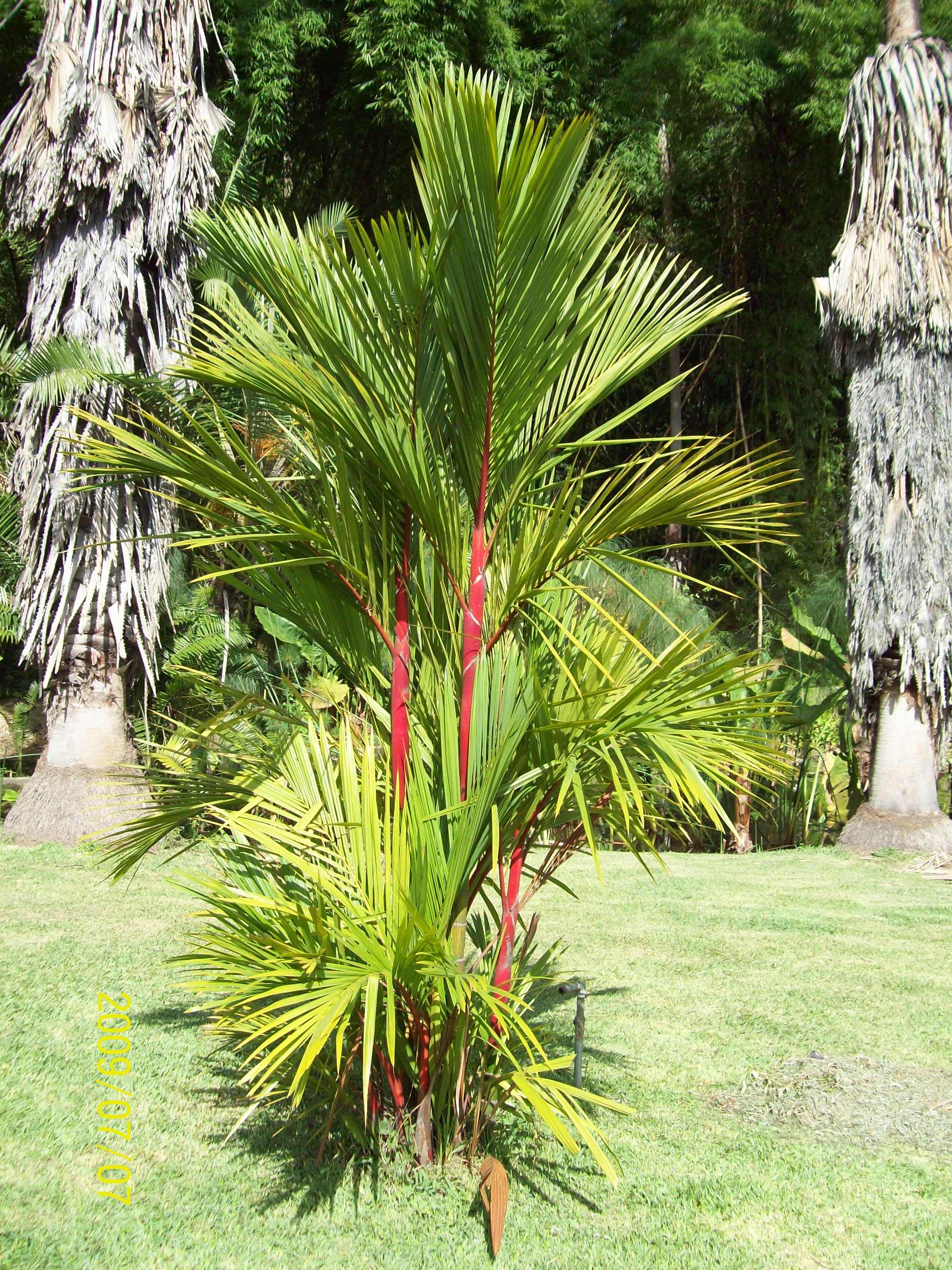
Cyrtostachys is a genus of flowering plants in the palm family (Arecaceae), order Arecales, first described by Carl Ludwig Blume in 1838. The genus comprises around seven to eight species distributed across Southeast Asia, New Guinea, the Bismarck Archipelago and the Solomon Islands, spanning parts of both the Asian and Wallacean/Oceanian biogeographic realms.
The best-known and most widely cultivated species is Cyrtostachys renda, commonly called the lipstick palm or red sealing wax palm. It is a slender, multi-stemmed, slow-growing, clustering palm reaching up to 16 metres tall, set apart from every other palm by its scarlet-to-bright-red crownshaft and leaf sheaths — the trait for which the genus is chiefly known and prized. Unlike most other species in the genus, which are confined to New Guinea and neighbouring Pacific islands east of the Wallace Line, C. renda occurs naturally to the west of that boundary, across Thailand, Peninsular Malaysia, Sumatra and Borneo.
In the wild, Cyrtostachys species typically grow in Southeast Asian lowland peat swamp forest, tolerating flooding and standing water thanks to well-drained, sandy, low-acid soils with a thin peat layer. Because of its unusual, vividly colored foliage, C. renda has become a sought-after ornamental exported to tropical regions worldwide, though it is difficult to propagate and intolerant of cold or drought. Traditional, more limited uses recorded for the genus include flooring and thatching materials, dart-making in Malaysia, and palm-heart harvesting in parts of Sumatra. Cyrtostachys renda was listed as Vulnerable on the IUCN Red List in 1995 and was given legislative protection from harvest in Indonesia in 1999, before being removed from the IUCN's protected list in 2000.
Etymology
The genus name combines the Greek cyrto- ("bent" or "curved") with stachys ("an ear of grain"). Its most familiar species, Cyrtostachys renda, takes its epithet from a Malay word for palm and its common name "sealing wax palm" from the crownshaft's resemblance to the wax historically used to seal letters and envelopes — though the plant is not actually a source of sealing wax.
Distribution
Species of Cyrtostachys occur across Southeast Asia, New Guinea, the Bismarck Archipelago, and the Solomon Islands. Cyrtostachys renda is the genus's sole representative found west of the Wallace Line, native to Thailand, Peninsular Malaysia, Sumatra and Borneo.
Ecology
Native habitat is Southeast Asian lowland peat swamp forest, characterized by well-drained, sandy, low-acid soil with a thin peat layer and low carbon-to-nitrogen ratio; the palms tolerate flooding and standing water. They need full sun to shade with humid conditions and well-draining soil, do not tolerate cold or drought, and are rated to hardiness zone 11 and above, suited to tropical rainforest/equatorial (Köppen Af) climates.
Cultivation
Grown chiefly as an ornamental for its brightly colored, unusual crownshaft foliage, the plant is in high demand for gardening and landscaping. Propagation difficulty and its striking color have driven prices as high as $1000 USD for collectors and gardeners.
Propagation
Propagation is by fresh seed, which is slow to germinate, or by dividing out basal suckers from clustering stems.
Cultural Uses
Traditional, limited-scale uses include flooring materials, roof thatching, and making darts in Pahang and elsewhere in Malaysia; some rural communities in Sumatra harvest the palm for palm hearts.
Conservation
Cyrtostachys renda was listed as "Vulnerable" on the IUCN Red List in 1995. Indonesia legislated protection against its harvest in 1999, and the IUCN subsequently removed it from its protected list in 2000.
Taxonomy Notes
The genus was described by Carl Ludwig Blume in 1838 (Bull. Sci. Phys. Nat. Néerl. 1: 66) and sits in family Arecaceae, order Arecales; GBIF's backbone lists 8 descendant taxa. Heterotypic synonyms recorded for Cyrtostachys renda include Cyrtostachys lakka/lacca (coined by Odoardo Beccari) and Pinanga rubricaulis Linden (1885).










