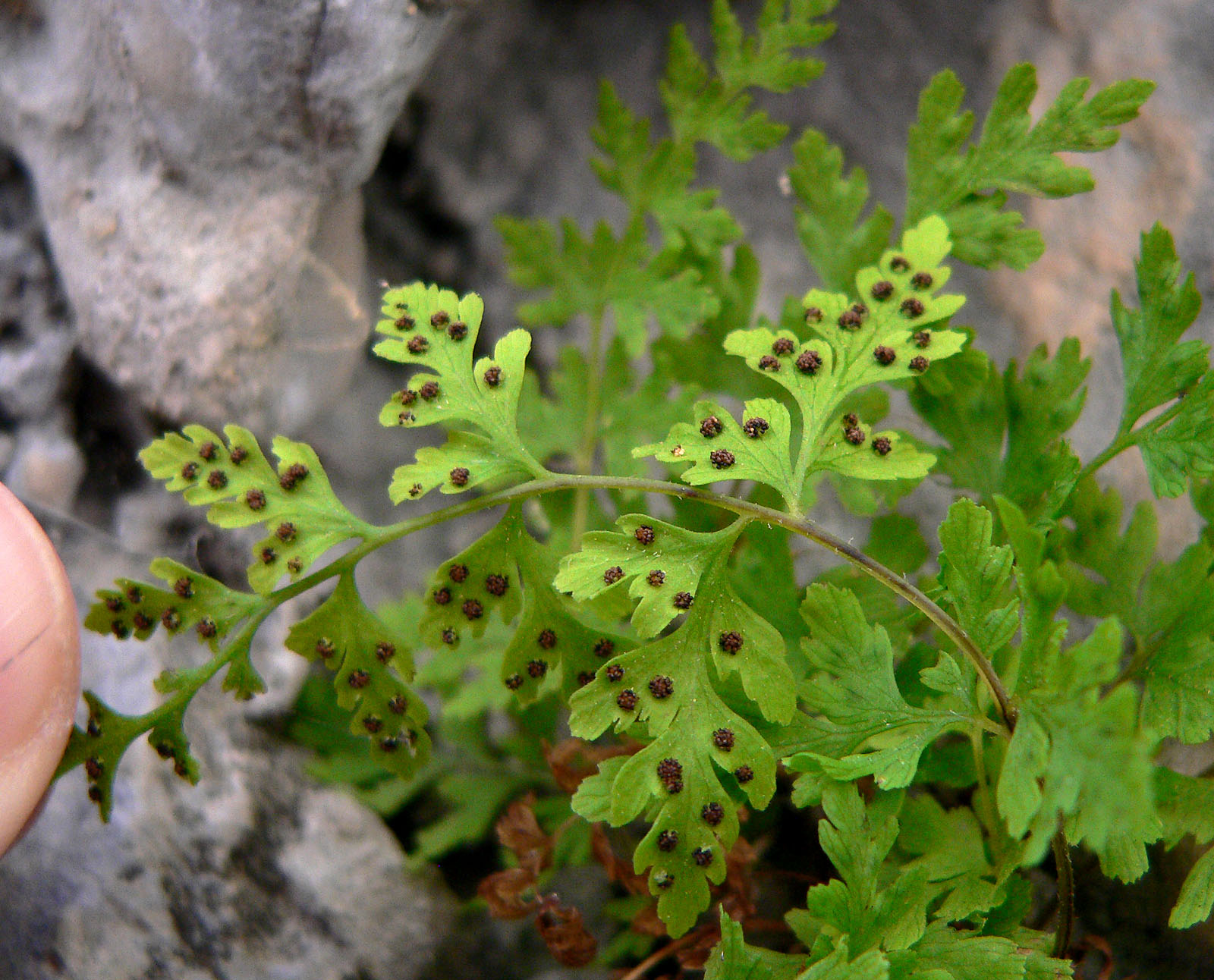
Cystopteris, commonly called bladderferns or fragile ferns, is a genus of approximately 20 species of small, delicate ferns belonging to the family Cystopteridaceae, in the order Polypodiales. The name derives from the Greek kystos (bladder) and pteris (fern), a reference to the distinctive hood-like indusium that arches, inflated, over each sorus when young.
These are rhizomatous perennials that grow terrestrially or on rock. The stems are short- to long-creeping, and the fronds are monomorphic, dying back in winter; the petiole base is often swollen and persists over winter as a trophopod. Fronds are ovate-lanceolate to deltate in outline, 1–3-pinnate-pinnatifid, and membranaceous to herbaceous in texture. Sori are round and arranged in a single row between the midrib and the leaf margin on ultimate segments; spores are brownish and echinate or verrucate. The base chromosome number is x = 42.
Cystopteris is distributed across temperate regions worldwide, but its extant diploid species are concentrated in North America, where they serve as progenitors for a suite of allopolyploid derivatives. The genus is taxonomically challenging: species hybridize freely wherever they co-occur, and individuals — especially those growing in stressful environments such as high elevations, high latitudes, or cold and dry climates — can appear highly reduced and atypical. The most widespread and variable member, C. fragilis (fragile fern), is found on nearly every continent and was formally described by Bernhardi in 1805.
Notable species include Cystopteris fragilis, the type and most widespread member; Cystopteris bulbifera, distinctive for its bulblets on rachises and costae; Cystopteris montana, a long-creeping alpine species; and Cystopteris tennesseensis, an allotetraploid hybrid derived from C. bulbifera and C. protrusa.
Etymology
The genus name Cystopteris derives from the Greek kystos (bladder) and pteris (fern), referring to the inflated, hood-like indusium that arches over each sorus when young. The common names "bladderfern" and "brittle fern" reflect these same features — the former the indusium shape, the latter the delicate, membranaceous frond texture.
Distribution
Cystopteris species occur in temperate climates worldwide, at tetraploid to octaploid ploidy levels. Within North America, the genus is best represented in the eastern and central United States, southwestern mountains, and boreal regions, with C. fragilis extending across Europe, Asia, Africa, and temperate South America. Diploid species are concentrated in North America and are the evolutionary source of most allopolyploid members found elsewhere.
Ecology
Bladderferns grow terrestrially or on rock, frequently colonizing cliff faces, rocky slopes, talus, and shaded ledges. They are particularly characteristic of high-elevation and high-latitude habitats, where plants may be reduced to highly stunted but fertile individuals. Wherever two species co-occur, hybridization is likely; hybrids typically produce shriveled and malformed spores, which can be used to identify them in the field.
Taxonomy
Cystopteris was formally described by Bernhardi in 1805 (Neues J. Bot. 1(2): 26). It is placed in the family Cystopteridaceae, order Polypodiales. The genus is taxonomically difficult, particularly because of the widespread and polymorphic C. fragilis sensu lato and the prevalence of allopolyploidy: many species are allotetraploids or allohexaploids derived from diploid progenitors native to North America. Hybrids are common and include C. ×christii (C. fragilis × C. montana) and C. ×illinoensis (C. bulbifera × C. tenuis), among others. An extinct or undiscovered diploid progenitor (informally labelled "C. hemifragilis") may have contributed to some polyploids.










