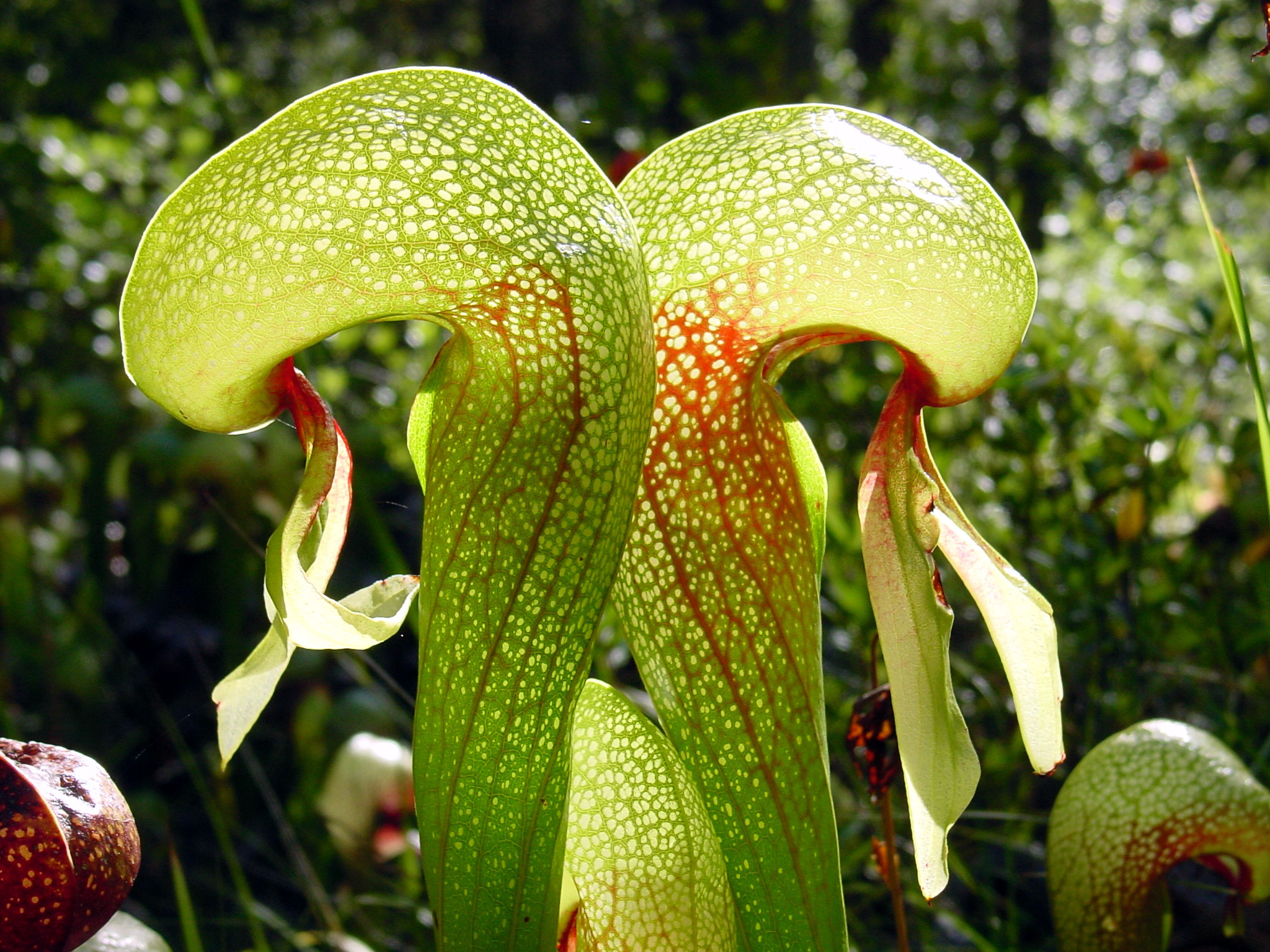
Darlingtonia is a monotypic genus of carnivorous plant in the new-world pitcher-plant family Sarraceniaceae (order Ericales), containing a single species, Darlingtonia californica — widely known as the cobra lily or cobra plant, and also called the California pitcher plant, Oregon pitcher plant, or Cascadian pitcher plant. The common name comes from its tubular leaves, which resemble a rearing cobra topped by a curled hood and a forked, yellow-to-purplish-green appendage suggestive of a serpent's tongue.
Unlike the other American pitcher-plant genera, Darlingtonia does not passively collect rainwater in its pitchers; it actively regulates the internal water level by secreting water drawn up through its roots. It was long believed to depend entirely on symbiotic bacteria and protozoa to digest trapped insects, but more recent research has shown the plant itself secretes at least one proteolytic digestive enzyme. Prey are trapped by slippery, downward-hair-lined walls and a curled hood that conceals the real exit while offering several translucent false exits, exhausting insects until they fall into the trap; the plant's forked "tongue," though popularly assumed to lure prey, has been shown not to affect capture rates. The root system is unusually large and rambling for the family and strikingly heat-sensitive — roots die back at temperatures only slightly above 10°C even though the foliage tolerates much higher heat — and the plant can resprout from its roots after fire.
The genus was discovered during the 1841 Wilkes Expedition by botanist William D. Brackenridge at Mount Shasta in Northern California, and was described in 1853 by John Torrey, who named it Darlingtonia in honor of Philadelphia botanist William Darlington. It is restricted in the wild to Northern California and southwest Oregon, growing in bogs, fens, and perennial seeps — including roadside drainage seeps — typically on nutrient-poor serpentine (ultramafic) rock or nutrient-poor silica sand deposits, where carnivory helps supplement scarce nitrogen. Two infraspecific forms are recognized, the typical green-veined f. californica and the all-green f. viridiflora. Its unusually shaped, yellowish-purple flowers make pollination biology a point of ongoing study; observations point to bees (particularly a miner bee, Andrena nigrihirta) as likely pollinators, with some capacity for self-pollination as well. Though fairly widely grown by carnivorous-plant enthusiasts — cultivation in the UK has earned it the Royal Horticultural Society's Award of Garden Merit — Darlingtonia is considered uncommon in the wild.
Etymology
Named Darlingtonia by botanist John Torrey, who described the genus in 1853, in honor of Philadelphia botanist William Darlington (1782–1863).
Distribution
Native to Northern California and southwest Oregon in the western United States, a Mediterranean-climate region (Köppen Csb) with cool wet winters and warm dry summers.
Ecology
Restricted to sites with year-round water flow — bogs, fens, and seeps, sometimes even roadside drainage-ditch seeps — usually on nutrient-poor serpentine (ultramafic) rock or nutrient-poor silica sand deposits, with carnivory supplementing the nitrogen these substrates lack. Its flower's pollination biology is only partly resolved; a 2011 study points to a miner bee (Andrena nigrihirta) as a likely pollinator (melittophily), alongside some capacity for self-pollination.
Cultivation
A challenging plant to grow, requiring cool-to-cold conditions, roots kept cooler than the rest of the plant (cold purified water, even ice cubes on the soil surface in heat), and 3–5 months of cold winter dormancy to persist long-term. Commercial growers often use styrofoam coolers packed with sphagnum moss to keep roots cool. Selected color morphs (all-green, all-red, red-green bicolor) are available; UK cultivation has earned it the RHS Award of Garden Merit.
Propagation
Growing from seed is very slow and seedlings are hard to maintain, so plants are usually propagated from the long stolons produced in late winter and spring — rooted stolon sections are laid on cool, moist, long-fibered sphagnum moss in bright, humid conditions until new plants emerge.
History
Discovered during the Wilkes Expedition of 1841 by botanist William D. Brackenridge at Mount Shasta, Northern California, and described in 1853 by John Torrey.
Taxonomy Notes
Monotypic genus (family Sarraceniaceae, order Ericales) with a single accepted species, D. californica, per GBIF. Two infraspecific forms are recognized: D. californica f. californica (autonym) and D. californica f. viridiflora B.Rice.
Conservation
Despite being fairly commonly grown in cultivation, Darlingtonia is considered uncommon due to its rarity in wild populations.










