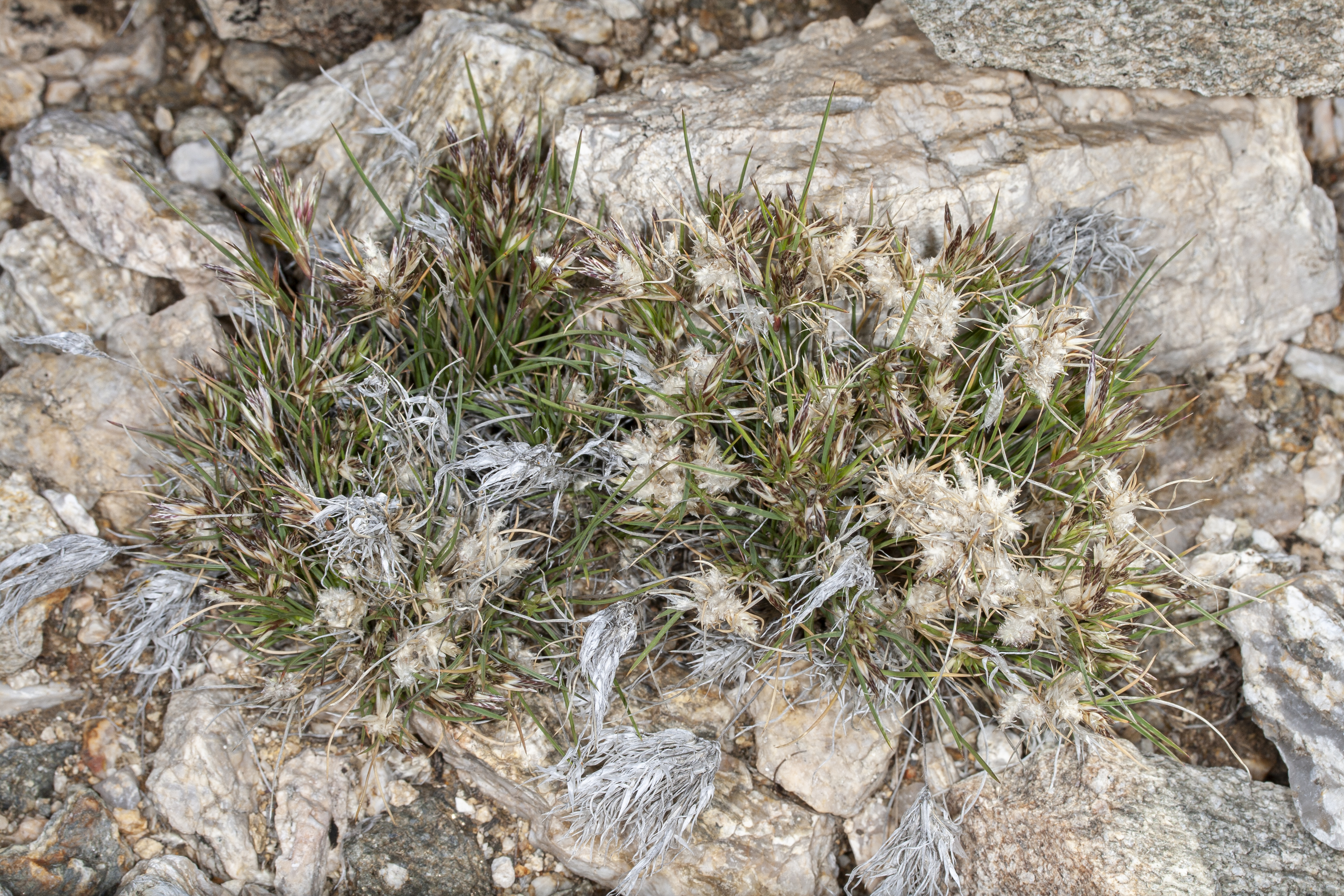
Dasyochloa is a monotypic genus of grass in the family Poaceae, order Poales, containing the single species Dasyochloa pulchella — known as desert fluff-grass or low woollygrass, and formerly classified as Erioneuron pulchellum. The genus was published by Steudel (based on a Willdenow name) in 1840.
It is a densely tufted, perennial bunchgrass, forming small tufts only a few centimeters high with clumps of short, sharp-pointed leaves. The tufts are often enveloped in masses of cottony fibers, which are actually hairlike strands of excreted and evaporated mineral salts rather than true plant hairs. The leaves also produce soft, cobweb-like hairs that dissolve in water following summer rains and are typically absent again by spring. Numerous hairless, wiry stems rise 5 to 13 centimeters (2 to 5 inches) tall, each topped by a hairy inflorescence — a spikelet 6 to 12 cm (2.5 to 4.5 in) long, surrounded by a bundle of bractlike leaves. The pale spikelets are sometimes striped with red, purple, or green, and the plant blooms from February to May.
Dasyochloa is native to the deserts of the southwestern United States, including California, and extends into northern and central Mexico, where it grows in dry, arid habitats characteristic of desert environments.
Distribution
Dasyochloa is native to the Southwestern United States (including California) and northern to central Mexico, occurring in dry desert regions.
Taxonomy Notes
Dasyochloa is a monotypic genus in the family Poaceae (order Poales), published by Steudel (based on a Willdenow manuscript name) in 1840. Its single species, Dasyochloa pulchella, was formerly classified under the genus Erioneuron as Erioneuron pulchellum.










