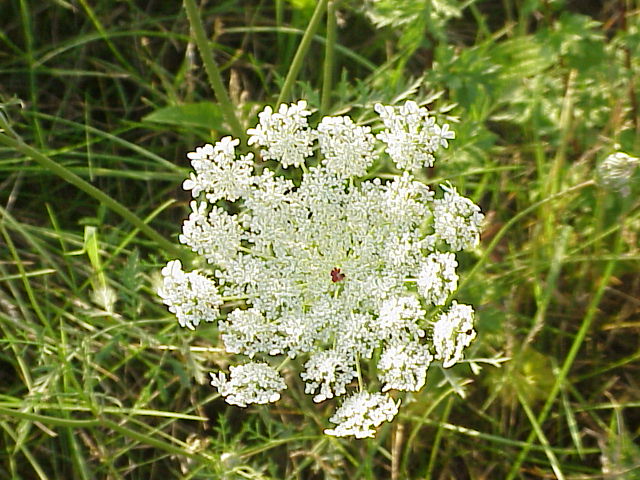
Daucus is a genus of approximately 45 herbaceous flowering plants in the family Apiaceae (the celery or carrot family), placed within the order Apiales. The genus has a worldwide distribution, with its centre of diversity in North Africa and Southwest Asia, and endemic species occurring across most continents, many islands, and isolated areas.
Members of Daucus are characterized by leaves that are 2–3 pinnatisect with narrow terminal segments, and by bristly stems. The genus is predominantly composed of biennial plants, though annual and perennial herbs are also represented. Flowers are borne in compound umbels and are mostly white, though reddish, pinkish, or yellowish petals occur; the outermost flowers in an umbel are often larger than the inner ones. The fruit is an ovoid to ellipsoidal schizocarp bearing primary ribs and secondary ribs armed with rows of hooked spines — an adaptation that aids dispersal via passing animals. Some species produce a small edible taproot resembling a radish.
The best-known member by far is Daucus carota, whose cultivated form (subsp. sativus) is the common garden carrot, one of the world's most important root vegetables. Wild relatives include subsp. carota (wild carrot or Queen Anne's lace) and subsp. gummifer (sea carrot), native to Europe. Fossil evidence of Daucus extends back at least 1.3 million years, with the oldest known carrot fossil recovered from the island of Madeira in the Atlantic Ocean.
Daucus is pollinated by a wide range of insects, including butterflies, beetles, flies, and bees. Some species are adapted to accumulate large stores of carbohydrate in their taproots, a trait that dry or cold seasonal conditions have shaped over evolutionary time.
Etymology
The genus name Daucus derives from the ancient Greek δαῦκος (daukos), a term used by Greek and Roman writers for carrot-like umbellifers. The name was formally adopted by Linnaeus and has been in continuous botanical use since the eighteenth century.
Distribution
Daucus is cosmopolitan, with species native to Europe, North Africa, Southwest Asia, sub-Saharan Africa (e.g. D. abyssinicus), the Americas, and various Atlantic and Mediterranean islands. The genus centre of diversity lies in North Africa and Southwest Asia within the Temperate Zone. Daucus carota subsp. sativus is now cultivated globally, while the wild carrot (D. carota subsp. carota) has naturalized widely outside its European homeland.
Ecology
Daucus species are insect-pollinated, with Lepidoptera, Coleoptera, Diptera, and Hymenoptera recorded as the primary visitors. The genus shows evolutionary adaptability to prolonged dry or cold conditions that retard vegetative growth. Several species invest heavily in underground taproots as carbohydrate storage organs, allowing survival through unfavourable seasons without impeding overall plant development. The hooked spines on the fruit schizocarps facilitate epizoochorous seed dispersal.
Cultivation
Daucus carota subsp. sativus — the garden carrot — is among the most widely cultivated root vegetables in the world, grown for its sweet, starchy taproot in temperate regions globally. Cultivation favours deep, loose, well-drained soils; compacted or stony ground causes forked roots. Carrots are typically grown as annuals from seed, though the plant is botanically biennial. Breeding has produced a wide range of cultivar groups differing in root colour (orange, purple, red, yellow, white), shape, and maturity time. Other Daucus species are not widely cultivated but some, such as D. broteroi, are studied in breeding programmes as wild relatives of the carrot.
History
The carrot (Daucus carota) has been cultivated for at least 1,000 years; early cultivated forms were likely purple or yellow, with the familiar orange carrot developed in the Netherlands during the 17th century through selective breeding. Wild carrots were used medicinally in ancient Greece and Rome — the genus name Daucus appears in the writings of Dioscorides. The oldest physical fossil evidence for the genus dates to 1.3 million years ago, recovered from Madeira.










