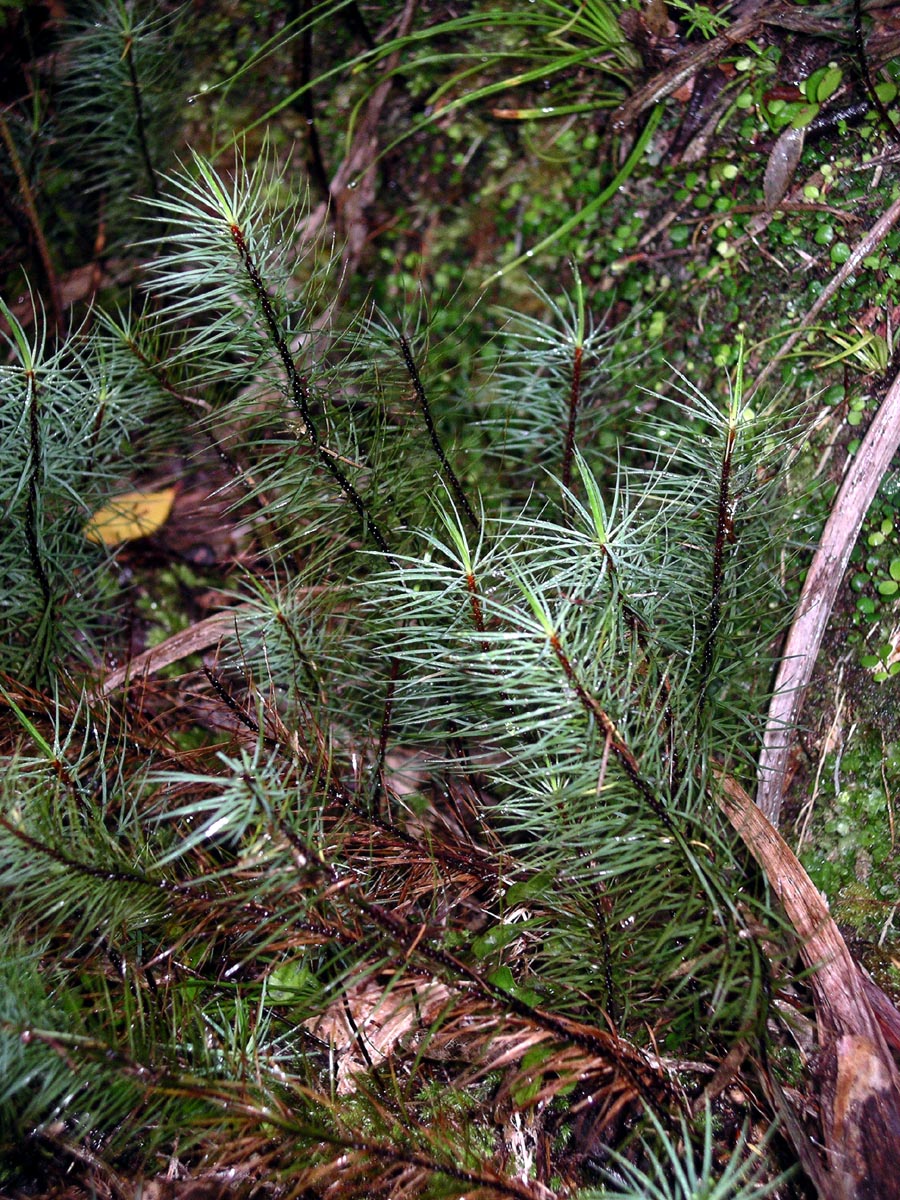
Dawsonia is a genus of mosses in the family Polytrichaceae, order Polytrichales, comprising around 15 accepted species. Like other members of the Polytrichales, Dawsonia species are acrocarpous — growing upright stems with terminal reproductive structures — and are notably taller and more robust than most mosses, whose gametophytes typically lack internal water-conducting tissue and are restricted to a low, sprawling stature.
The stems of Dawsonia contain a specialized conducting system functionally analogous to the xylem and phloem of vascular plants: a water-conducting hydrome built from elongated hydroid cells, and a food-conducting leptome built from leptoid cells resembling sieve cells. Because bryophytes lack lignin, these tissues lack the secondary cell-wall thickening seen in true vascular tissue. The leaves are also unusually thick for a moss, bearing lamellae — upright sheets of photosynthetic cells on the upper leaf surface that increase the surface area available for carbon dioxide uptake while trapping a layer of moist air between them to reduce water loss; a waxy layer on the lamella margins further prevents water from flooding the interlamellar spaces.
The best-known species, Dawsonia superba, is recognized as the tallest moss in the world, with stems reaching up to 50 centimetres. It occurs in New Zealand, Australia, and New Guinea. A second species, D. longifolia, is found in the Philippines, Indonesia, Malaysia, and Australia; the two are similar enough that some authors have questioned whether they are truly distinct species.
The genus was described by Scottish botanist Robert Brown in 1811 and named in honor of Dawson Turner (1775–1858), an English cryptogamist and friend of Brown's.
Etymology
Named by Robert Brown in 1811 in honor of Dawson Turner (1775–1858), an English cryptogamist and friend of Brown's.
Distribution
Dawsonia superba occurs in New Zealand, Australia, and New Guinea, while the closely related D. longifolia is found in the Philippines, Indonesia, Malaysia, and Australia.
Taxonomy Notes
GBIF places the genus in family Polytrichaceae, order Polytrichales, with about 15 accepted species worldwide. Some authors have questioned whether D. superba and D. longifolia — its two most cited species — are truly distinct.










