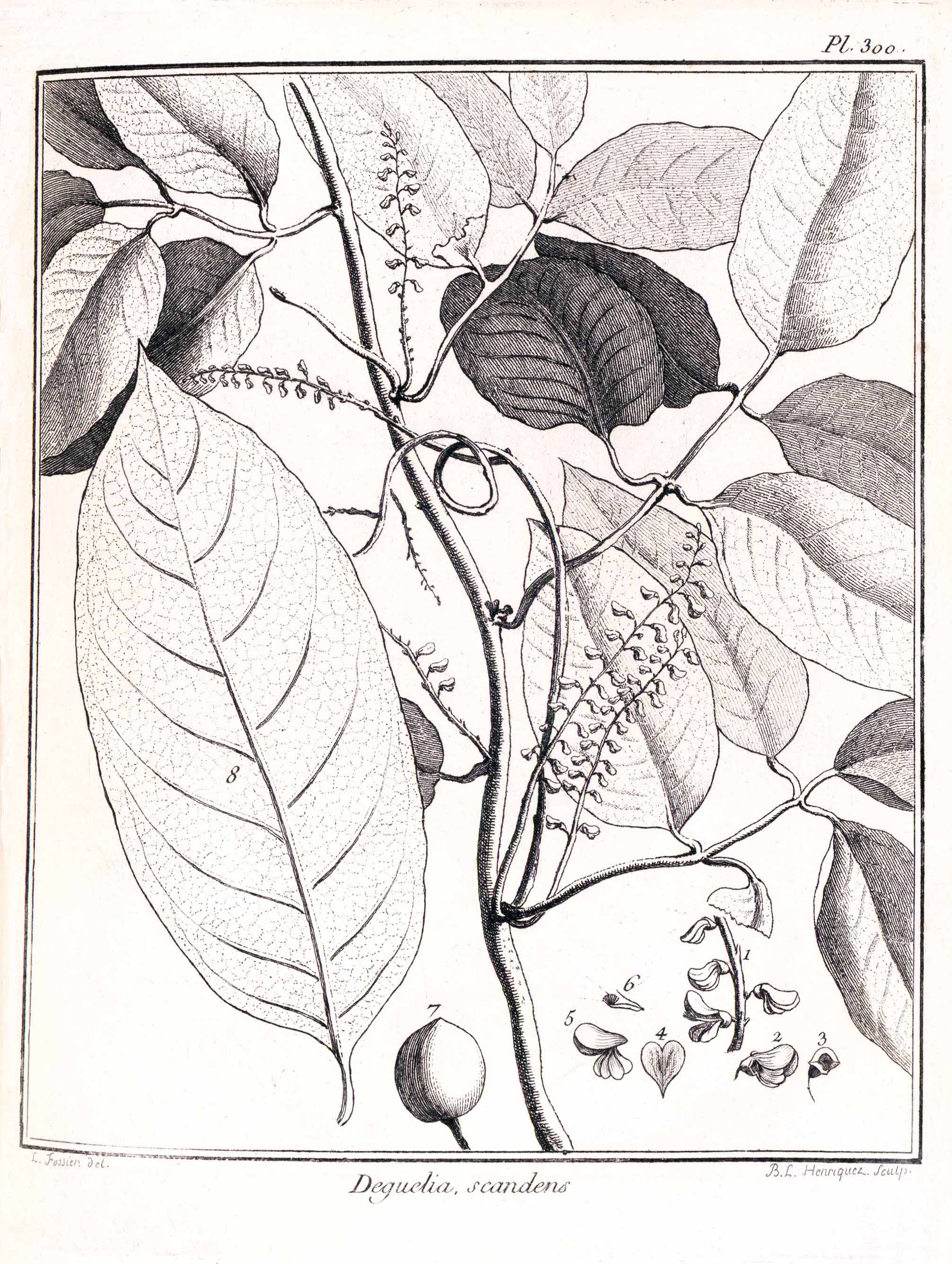
Deguelia is a genus of flowering plants in the pea family, Fabaceae, placed in subfamily Faboideae and order Fabales. It was described by the French botanist Jean Baptiste Christophore Fusée Aublet in 1775 (Histoire des Plantes de la Guiane Françoise, vol. 2, p. 750), with Deguelia scandens as its type species. The genus is native to the tropical Americas, with a range extending from Nicaragua and Costa Rica through Panama, Colombia, Ecuador, Peru, Bolivia, Venezuela, and the Guianas (Guyana, French Guiana, Suriname) to Brazil, including the country's northern, northeastern, west-central, and southeastern regions; occurrences are also recorded from Puerto Rico. Sources differ on species count — Wikipedia's summary states around ten species, while its own species list and GBIF's backbone taxonomy each enumerate roughly twenty to twenty-five accepted names, mostly woody lianas and shrubs.
Deguelia has a tangled taxonomic history: several of its species, including the type species D. scandens, were formerly classified in the related genus Lonchocarpus before being segregated into Deguelia, and older literature and specimen labels still commonly use the Lonchocarpus names.
The genus's best-known member is Deguelia utilis (cubé, lancepod, or barbasco; syn. Lonchocarpus utilis), a shrub native to the tropical forests of Peru, Brazil, and Guyana, typically growing between 100 and 1,800 m elevation. Its roots yield "cubé resin," a commercial insecticide and piscicide (fish poison) whose principal active compounds are rotenone and deguelin — the same class of compound associated with other regional "barbasco" plants such as Deguelia urucu. While naturally derived, rotenone is no longer regarded as environmentally safe, and cubé root or its powdered extract poses an inhalation hazard to humans and other mammals as well as being toxic to insects and fish.
Distribution
Native to the tropical Americas, from Nicaragua and Central America south through the Andes and Amazon basin (Colombia, Ecuador, Peru, Bolivia, Venezuela) and the Guianas to Brazil, reaching as far as southeastern Brazil; also recorded from Puerto Rico.
Taxonomy Notes
Several Deguelia species, including the type species D. scandens, were historically treated under the genus Lonchocarpus (e.g., D. scandens = Lonchocarpus scandens, D. utilis = Lonchocarpus utilis) before being segregated into Deguelia; older sources and specimen labels still frequently use the Lonchocarpus names.
Cultural Uses
Deguelia utilis ("cubé") and the related D. urucu ("barbasco") yield a root extract, cubé resin, used commercially as an insecticide and fish poison (piscicide); its main active compounds, rotenone and deguelin, are toxic to insects and fish and pose an inhalation hazard to humans and other mammals when handled as powdered root or extract.










