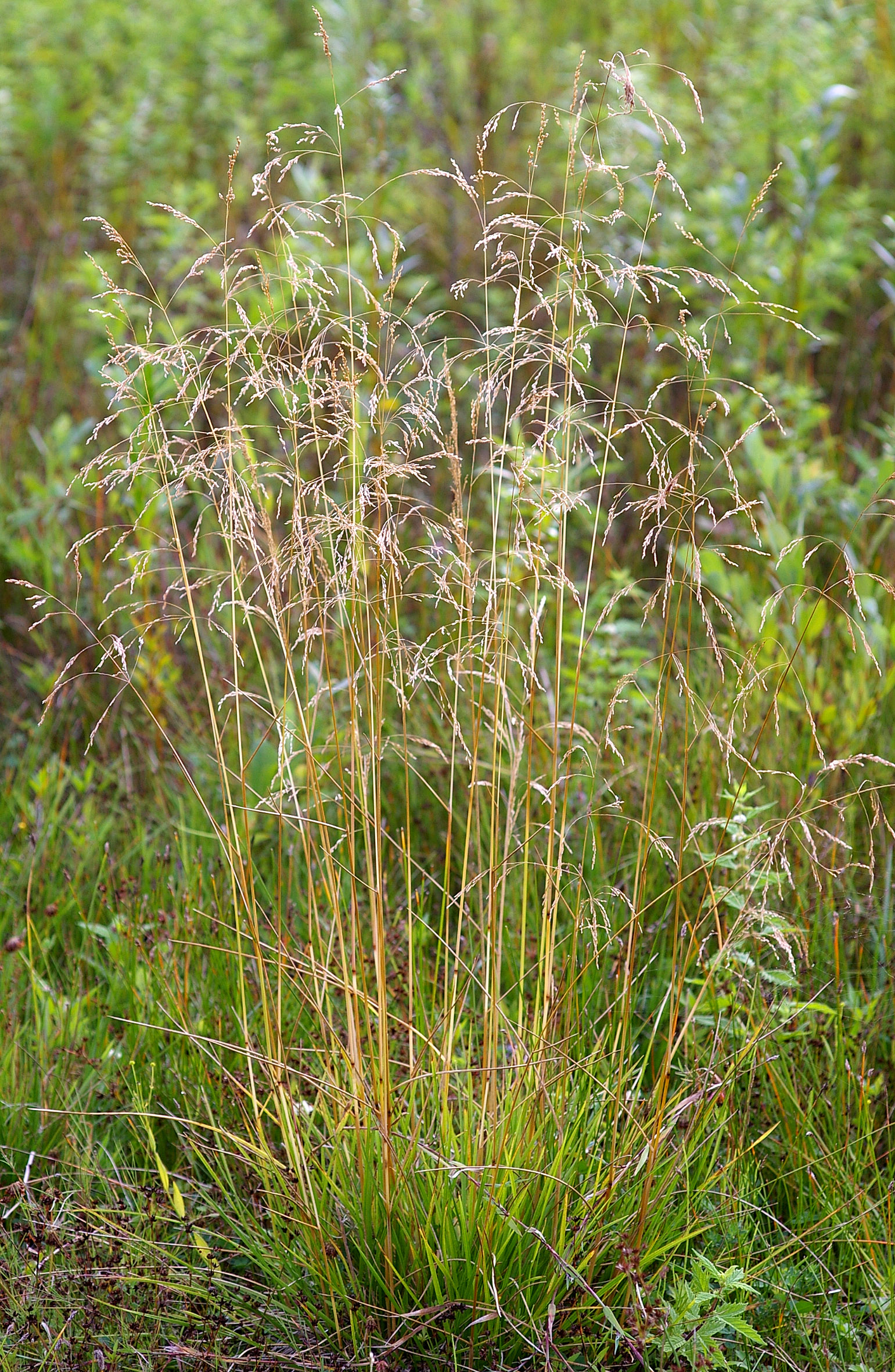
Deschampsia P.Beauv. is a genus of grasses in the family Poaceae (order Poales), commonly known as hair grasses or tussock grasses. It was described by Ambroise Marie François Joseph Palisot de Beauvois in 1812 and named in honour of French physician and naturalist Louis Auguste Deschamps (1765–1842). The genus comprises roughly 30–60 accepted species (GBIF backbone lists 138 descendants including infraspecific taxa), distributed worldwide across temperate, boreal, alpine, and polar environments — from the high Arctic and Antarctic through Europe, Asia, Africa, Hawaii, and the Americas.
Hair grasses are perennial (rarely annual) tufted or mat-forming grasses with narrow, often wiry or bristle-like leaf blades and open or contracted panicles bearing small, shiny, two-flowered spikelets. The name “hair grass” refers to the slender, delicate appearance of the foliage and inflorescence. Many species form dense tussocks and are characteristic of wet, acidic, or nutrient-poor habitats such as bogs, moorlands, wet heathlands, and alpine meadows.
The genus has an exceptional ecological range. Deschampsia antarctica is the world’s most southern monocot and one of only two flowering plants native to Antarctica, thriving on the Antarctic Peninsula and sub-Antarctic islands. In the northern hemisphere, species such as D. cespitosa (tufted hair grass) are common components of wet grasslands, flushes, and woodland rides, while D. flexuosa (wavy hair grass) dominates acidic heathland and upland moorland. Several species occupy highly specific niches: D. nubigena is endemic to Hawaii, and multiple species are restricted to remote archipelagos such as Tristan da Cunha and the Azores.
Deschampsia species serve as larval food plants for numerous moth species, including the antler moth, the clay, dark arches, and common wainscot. Some species, notably D. cespitosa and its cultivars, are cultivated as ornamental grasses valued for their graceful, airy panicles and tolerance of shaded or moist conditions.
Etymology
The genus name Deschampsia honours Louis Auguste Deschamps (1765–1842), a French physician and naturalist. It was formally described by Ambroise Marie François Joseph Palisot de Beauvois in his Essai d’une nouvelle Agrostographie (1812).
Distribution
Deschampsia is a cosmopolitan genus occurring across Arctic, boreal, temperate, alpine, and Antarctic zones on every continent. Notably, D. antarctica is native to the Antarctic Peninsula, sub-Antarctic islands (including the Falkland Islands, South Georgia, Crozet, Heard-McDonald, Kerguelen, and South Sandwich Islands), and is the world’s southernmost monocot. Other species span western North America, the Andes, Europe (including Atlantic archipelagos such as the Azores, Madeira, and Canary Islands), Russia and Siberia, Central Asia, East Africa, and Hawaii.
Ecology
Many Deschampsia species are characteristic of wet, acidic, or infertile soils — bogs, moorland, upland heath, riparian flushes, and alpine meadows. Some species (e.g. D. cespitosa) tolerate waterlogged conditions and are indicators of poorly drained acidic grassland. The genus also plays a role as a larval host plant for numerous moths, including the antler moth (Cerapteryx graminis), dark arches, dusky brocade, common wainscot, and several other noctuid species.
Cultivation
Several Deschampsia species, particularly cultivars of D. cespitosa (tufted hair grass), are cultivated as ornamental grasses. They are valued for their graceful, arching clumps of fine foliage and shimmering panicles that catch the light from early summer into autumn. They perform well in moist to moderately dry soils, tolerate partial shade, and are well-suited to woodland gardens, borders, and naturalistic planting schemes.










