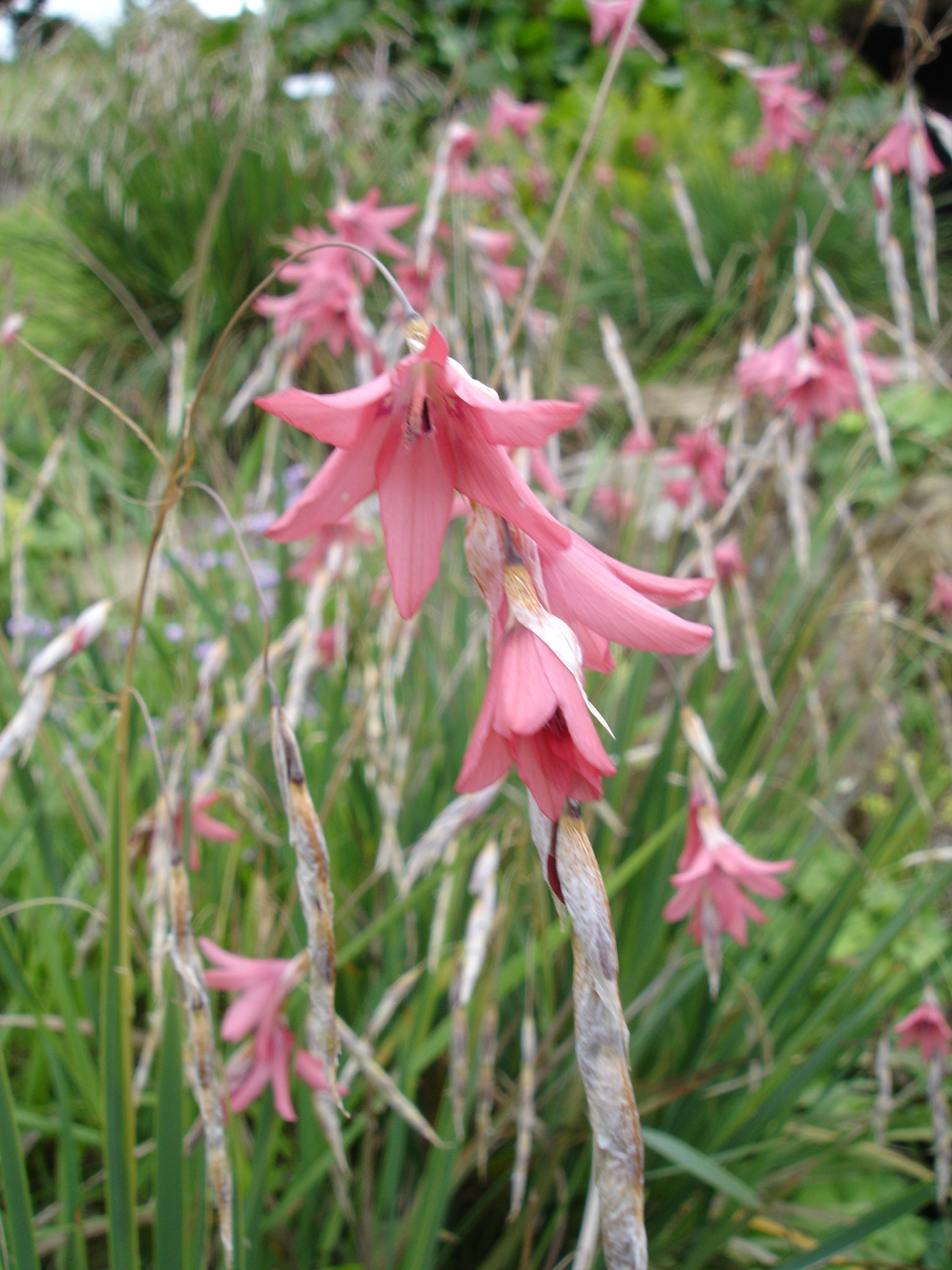
Dierama is a genus of flowering plants in the family Iridaceae, order Asparagales. Species are known by common names such as hairbells, angel's fishing rod, fairybells, and wandflowers in English, and grasklokkies in Afrikaans. The genus is native to Africa, with the great majority of its roughly dozen accepted species occurring in the southern part of the continent; its center of diversity is the KwaZulu-Natal province of eastern South Africa.
Plants in this genus are evergreen perennial herbs that grow from large corms wrapped in fibrous tunics. The lowest two or three leaves are dry, sheathing cataphylls, while the true leaves have linear blades with thick longitudinal veins and often no midrib. The stem is thin and wiry, branching, and characteristically bends or droops under the weight of the flowers. The inflorescence takes the form of a panicle of several flower spikes, which may hang bell-like or stand erect, surrounded by dry, thin, membranous, translucent bracts often streaked or veined with brown. Flowers are bell-shaped and pink in most wild species, though red, purple, yellow, and white-flowered taxa also occur in the wild, and cultivated forms extend the color range further, sometimes with spots of yellow or blue. The fruit is a spherical capsule.
The genus name comes from the Greek word for "funnel," a reference to the funnel-like shape of the flowers. Several species are grown as ornamentals for their arching flower stems, and at least one species has documented traditional uses in southern Africa, including medicinal and ritual applications tied to its corm. Some narrow-endemic species have declined due to habitat loss and are considered endangered, reflecting the genus's concentration in a biodiverse but pressured region of South Africa.
Etymology
The genus name Dierama derives from the Greek word for "funnel," alluding to the funnel-like shape of its flowers.
Distribution
Dierama is native to Africa, with most species found in the southern regions of the continent; the genus's center of diversity is KwaZulu-Natal province in eastern South Africa.
Conservation
Some Dierama species, particularly narrow endemics, are declining due to habitat loss. Three South African natives — D. ambiguum, D. erectum, and D. nixonianum — are considered endangered.
Cultivation
Several species are grown as ornamentals for their arching, bell-flowered stems, such as the purple-pink D. pendulum and the tall, large-flowered D. erectum; many garden cultivars extend the wild color range. D. erectum is prone to attack by the bean weevil Urodon lilii.
Cultural Uses
Certain species have documented traditional uses in southern Africa: D. erectum has been used by the Sotho people as an enema and as a treatment for stomach problems, and its corm serves as a fertility charm believed to bring a good harvest.










