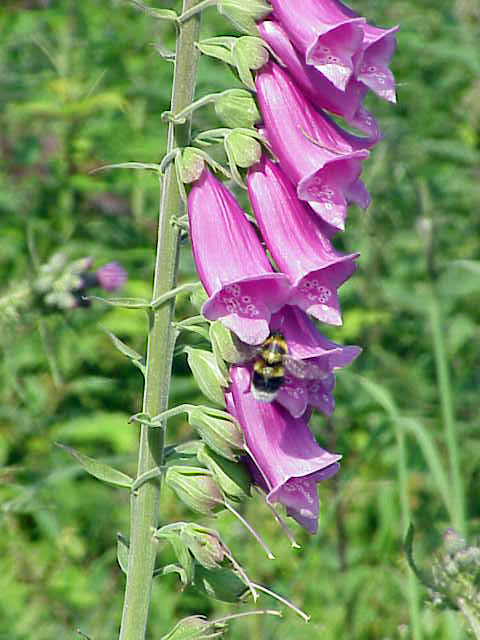
Digitalis is a genus of about twenty to thirty herbaceous flowering plants, known commonly as foxgloves, in the plantain family Plantaginaceae. The genus is native to Europe, western Asia, the Mediterranean basin, northwestern Africa and the Canary Islands. Recent molecular work has reunited the former Macaronesian genus Isoplexis with Digitalis, so the contemporary circumscription includes both temperate European species and several woody Canary-Island endemics; GBIF currently lists around thirty-four accepted species plus a handful of natural hybrids.
Most foxgloves are biennial or short-lived perennial herbs that form a basal rosette of soft, often hairy leaves in their first year, then send up an unbranched flowering spike in their second. Spikes typically reach 45 to 150 centimetres tall and carry one-sided racemes of pendent, tubular to bell-shaped flowers that may be up to about 6.5 centimetres long. Flower colour varies widely between species, from the deep purple-pink and white of the common foxglove to the rusty browns of D. ferruginea, the soft yellows of D. lutea and D. grandiflora, and the dark chocolate-maroon of D. parviflora. The shrubby ex-Isoplexis species from the Canary Islands carry yellow to coppery flowers on woody stems.
The genus name was coined by the German botanist Leonhart Fuchs in 1542 from the Latin digitus, "finger", echoing the German vernacular Fingerhut ("thimble"). Linnaeus formally published the genus in Species Plantarum in 1753. The English common name "foxglove" descends from Old English foxes glofe.
Foxgloves are best known horticulturally as classic cottage-garden and woodland-edge perennials, and pharmaceutically as the source of the cardiac glycosides digitoxin and digoxin, used to treat congestive heart failure and certain cardiac arrhythmias. All parts of the plant — including roots and seeds — contain these glycosides and are toxic if ingested. Their long tubular flowers are pollinated chiefly by long-tongued bumblebees, and the larvae of the foxglove pug moth feed inside the corollas.
Etymology
The genus name Digitalis was coined by Leonhart Fuchs in 1542, from the Latin digitus ("finger"), a Latinisation of the German vernacular name Fingerhut, meaning "thimble" — a reference to the way the tubular corolla fits over a fingertip. Carl Linnaeus adopted Fuchs's name when he formally established the genus in Species Plantarum in 1753. The English common name "foxglove" descends from Old English foxes glofe, and although folk etymology gave rise to stories about foxes wearing the flowers on their paws, those tales appear to be post-hoc inventions rather than the true origin of the word.
Distribution
Digitalis is native to Europe, western Asia, the Mediterranean region, northwestern Africa and the Canary Islands. Its main centres of diversity are the Mediterranean basin and Anatolia, with additional endemic species in the Iberian Peninsula, the Balkans, the Caucasus, Iran and on the Canary Islands (the latter formerly treated as the genus Isoplexis). In central Europe the genus reaches its northern range as a temperate woodland and meadow component; in Switzerland, for example, only four species occur natively or naturalised — D. grandiflora, D. lanata, D. lutea and D. purpurea. Several species, especially D. purpurea, have become widely naturalised outside the native range as garden escapes.
Ecology
Foxgloves grow in woods, grassy clearings, rocky slopes and scrub, reaching altitudes of up to about 2,700 metres in parts of the native range. The long, pendent tubular flowers are adapted for pollination by long-tongued bees, especially bumblebees such as the common carder bee, which crawl into the corolla to reach nectar at its base. Larvae of the foxglove pug moth feed on the flowers of D. purpurea and other species. The plants typically behave as biennials, building a basal rosette in the first season and flowering in the second before setting copious wind- and gravity-dispersed seed.
Cultivation
Foxgloves are popular garden ornamentals and easily grown in ordinary garden soils, particularly those that are moisture-retentive and rich in organic matter. They tolerate a wide range of textures from light sandy through medium loams to heavy clays, on mildly acid to basic pH. Most species prefer semi-shade, but they will thrive in full sun where soil moisture is adequate, and once established they are reasonably drought tolerant. Hardiness is roughly to -15 °C, with species-level ranges spanning USDA zones 3 through 10. Numerous hybrids and cultivars in white, pink, purple, apricot and yellow are widely available for cottage gardens, woodland edges and mixed borders.
Propagation
Digitalis is most often raised from seed. Surface-sow in early spring in a cold frame — the small seeds need light to germinate — with germination usually taking two to four weeks at around 20 °C. Autumn sowing also works well for biennial species, which then flower the following summer. Prick out seedlings into individual pots once they are large enough to handle and plant out into their final positions in summer.
Cultural uses
The most important cultural use of Digitalis is medicinal: the dried leaves of D. purpurea and especially D. lanata are the commercial source of the cardiac glycosides digitoxin and digoxin, drugs that strengthen cardiac contraction and slow the heart rate and are still used to treat congestive heart failure and atrial fibrillation. This pharmaceutical use dates from William Withering's 1785 treatise "An Account of the Foxglove," in which he extracted the active principle from a Shropshire folk remedy and laid down dosing standards for treating dropsy. Beyond medicine, foxgloves are major ornamentals, especially in cottage gardens, woodland gardens and naturalistic perennial borders, where their tall spikes of bell-shaped flowers are valued for vertical accent and for attracting bumblebees.
History
The medicinal history of Digitalis is dominated by the Birmingham physician William Withering, whose 1785 treatise "An Account of the Foxglove and Some of Its Medical Uses" reported a decade of systematic clinical observation in 156 patients with dropsy — a condition now understood largely as oedema from congestive heart failure. By experimenting with different plant parts, harvest seasons and preparations, Withering isolated foxglove as the single active ingredient of a complex Shropshire folk remedy, and laid out the first quantitative dosing recommendations and warnings about toxicity. The active glycoside in D. purpurea was later identified as digitoxin; in the twentieth century digoxin from D. lanata became the dominant therapeutic preparation. Withering's monograph is widely regarded as a foundational text of clinical pharmacology and a key starting point of modern cardiology.
Taxonomy notes
Digitalis L. was published by Linnaeus in Species Plantarum 2: 621 (1753). It was traditionally placed in Scrophulariaceae, but molecular phylogenetics led to its reassignment first to Veronicaceae (2001) and then to the broadly recircumscribed Plantaginaceae, where it sits in the order Lamiales. Bruno Werner's 1965 monograph divided 19 species among five sections, but a 2004 molecular study (Bräuchler, Meimberg, Heubl and colleagues) reorganised those sections and merged the formerly separate Macaronesian genus Isoplexis into Digitalis, bringing the recognised species count to roughly 23 or more. The GBIF backbone currently treats the genus as containing about 34 accepted species plus several recognised nothospecies (D. × purpurea hybrids with D. grandiflora, D. lutea and D. micrantha).
Toxicity
All parts of every Digitalis species — leaves, flowers, stems, roots and seeds — contain cardiac glycosides and are toxic if ingested. Acute "digitalism" presents with gastrointestinal upset (nausea and vomiting), cardiac arrhythmias and neurological effects, classically including xanthopsia, a yellowing of vision sometimes credited as an inspiration for Van Gogh's late palette. The same compounds are the basis for the genus's pharmaceutical value, but the therapeutic window is narrow and unprocessed plant material should never be self-administered.










