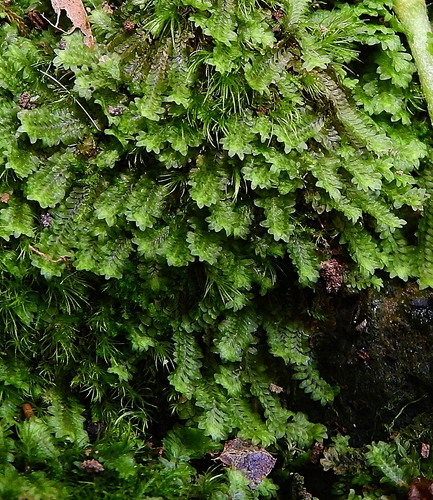
Diplophyllum is a genus of leafy (as opposed to thallose) liverworts in the order Jungermanniales, placed in the family Scapaniaceae — a family that has been broadened to also absorb the former family Lophoziaceae. The genus was established by the Belgian botanist Barthélemy Charles Dumortier, who described it in his 1835 work Recueil d'Observations sur les Jungermanniacées; GBIF records its author citation as "(Dumort.) Dumort.," reflecting that Dumortier both proposed and later validated the name at generic rank.
The genus name is echoed across the vernacular names used for it in different countries, nearly all of which point to the same defining trait: a doubled or folded leaf. German speakers call the group Doppelblattmoose ("double-leaf mosses"), Dutch and Belgian sources use Zaagmos ("saw-moss"), Polish dwupłat ("double-lobe"), and Swedish and Norwegian both use variants of "fold-moss" (veckmossor, foldmoseslekta). This consistent theme across unrelated languages points to a shared, deeply two-lobed leaf shape as the genus's most recognizable feature.
GBIF's backbone taxonomy currently recognizes 36 species-level taxa in Diplophyllum. Occurrence records are heavily concentrated in the temperate Northern Hemisphere — Great Britain, Scandinavia, continental Europe, Russia, and North America top the list of countries with recorded observations — giving the genus a broadly Holarctic distribution, though species such as D. africanum extend its range onto other continents. The best-documented member, Diplophyllum albicans, is described on Wikipedia as native to Eurasia and North America. No dedicated English-language encyclopedia article treats the genus itself in detail; the name currently redirects readers to the Scapaniaceae family page.
Etymology
Vernacular names for Diplophyllum in several European languages — German Doppelblattmoose, Dutch Zaagmos, Polish dwupłat, Swedish veckmossor, Norwegian foldmoseslekta — all reference a doubled or folded leaf, consistent with a genus name built from Greek roots for "double" and "leaf."
Distribution
Occurrence data shows Diplophyllum is recorded most heavily in Great Britain, Scandinavia (Norway, Sweden, Finland), continental Europe (France, Portugal, Belgium), Russia, and North America (United States, Canada) — a broadly Holarctic, temperate-zone pattern. Diplophyllum albicans, its best-known species, is described as native to Eurasia and Northern America.
Taxonomy Notes
Diplophyllum sits in the family Scapaniaceae (order Jungermanniales, class Jungermanniopsida), a family that has been expanded to subsume the former Lophoziaceae. It was authored by Barthélemy Charles Dumortier (1835). No dedicated English Wikipedia article exists for the genus — "Diplophyllum" redirects to the Scapaniaceae family article.










