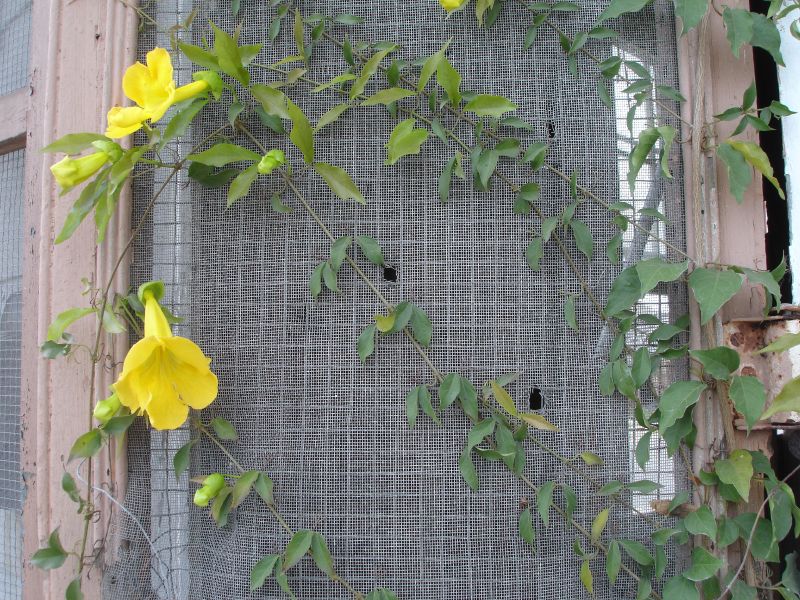
Dolichandra is a genus of flowering plants in the family Bignoniaceae (order Lamiales), comprising a small group of climbing lianas native to Latin America and the Caribbean. Plants in this genus ascend by means of trifid and uncate (hook-tipped) tendrils, which allow them to grip and scale host structures. The genus belongs to tribe Bignonieae, a group of predominantly neotropical lianas within Bignoniaceae, and shares the characteristic trumpet-shaped flowers typical of the family.
The best-known and most widely cultivated member is Dolichandra unguis-cati (cat's claw creeper), an aggressive liana that produces showy yellow flowers and is capable of covering large areas rapidly. Because of its vigorous growth habit, it is considered an invasive species in several regions outside its native range, including parts of Australia, South Africa, and the southeastern United States. Other species in the genus include D. cynanchoides, D. quadrivalvis, D. uncata, D. chodatii, and D. dentata.
Distribution
Dolichandra species are native to Latin America and the Caribbean. D. unguis-cati in particular has been widely introduced beyond this native range and has naturalized in warm-temperate and subtropical regions worldwide, including Australia, South Africa, and the Gulf Coast of the United States.
Ecology
Members of Dolichandra are woody lianas that use trifid, hook-tipped tendrils to climb host trees, shrubs, and structures. Their large, tubular yellow flowers are characteristic of Bignoniaceae and attract pollinators. Dolichandra unguis-cati is noted for its aggressive growth in introduced regions, where it can smother native vegetation and is listed as an invasive weed.

