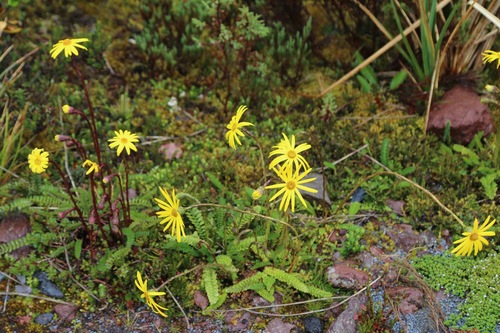
Dorobaea is a small genus of flowering plants in the daisy family, Asteraceae, placed in the order Asterales. The genus was described by the French botanist Alexandre Henri Gabriel de Cassini in 1827, in the Dictionnaire des Sciences Naturelles (vol. 48, p. 453).
According to GBIF's backbone taxonomy, the genus comprises three accepted species: Dorobaea callacallensis, Dorobaea laciniata, and Dorobaea pimpinellifolia. Distribution records associated with the genus in GBIF (sourced from the World Checklist of Vascular Plants) place it in Colombia, Ecuador, and Peru, consistent with a native range in the Andes of western South America.
Beyond its taxonomic placement and native range, little further botanical detail is available from the sources consulted here — the genus lacks a developed general-reference description.
Distribution
Native to the Andes of western South America, with records in Colombia, Ecuador, and Peru per the World Checklist of Vascular Plants (via GBIF).
Taxonomy Notes
Described by Cassini in 1827 in the Dictionnaire des Sciences Naturelles (vol. 48, p. 453). GBIF's backbone taxonomy recognizes 3 accepted species in the genus: D. callacallensis, D. laciniata, and D. pimpinellifolia.










