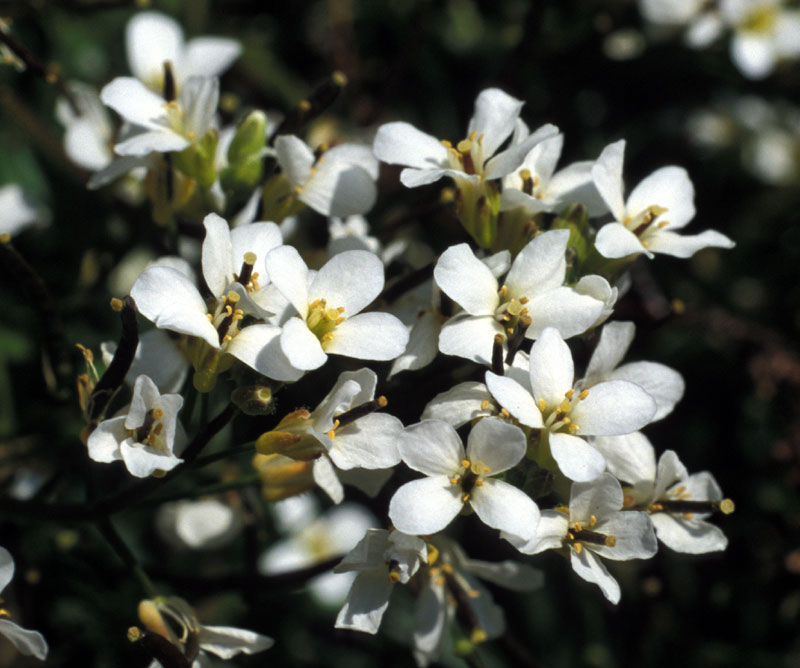
Draba, commonly known as whitlow-grasses, is a large genus of flowering plants in the mustard family (Brassicaceae). Despite the common name, whitlow-grasses are entirely unrelated to true grasses; the name historically referred to their use in treating whitlows (finger infections). The genus was formally described by Dillenius and Linnaeus in 1753, published in Species Plantarum: 642, under the authorship Dill. ex L.
With roughly 433 widely accepted species (and up to 679 taxa including infraspecifics and synonyms in some treatments), Draba is one of the largest genera in Brassicaceae and among the most species-rich in the entire plant kingdom. The genus is especially prominent at high altitudes and high latitudes, with many species adapted to arctic, subarctic, and alpine environments where few other flowering plants can survive. Forms range from minute cushion-forming annuals a few centimetres tall to more robust biennials reaching 30 cm or more.
Whitlow-grasses are recognized by their small four-petalled white or yellow flowers, rosette-forming leaves that are often hairy or toothed, and flattened silicle (seed pod) fruits typical of the mustard family. The genus shows extraordinary ecological diversity: some species colonize bare scree and rock crevices; others grow on limestone pavements, walls, meadows, and disturbed ground.
Draba is distributed on all inhabited continents, with the greatest diversity in arctic and montane regions of the Northern Hemisphere — particularly the Rocky Mountains, the Alps, the Caucasus, and the mountains of Central Asia. The genus also has native representatives in the Andes of South America and in scattered montane habitats of North Africa. Introduced populations have established in parts of the eastern United States, Australia, and New Zealand.
Over two dozen genera have been absorbed into Draba through modern phylogenetic revision, among them Erophila, Eriophila, and Schivereckia. The genus name Draba is ancient, used by Dioscorides for a pungent plant (likely from the Greek drabe, a kind of cress), and was formally adopted by Linnaeus for this genus in 1753.
Etymology
The genus name Draba is ancient and appears in the writings of Dioscorides, who used it (as drabe) for a pungent-tasting cress-like plant. The word is of Greek origin and broadly refers to a sharp or acrid herb, reflecting the characteristic mustard-family bite. Linnaeus adopted the name formally in Species Plantarum (1753). In several European vernacular traditions the genus is associated with poverty or hardship: the German common names Hungerblümchen ("little hunger flower") and the Dutch Hongerbloempje carry the same sense, possibly because the plants flower early in spring when little else is growing and were foraged in lean times. The German Felsenblümchen ("little rock flower") references the alpine and rock-crevice habitats where many species occur.
Distribution
Draba has one of the broadest distributions of any plant genus, occurring natively on every continent except Antarctica. The genus reaches its greatest species richness in the arctic and alpine zones of the Northern Hemisphere: the Rocky Mountains and western cordilleras of North America, the Alps and Carpathians of Europe, the Caucasus, the mountains of Central Asia, and the Altai–Sayan region of Siberia are all major centers of diversity. In Europe, the genus extends from Scandinavia and Iceland south to northwest Africa and the Iberian Peninsula, with twelve species recorded in Switzerland alone. In the Americas, native populations span Alaska through the western United States, across Canada, and south along the Andes into Argentina, Bolivia, Colombia, Ecuador, Peru, and Venezuela. Scattered native occurrences exist in North Africa (Algeria, Tunisia, Libya, Ethiopia) and in circumpolar Arctic territories including Svalbard and Greenland.
Introduced populations have become established in several regions outside the native range. In the United States, Draba nemorosa and related weedy taxa have naturalized across much of the eastern seaboard and Midwest (Alabama, Arkansas, Georgia, Ohio, Pennsylvania, and elsewhere). In the Southern Hemisphere, introduced plants occur in New South Wales, South Australia, Tasmania, Victoria, and New Zealand. Overall, approximately 90% of WCVP distribution records are classified as native, with roughly 10% introduced.
Ecology
Most Draba species are pioneers of disturbed, open, and often nutrient-poor habitats where competition from larger plants is limited. Alpine and arctic species grow in rock crevices, scree slopes, fell-fields, snowbed margins, and frost-heaved soils, sometimes at elevations exceeding 4,000 m. Their small size, early-flowering habit, and tolerance of freeze–thaw cycles are key adaptations to these extreme conditions. In Switzerland, species such as D. aizoides, D. fladnizensis, and D. tomentosa occupy distinct niches from calcareous cliffs to high-alpine turf, as documented by Info Flora distribution and Red List records.
At lower elevations, several species behave as winter annuals or spring ephemerals — germinating in autumn or early spring and completing their life cycles before summer drought or competition sets in. Draba muralis and D. nemorosa typify this strategy, colonizing walls, disturbed ground, and waste places across temperate Europe and Asia. A few species (notably Draba verna / Erophila verna) are weedy and widespread across agricultural and urban habitats in the Old World, and have been introduced to other continents. The genus as a whole tolerates a wide range of soils, including limestone-derived substrates, dry sandy soils, and clay, in sun to partial shade.
Taxonomy
The genus Draba was established by Dillenius and published by Linnaeus in Species Plantarum: 642 (1753), with Draba verna as the type species. The authorship is cited as Dill. ex L. GBIF records it as ACCEPTED at genus rank within Brassicales → Brassicaceae → Magnoliopsida.
Modern molecular phylogenetics has expanded Draba considerably by lumping numerous formerly separate genera into it. GBIF lists 23 synonym genera, including Erophila DC. (spring whitlow-grasses, previously often kept separate), Eriophila Rchb., Schivereckia Andrz. ex DC., Drabopsis K.Koch, Coelonema Maxim., Nesodraba Greene, Pseudobraya Korsh., and Tomostima (Raf.) O.E.Schulz. Wikipedia cites 21 absorbed synonyms. The circumscription of the genus — particularly the question of whether Erophila should remain merged — continues to be discussed by taxonomists, and species counts vary by authority: Wikipedia cites 433 accepted species, while GBIF numDescendants reaches 679 when all infraspecifics and doubtful records are included.
Cultivation
Draba species, particularly the compact alpine and rock-garden forms, are cultivated by alpine plant enthusiasts for troughs, raised beds, and rock gardens. They thrive in gritty, sharply drained soils in full sun, conditions that mimic their natural scree and cliff habitats. According to PFAF data, plants tolerate a wide range of soil textures (sandy, loamy, clay) and pH from mildly acidic to mildly alkaline, and can manage both dry and moist conditions. Most cultivated species are hardy and non-frost-tender.
Draba aizoides (yellow whitlow-grass) is among the most popular for horticultural use, prized for its bright yellow flowers in early spring and tight cushion-forming habit. Other species grown include D. lasiocarpa and various high-alpine cushion types. They are generally low-maintenance once established in appropriate conditions.
Propagation
Propagation from seed is the primary method. PFAF recommends sowing seed in spring directly in situ (in the ground or container where the plant is to grow). For alpine species in cultivation, seed can also be sown in pots of gritty compost and kept in a cold frame over winter, as cold stratification aids germination in many mountain species. Division of clump-forming cushion species is possible after flowering for vegetatively propagated selections.
Uses
Some Draba species have a minor historical record of human use. PFAF notes that the plants contain significant levels of vitamin C and were used as an antiscorbutic — that is, to prevent or treat scurvy — a property shared with many Brassicaceae members. Nutritional analysis cited by PFAF shows notably high calcium (3,310 mg per 100 g dry weight) and potassium (1,780 mg per 100 g) content in at least one species. The edibility of Draba as food is uncertain, and PFAF flags it as questionable. German folk names referencing hunger (Hungerblümchen, Hongerbloempje) suggest the plants may have been foraged in lean spring periods in parts of northern Europe, though documented culinary use is limited.










