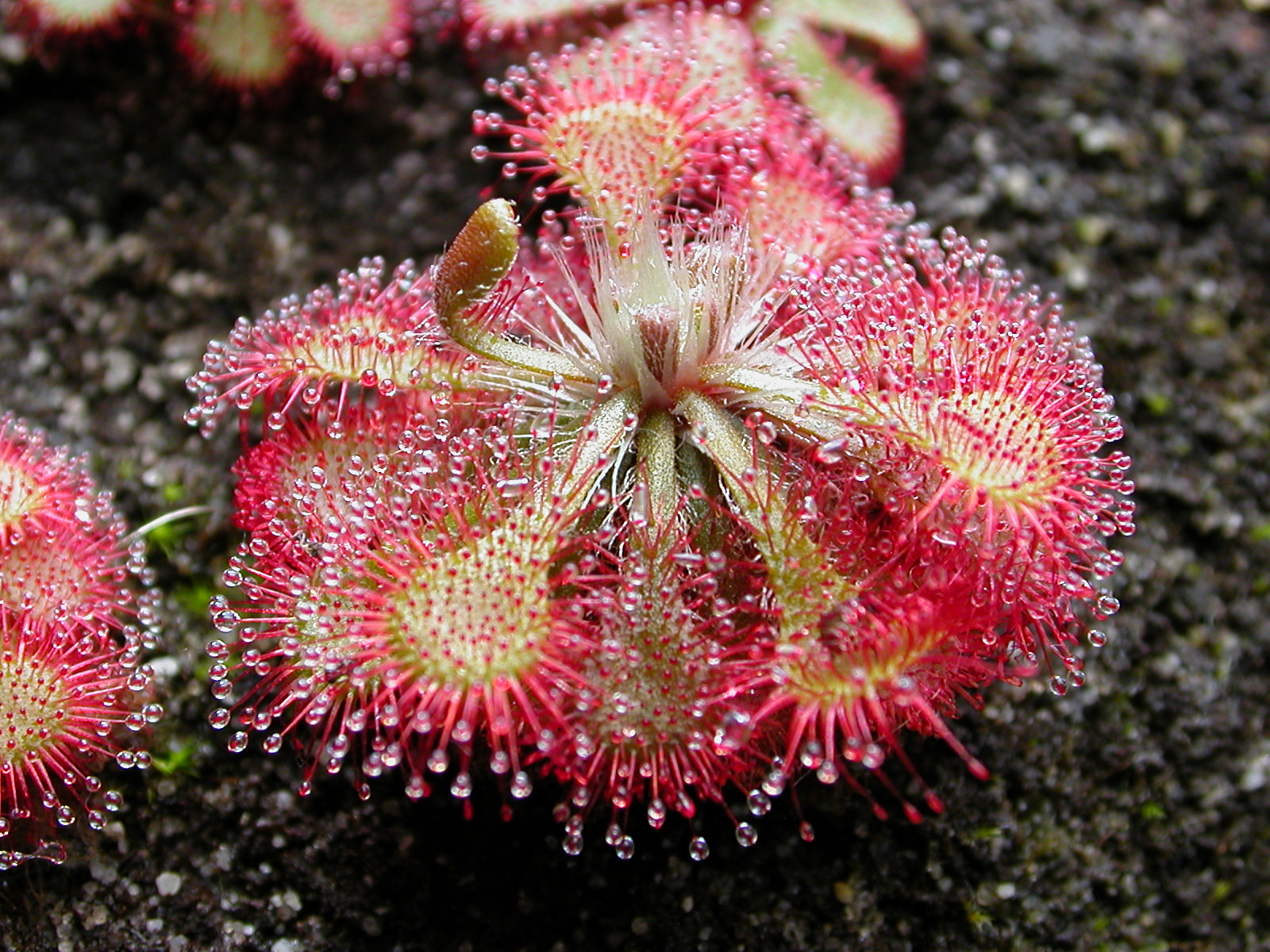
Drosera, commonly known as sundews, is one of the largest genera of carnivorous plants, comprising at least 194 accepted species (with over 350 taxa documented in global checklists) in the family Droseraceae. The genus name derives from the Greek drosos, meaning "dew" or "dewdrops," a reference to the glistening drops of sticky mucilage that tip the glandular hairs covering each leaf. The English name "sundew" echoes this imagery, tracing to the Latin ros solis, "dew of the sun." Carl Linnaeus formally described the genus in Species Plantarum (1753).
Plants are typically perennial herbaceous rosettes ranging from 1 to 100 cm tall, though some climbing Australian species reach 3 m. Leaves are extraordinarily varied — from rounded spoon shapes to forked, linear, or bipinnate forms — and are densely covered with tentacle-like stalked glands. Each gland secretes a viscous mucilage that attracts, ensnares, and digests insect prey. Stalked glands produce digestive enzymes including proteases, esterases, and phosphatases; sessile glands on the leaf surface absorb the resulting nutrient solution. Most species move their tentacles toward trapped prey (thigmonasty), and some, such as D. capensis, curl their entire leaf around prey within minutes. Prey death typically occurs within 15 minutes of initial contact.
Flowers are held on long, erect scapes well above the trapping leaves — an adaptation to avoid ensnaring pollinators. They are radially symmetrical, usually five-petaled, and mostly white to pink, though Australian species may be orange, red, yellow, or metallic violet. Plants are largely self-fertile and produce numerous tiny seeds. Asexual reproduction strategies vary by ecological group: pygmy sundews release gemmae, tuberous species form corms, and other species propagate via leaf, root, or crown cuttings.
Etymology
The genus name Drosera is taken directly from the Greek word drosos, meaning "dew" or "dewdrops," describing the glistening beads of mucilage secreted by the glandular hairs on each leaf. The common English name "sundew" derives from the Medieval Latin ros solis, translating as "dew of the sun" — an allusion to the dewdrop-like appearance of the traps under sunlight. The name herba sole ("herb of the sun") was used by the 12th-century physician Matthaeus Platearius. Other historical vernacular names include "lustwort," reflecting its former reputation as an aphrodisiac.
Distribution
Drosera has a nearly cosmopolitan range, occurring on every continent except Antarctica, from Alaska south to New Zealand and Tierra del Fuego. The center of diversity is Australia, which hosts approximately half of all species; South America and southern Africa each support more than 20 species. Europe has only three native species — D. anglica, D. intermedia, and D. rotundifolia — with two documented natural hybrids. North America supports six species; the southeastern USA is the most species-rich region with eight native taxa. The genus is largely absent from arid zones, the American Pacific Coast, Polynesia, the Mediterranean basin, and North Africa. The prevailing hypothesis holds that the genus originated in Africa or Australia and spread via long-distance dispersal rather than continental drift.
Taxonomy
Drosera belongs to the family Droseraceae within the order Caryophyllales and was first published by Linnaeus in Species Plantarum (1753, page 281). GBIF recognizes 358 descendant taxa under this usage key, while accepted-species counts range from at least 194 to over 250 depending on the checklist. The genus is divided into several subgenera reflecting major ecological and morphological groups: Drosera (temperate and subtropical rosette species), Ergaleium (tuberous sundews, endemic to Australia), Bryastrum (pygmy sundews, also Australian), and smaller subgenera including Phycopsis, Coelophylla, Lasiocephala, Meristocaulis, Regiae, and Stelogyne. Phylogenetic relationships between Drosera and its carnivorous relatives Aldrovanda (waterwheel plant) and Dionaea (Venus flytrap) remain a subject of active research.
Ecology
Sundews are obligate inhabitants of nutrient-poor, wet, acidic environments. Typical habitats include bogs, fens, swamps, marshes, Venezuelan tepuis, Australian wallums, and South African fynbos. They frequently co-occur with sphagnum moss, which acidifies the substrate and further depletes mineral nutrients — conditions that give carnivorous plants a competitive advantage over non-carnivores. Most species require full sunlight and consistently moist to waterlogged substrate, though some have colonized atypical habitats including rainforests and semi-arid areas. Root systems are typically weakly developed, serving primarily for anchorage and water uptake rather than nutrient absorption. Temperate species survive winter by forming compact hibernacula; tuberous species form underground corms to endure dry Australian summers; pygmy sundews produce gemmae during unfavorable seasons. Some species form arbuscular mycorrhizae.
Cultivation
Sundews are popular ornamental plants, prized for their glistening, insect-trapping leaves. The most forgiving species for cultivation include D. capensis (Cape sundew), D. aliciae, and D. spatulata, all of which tolerate a range of indoor conditions. All sundews share a core set of requirements: they must be watered exclusively with pure water (distilled, reverse osmosis, or collected rainwater — tap water is harmful due to dissolved minerals); the substrate must remain consistently moist to saturated; and fertilizers must never be applied, as nutrient-rich conditions suppress the carnivorous mechanism and can kill the plant. The preferred growing medium is a nutrient-poor mix of sphagnum moss, peat, and coarse sand or perlite. Most species thrive in full sun to partial shade. Temperate species require a cool winter dormancy period; tuberous species from Australia need a warm dry summer rest followed by cool moist conditions for growth.
Propagation
Most Drosera species are self-fertile and produce abundant seed. Temperate species' seeds require a period of cold, moist stratification before germination; tuberous species from Australia require exposure to a hot dry summer period followed by cool moist conditions. Vegetative propagation methods vary by ecological group: leaf pullings or leaf cuttings are effective for many species; root cuttings work for D. adelae, D. hamiltonii, and others; pygmy sundews naturally produce gemmae from the center of the rosette that can be collected and sown; tuberous species produce corm offsets; and some species spread via stolons or by rooting of older leaves. Division of established clumps is also practiced in cultivation.
Conservation
Drosera species face conservation pressure across their global range. In the United States there is no federal protection, though many state-level listings exist; most populations persist on protected wetland reserves. In Europe, sundews are legally protected in Germany, Austria, Switzerland, the Czech Republic, Finland, Hungary, France, and Bulgaria, reflecting the critical loss of bog habitats to drainage and peat extraction. Switzerland's Info Flora documents Red List assessments for all four nationally occurring taxa. Drosera madagascariensis is under severe pressure from commercial wild harvest — between 10 and 200 million plants are extracted annually for the herbal medicine trade. At the global scale, D. insolita and D. katangensis are classified as Critically Endangered and D. bequaertii as Vulnerable. Primary threats across the genus are habitat destruction, wetland drainage, peat harvesting, illegal collection for horticulture, and increasing drought frequency linked to climate change.
Cultural Uses
Drosera has a long history of human use across multiple cultures. Indigenous Australians have long consumed the starchy corms of tuberous sundews as food. In the Scottish Highlands, D. rotundifolia was traditionally used to produce purple and yellow textile dyes. A sundew liqueur is prepared from the fresh leaves of D. capensis, D. spatulata, and D. rotundifolia. Medicinal applications stretch back to at least the 12th century, when Matthaeus Platearius prescribed it as herba sole for respiratory ailments. By the 19th and early 20th centuries, European herbalists used sundew preparations — mainly D. rotundifolia, D. intermedia, D. anglica, and D. madagascariensis — for bronchitis, whooping cough, asthma, and tuberculosis. The French Pharmacopoeia retained sundew in its 1965 edition. Folk applications included treatment of warts, corns, and freckles. The Zafimaniry people of Madagascar use D. madagascariensis for dysentery and fever. Contemporary research into sundew mucilage has revealed potential biomedical applications in tissue engineering and wound care, owing to the mucilage's elasticity and nanofibre content.
History
The scientific study of Drosera was transformed by Charles Darwin, who conducted extensive experiments on D. rotundifolia in the 1860s and 1870s, ultimately confirming the reality of plant carnivory. His enthusiasm was legendary: in 1860 he wrote that he cared "more about Drosera than the origin of all the species in the world." Darwin's findings were published in his 1875 monograph Insectivorous Plants. The genus had been part of the pharmacopoeial tradition long before Darwin — European use as a cough remedy is documented from the 12th century onward — but Darwin's work established it as a key subject in plant biology. Linnaeus originally described the genus in Species Plantarum (1753), and it has remained a focus of intense botanical interest, particularly regarding the evolution of carnivory and its phylogenetic position within Caryophyllales.










