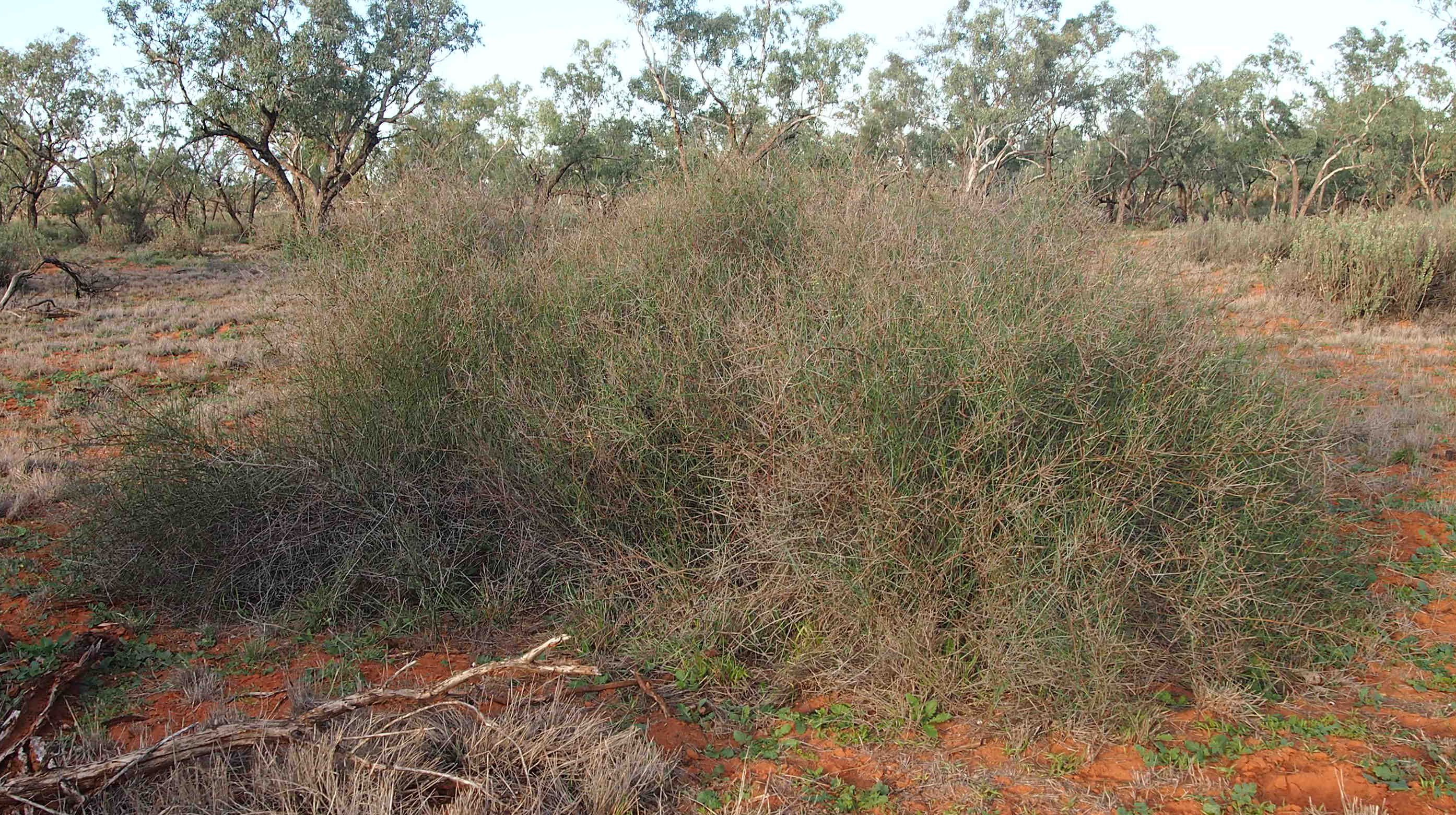
Duma is a small genus of shrubby flowering plants in the family Polygonaceae (subfamily Polygonoideae, tribe Polygoneae), comprising three accepted species native to Australia. The genus was described by botanist Tanja M. Schuster in 2011, after molecular phylogenetic studies showed that several species long placed in the related genus Muehlenbeckia in fact formed a distinct evolutionary lineage. Within the tribe Polygoneae, Duma is most closely allied with the genera Atraphaxis and Polygonum — together forming what researchers have called the "DAP clade" — and is notably less closely related to Muehlenbeckia, the genus it was carved out of.
Species of Duma are rigid, much-branched shrubs whose numerous flexible stems terminate in thorn-like tips, giving the plants a tangled, spiny habit that is echoed in the genus name itself, derived from the Latin for "thorn-bush." The bark is whitish to greyish, and the leaves are longer than broad, each tipped with a small curved spine. Flowers are borne without stalks, and plants are dioecious, with separate male and female individuals: staminate flowers carry eight stamens and a rudimentary or absent pistil, while pistillate flowers bear staminodes in place of stamens. The fruit is a smooth, shiny, ovoid or three-angled achene.
Three species are currently accepted in the genus — Duma coccoloboides, Duma florulenta, and Duma horrida — all of which were formerly classified as species of Muehlenbeckia. Duma florulenta, commonly known as tangled lignum or simply lignum, is by far the best-known member of the genus, forming extensive shrublands across floodplains and wetlands of inland Australia.
GBIF places Duma within the order Caryophyllales, alongside the broader buckwheat and knotweed family Polygonaceae. Distribution records for the young genus (erected only in 2011) are still being reconciled across databases: while both Wikipedia and most checklist records confine Duma to Australia (New South Wales, Northern Territory, Queensland, South Australia, Victoria, and Western Australia), at least one source checklist also lists Central Asian localities that appear to be an anomaly rather than a genuine part of the genus's range.
Etymology
The genus name Duma derives from the Latin word for "thorn-bush," a reference to the thorn-tipped branches shared by all species in the genus.
Distribution
Duma is native to Australia. GBIF's underlying checklist data records the genus across New South Wales, the Northern Territory, Queensland, South Australia, Victoria, and Western Australia; the same source also lists Tadzhikistan and Uzbekistan, which conflicts with Wikipedia's account of an Australia-only native range and appears to be a data anomaly.
Taxonomy Notes
Duma was described by Tanja M. Schuster in 2011 to accommodate a group of species previously placed in Muehlenbeckia but shown by molecular phylogenetics to form a separate clade. Within the tribe Polygoneae, Duma groups most closely with Atraphaxis and Polygonum (the "DAP clade") rather than with Muehlenbeckia. Three species are currently accepted: Duma coccoloboides, Duma florulenta, and Duma horrida, each with a corresponding Muehlenbeckia synonym.










