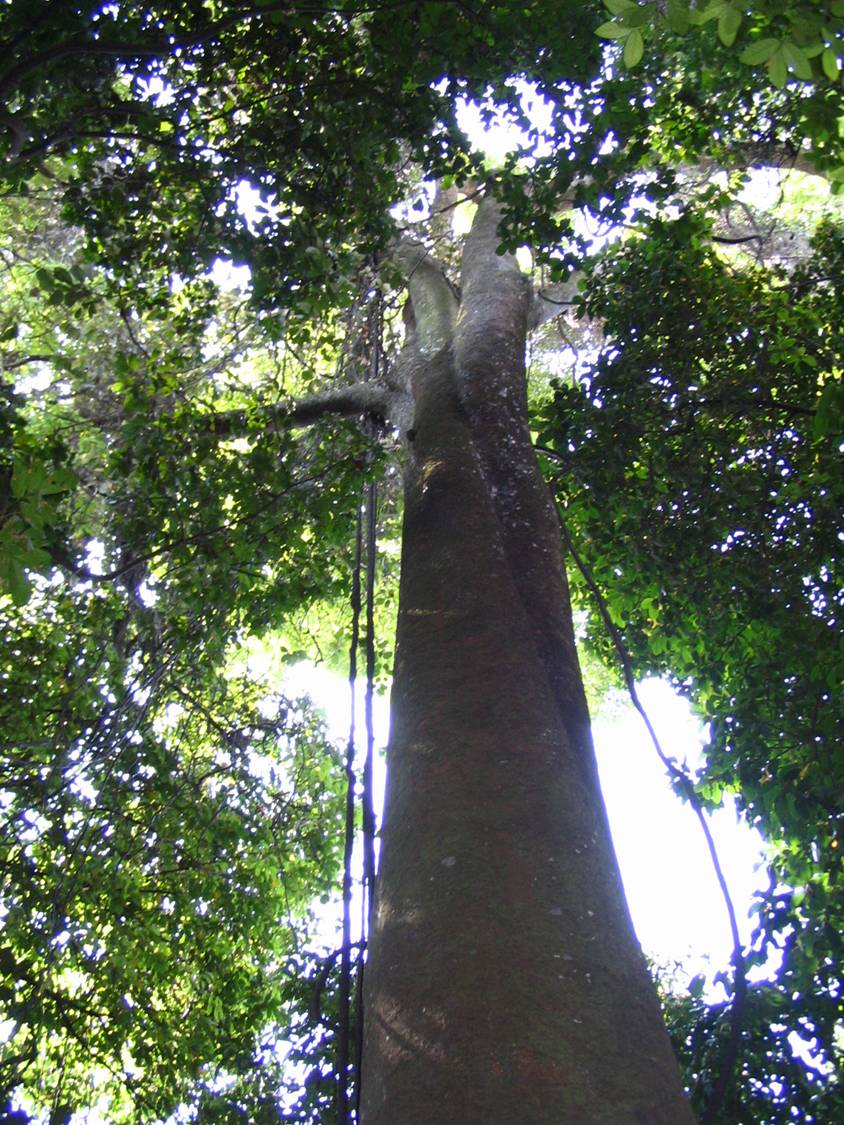
Dyera is a genus of large tropical trees in the dogbane family (Apocynaceae), placed in the order Gentianales. It was first described in 1882 by the British botanist Joseph Dalton Hooker. The genus is native to Southeast Asia and comprises two accepted species, Dyera costulata and Dyera polyphylla, distributed across Peninsular Malaysia, Thailand, Borneo, and Sumatra.
Species in the genus are among the tallest trees of the Southeast Asian lowland rainforest canopy, reaching 60 m and exceptionally up to 80 m in height, with trunk diameters up to 2-3 m and clear, straight boles rising 30 m before branching. Like other Apocynaceae, Dyera trees produce a milky latex.
The best-known member of the genus, Dyera costulata, commonly called jelutong, has long been economically important. From the 1920s through the 1960s its tapped latex was a major source of chewing gum, and the timber - a lightweight hardwood with properties similar to balsa - is still harvested commercially. Its straight grain and fine, workable texture make it popular with model makers and in patternmaking, while its roots have been used as a cork substitute. This history of tapping and logging has led to overharvesting, and jelutong is now considered threatened in parts of its range, with protected status in sections of Malaysia and Thailand.
Distribution
The genus is native to Southeast Asia. Dyera costulata occurs in Thailand, Peninsular Malaysia, Borneo, and Sumatra, while Dyera polyphylla is found in Borneo and Sumatra.
Taxonomy Notes
Dyera Hook.f. was described in 1882 (J. Linn. Soc. 19: 293) and placed in family Apocynaceae, order Gentianales. The genus holds two accepted species: Dyera costulata and Dyera polyphylla.
Ecology
Dyera trees grow in scattered locales of low-elevation tropical evergreen forest, reaching the upper canopy at heights up to 80 m with long, clear, straight trunks.
Cultural Uses
Jelutong (Dyera costulata) latex was tapped commercially and, from the 1920s through the 1960s, was an important source of chewing gum. The tree is also grown commercially for its timber, a lightweight hardwood comparable to balsa that is popular with model makers and in patternmaking; its roots have historically been used as a cork substitute.
Conservation
Traditional overharvesting of jelutong latex and timber has left the species threatened in many areas, and it is now a protected species in parts of Malaysia and Thailand.










