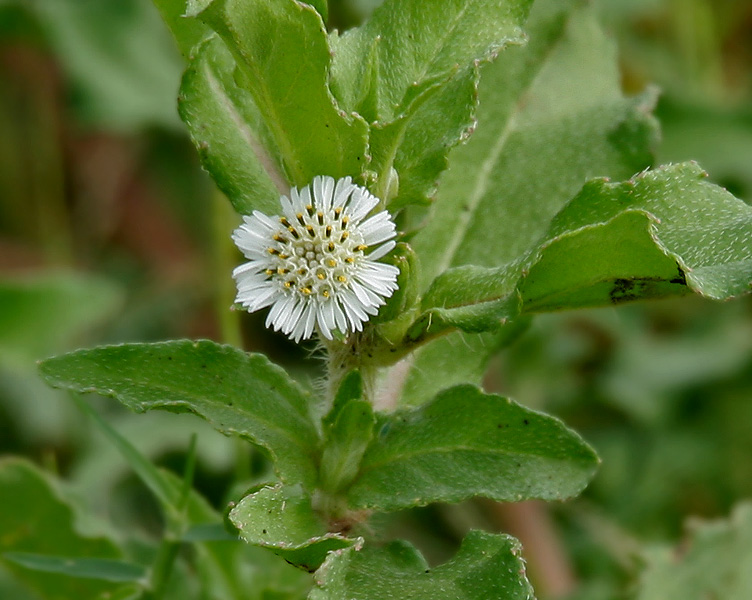
Eclipta L. is a small genus of flowering plants in the daisy family, Asteraceae (order Asterales). It was published by Linnaeus in 1771 (Mantissa Plantarum 2: 157), and the GBIF backbone taxonomy currently lists 29 taxa under the name.
Wikipedia's species overview names about nine species spread across a broad range of warm regions: E. alatocarpa in Queensland, the Northern Territory, and South Australia; E. angustata, native to Nepal and Bengal but widely naturalized across China, the Ryukyu Islands, Southeast Asia, and northern India; E. elliptica and E. megapotamica in southern Brazil, Uruguay, and northeastern Argentina; E. leiocarpa in Colombia; E. paludicola in southern Brazil; E. platyglossa in Australia; and E. pusilla in Puerto Rico.
The genus's best-known and most widespread member is Eclipta prostrata, commonly called false daisy. It is a small herb with cylindrical, grayish roots and solid, circular, purplish stems bearing fine white hairs, growing to roughly 0.8 m. Its leaves are arranged in opposite pairs, hairy on both sides, lanceolate, and serrated. Solitary flower heads 6–8 mm across carry white florets, followed by bumpy, compressed, narrowly winged achenes. It is native to North and South America and now grows commonly in moist habitats — marsh edges, lake shores, river banks, brackish marshes, and cypress-depression swamps — throughout warm temperate to tropical regions worldwide, having naturalized across Europe, Africa, and the Pacific Islands as well as much of Asia and Australia.
Eclipta prostrata (and the related white-flowered E. alba) carry long-standing traditional significance, particularly in South and Southeast Asia. In India the plant is known as bhangra or bhringaraj and holds a place in Ayurvedic tradition; in Bali it is cooked as a vegetable, and in Java it is eaten as part of lalap and was historically infused with coconut oil as a hair treatment. Its leaves have also been used as a black hair dye and in tattooing. Chemically, the plant contains coumestans, polypeptides, polyacetylenes, thiophene derivatives, steroids, sterols, triterpenes, and flavonoids, though rigorous clinical evidence for its traditional medicinal uses is lacking.
Distribution
Species of Eclipta occur across a wide range of warm regions worldwide, from Australia (E. alatocarpa, E. platyglossa) and South America (E. elliptica, E. leiocarpa, E. megapotamica, E. paludicola) to South and East Asia (E. angustata). The most widespread species, E. prostrata, is native to North and South America and has naturalized across Europe, Africa, Asia, Australia, and the Pacific Islands, favoring moist, warm-temperate to tropical habitats.
Ecology
Eclipta prostrata, the genus's most widespread member, grows in consistently moist habitats such as marsh edges, lake shores, river banks, brackish marshes, and cypress-depression swamps, across warm temperate to tropical climates.
Cultural Uses
Eclipta prostrata (bhangra/bhringaraj) has a long history of traditional use in South and Southeast Asia. In India it holds a place in Ayurvedic medicine; in Southeast Asia the dried whole plant appears in traditional medicine, though clinical evidence for efficacy is lacking. It is eaten as a vegetable in Bali and as part of Javanese lalap, and was historically infused with coconut oil as a popular hair treatment until the 1970s. Its leaves have also served as a black hair dye and in tattooing.
Taxonomy Notes
The genus Eclipta was published by Linnaeus in 1771 and sits in the daisy family, Asteraceae, order Asterales; GBIF's backbone taxonomy currently records 29 taxa under the name. Common names create some cross-genus confusion: the white-flowered Eclipta alba is called "white bhangra," while the similarly named but unrelated yellow-flowered Wedelia calendulacea is called "yellow bhangra" — the two genera share vernacular names despite being taxonomically distinct.










