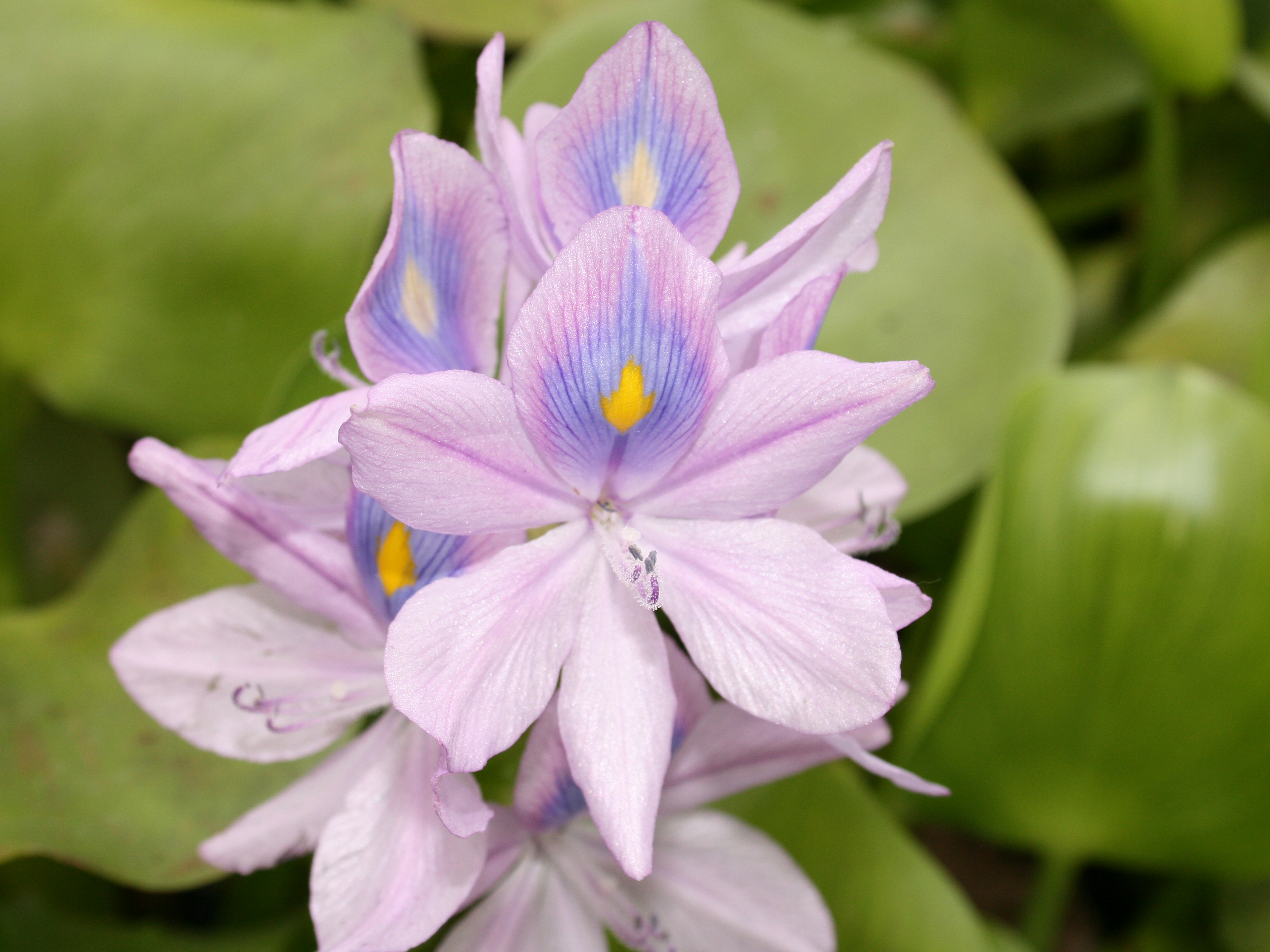
Eichhornia Kunth (1843) is a genus of perennial aquatic flowering plants — commonly known as water hyacinths — in the family Pontederiaceae, order Commelinales. Its species are hydrophytes with prostrate, densely branched stems that float or root in shallow water, producing inflorescences of one to 30 conspicuous flowers, mostly lavender to pink and rarely white.
Molecular phylogenetic study found Eichhornia to be polyphyletic: its species fall into three separate lineages nested within the related genus Pontederia rather than forming a natural group of their own. As a result, taxonomic authorities including GBIF's backbone taxonomy now treat Eichhornia as a synonym of Pontederia L., with its former species redistributed across three Pontederia subgenera — Cabanisia (including P. paniculata, the Brazilian water hyacinth), Oshunae (including P. crassipes, the common water hyacinth), and Eichhornia (including P. azurea, P. diversifolia, P. heterosperma, and P. natans).
Geographically the group is pantropical and centered in South America; P. natans is the exception, endemic to continental Africa and Madagascar rather than the Neotropics. The genus name honours Friedrich Eichhorn, an early-19th-century Prussian minister of education.
The best-known member by far is the common water hyacinth (Eichhornia/Pontederia crassipes), a free-floating species notorious worldwide as one of the most aggressive invasive aquatic weeds, capable of forming dense mats that choke waterways, block light and oxygen exchange, and disrupt native aquatic ecosystems.
Etymology
Named in honour of Friedrich Eichhorn, an early-19th-century Prussian minister of education.
Distribution
Pantropical, centered in South America. Three of its four former "true" Eichhornia species are restricted to the Neotropics, while P. natans is endemic to continental Africa and Madagascar. Other former Eichhornia species (now in subgenera Cabanisia and Oshunae, including the widespread invasive P. crassipes) extend the group's effective range worldwide through introduction.
Taxonomy Notes
Eichhornia Kunth was found to be polyphyletic — its species recovered in three independent lineages rather than a single natural group — and has consequently been sunk into Pontederia, with each lineage recognized as a Pontederia subgenus (Cabanisia, Oshunae, and Eichhornia). GBIF's backbone taxonomy accordingly lists Eichhornia as a synonym of the accepted genus Pontederia L.










