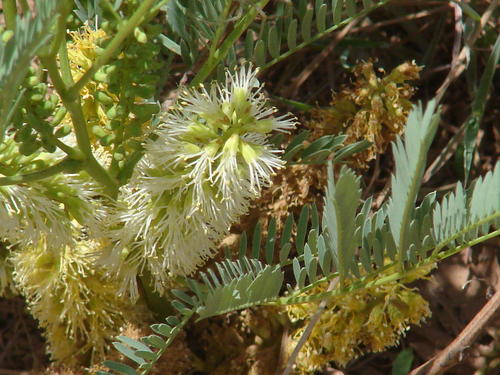
Elephantorrhiza is a small genus of leguminous plants in the family Fabaceae (order Fabales), placed in the mimosoid alliance historically classified under the subfamily Mimosoideae. The genus was published in 1841 by the botanist George Bentham, who erected it for a plant first collected by William Burchell in the South African interior and originally described as Acacia elephantina. The name Elephantorrhiza is a Greek compound meaning "elephant root," referring to the large, woody underground rootstock of the type species, E. elephantina.
Elephantorrhiza is an exclusively African genus, occurring across almost all major biomes south of the equator, with member species recorded from Angola, Namibia, Botswana, Zimbabwe, Mozambique, Swaziland, Lesotho and several South African provinces. Sources describe it as comprising roughly eight or nine species with additional infraspecific taxa. Its closest relative is the pantropical genus Entada (which includes the buoyant-seeded Snuff Box Sea Bean, Entada rheedii); together the two form what has been called the "Entada-group" within the Mimosoideae. Reflecting how close that relationship is, current treatments by English Wikipedia and iNaturalist no longer maintain Elephantorrhiza as a separate name, instead folding its species into Entada — a revision that conflicts with the GBIF backbone taxonomy, which still lists Elephantorrhiza as an accepted, distinct genus.
Morphologically the best-documented member, E. elephantina, exemplifies a distinctive "underground tree" (suffrutescent) growth form: a large, long-lived woody rootstock lies beneath the soil while only short, unbranched, unarmed aerial stems (to about 0.9 m) emerge each growing season, an adaptation to the frost and periodic fire common across its Highveld and savanna range. Leaves are bipinnately compound; flowers are borne in axillary racemes of golden-yellow to pale yellowish-white blooms near ground level, pollinated chiefly by the African honeybee (Apis mellifera). Fruits are compressed, dark reddish-brown pods containing dark, ellipsoid seeds.
Etymology
The name Elephantorrhiza comes from Greek, meaning "elephant root," a reference to the large underground rootstock of the type species, E. elephantina.
Distribution
Elephantorrhiza is an exclusively African genus found across southern Africa, including Angola, Namibia, Botswana, Zimbabwe, Mozambique, Swaziland, Lesotho and multiple South African provinces, occupying habitats across almost all major biomes south of the equator.
Ecology
Flowers are pollinated mainly by the African honeybee (Apis mellifera), offering pollen as the only reward. Several species show a suffrutescent, "underground tree" growth habit — a persistent woody underground rootstock topped by short-lived aerial stems — thought to be an adaptation to recurring frost and fire.
History
The genus was published in 1841 by George Bentham, founded on a plant first collected by William Burchell and originally described as Acacia elephantina before earlier authors had also placed it in Prosopis.
Taxonomy Notes
Elephantorrhiza's closest relative is Entada, together forming the "Entada-group" within the Mimosoideae. Current treatments differ on whether Elephantorrhiza remains distinct: GBIF's backbone taxonomy still lists it as an accepted genus, while English Wikipedia (which redirects "Elephantorrhiza" to "Entada") and iNaturalist (which files its species under Entada, e.g. Entada elephantina) treat it as merged into Entada.
Cultural Uses
Documented chiefly for the type species, E. elephantina: its roots have long been used for tanning leather, and in Xhosa and Zulu traditional medicine for ailments including dysentery, diarrhoea, bleeding and heart complaints; roasted seeds have served as a coffee substitute, though raw seeds are toxic.










