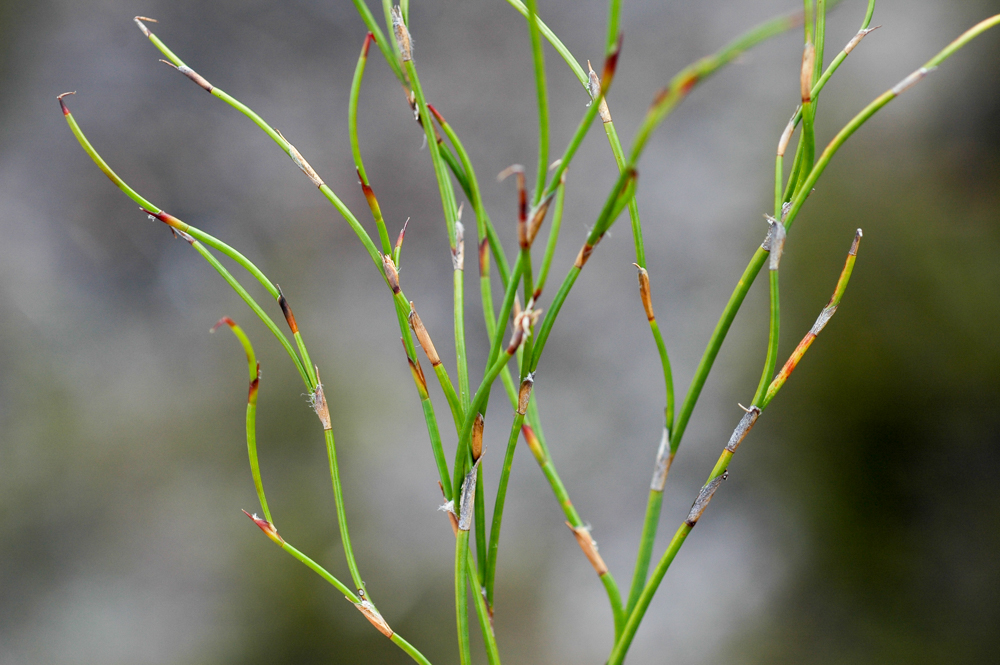
Empodisma is a small genus of rush-like flowering plants in the family Restionaceae (order Poales), comprising three species native to Australia and New Zealand. The genus was first described in 1974 by L.A.S. Johnson and D.F. Cutler, and later substantially revised by Wagstaff & Clarkson (2012), whose systematic study of the genus described a new species, Empodisma robustum, from peatlands in northern New Zealand — material previously conflated with E. minus.
Plants are dioecious, perennial herbs producing numerous branched, flexuose culms that collectively form densely interwoven, wiry tangles; true leaves are reduced to small mucronate sheaths, and the inconspicuous flowers are borne in small spikelets. Growth is typically widely spreading, decumbent, trailing or even lianoid, giving rise to common names such as "wire rush." The genus name itself reflects this habit: empodisma translates as "tangle-foot." Empodisma minus (lesser wire rush) is the most widespread species, found from coastal to alpine sites across much of Australia and New Zealand's North, South and Stewart Islands; Empodisma robustum is a larger-statured species endemic to a restricted part of New Zealand's northern North Island; and Empodisma gracillimum is confined to Western Australia.
Ecologically, New Zealand's two Empodisma species are notable as the dominant peat-forming plants of oligotrophic, ombrotrophic raised bogs (low moor and high moor wetlands), tolerating extremely acidic soils down to pH 2.5 and often coexisting with the related restiad genus Sporadanthus. Because of its narrow habitat restriction to northern New Zealand gumland and peat-bog remnants, Empodisma robustum is currently assessed as At Risk – Declining, while the far more widespread E. minus is considered Not Threatened.
Etymology
The genus name Empodisma means "tangle-foot," referring to the widely spreading, decumbent, trailing to lianoid growth habit that forms densely interwoven tangles of wiry culms.
Distribution
Empodisma is native to Australia and New Zealand. Empodisma minus ranges from coastal to alpine sites across Queensland, New South Wales, Victoria, Tasmania, South Australia and New Zealand's North, South, and Stewart Islands; Empodisma robustum is endemic to a restricted area of New Zealand's northern North Island (Te Aupouri Peninsula to the lower Waikato); Empodisma gracillimum is confined to Western Australia.
Ecology
The New Zealand species of Empodisma are the dominant peat-forming plants of oligotrophic, ombrotrophic raised bogs (low moor and high moor wetlands), tolerating extremely acidic soils down to pH 2.5. Empodisma robustum is restricted to ombrotrophic raised peat bogs, fens and gumland heathland peats in northern New Zealand, often coexisting with the related restiad Sporadanthus ferrugineus.
Conservation
Conservation status varies by species within the genus: under the 2023 New Zealand Threat Classification System, Empodisma minus is assessed as Not Threatened, while the narrow-range Empodisma robustum is assessed as At Risk – Declining.
Taxonomy Notes
Empodisma was first described in 1974 (Johnson & Cutler, Kew Bull. 28: 383). What had been treated as a single species, Calorophus minor (in Flora of New Zealand Vol. II, 1970), was later shown to comprise two distinct taxa; Wagstaff & Clarkson's 2012 systematic revision of the genus formally described the larger-statured northern New Zealand plants as the new species Empodisma robustum, distinguishing it from the more widespread Empodisma minus.










