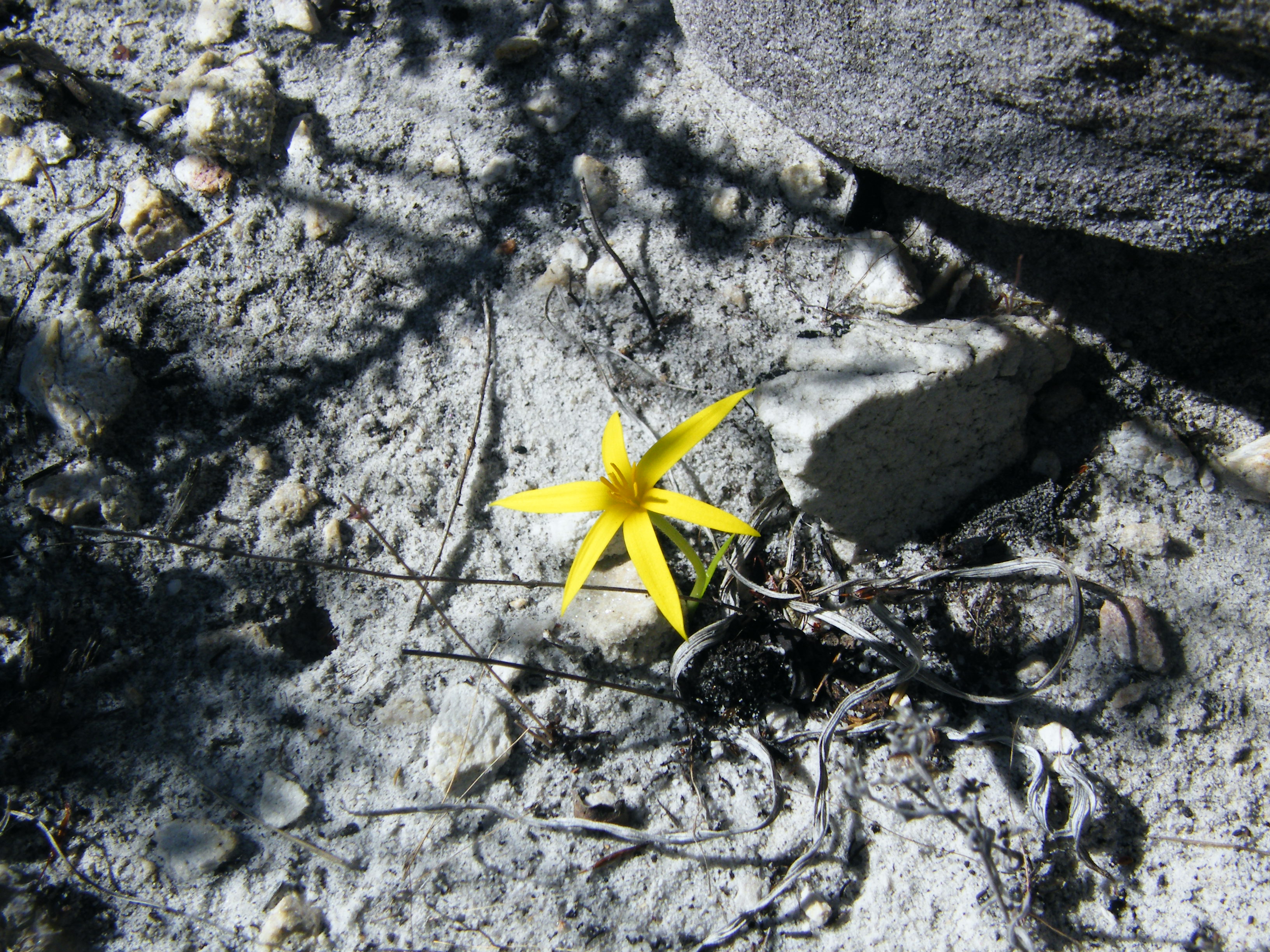
Empodium is a genus of flowering plants in the family Hypoxidaceae, placed in the order Asparagales. It was first described by Richard Anthony Salisbury in 1866 (published in Genera Plantarum, p. 43), and is recognized as an accepted genus in the GBIF Backbone Taxonomy with seven accepted species.
Plants in this genus grow from a small corm, an adaptation shared with other Hypoxidaceae, which allows them to survive the dry summer season by dying back to an underground storage organ. From this corm, Empodium produces lance-shaped or pleated leaves — sometimes hairy — reaching 10 to 30 centimetres in length, along with star-shaped flowers that appear in autumn, timed to the onset of the winter rains across its native range.
The genus is endemic to winter-rainfall regions of southern Africa, with species distributed across South Africa (notably the Cape Provinces and KwaZulu-Natal), Eswatini, Lesotho, and Namibia. Its seven recognized species — including Empodium plicatum, E. gloriosum, E. elongatum, E. veratrifolium, E. flexile, E. namaquensis, and E. monophyllum — are largely restricted to this Cape-centered range, reflecting the strong regional endemism characteristic of the winter-rainfall flora of the Greater Cape Floristic Region.
Distribution
Empodium is native to winter-rainfall areas of southern Africa, occurring in South Africa, Eswatini, Lesotho, and Namibia, with most species concentrated in the Cape Provinces.
Taxonomy Notes
Empodium was described by Salisbury in 1866 (Genera Plantarum, p. 43) and is classified in family Hypoxidaceae, order Asparagales. GBIF recognizes 7 accepted species in the genus, matching the species recorded here.










