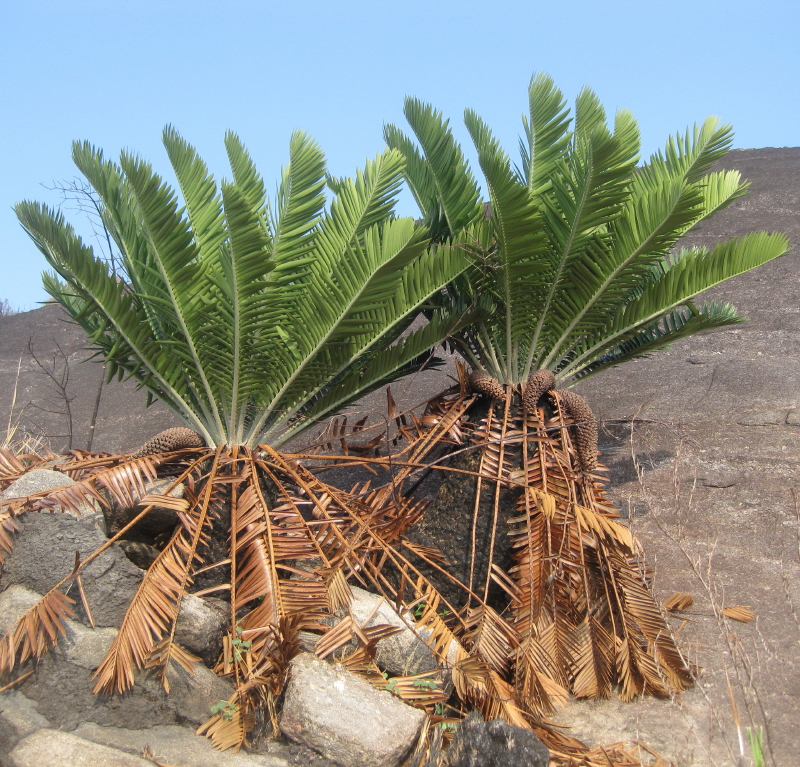
Encephalartos is a genus of cycads in the family Zamiaceae, native exclusively to sub-Saharan Africa. Often called bread trees, bread palms or kaffir bread, members of the genus are stout, palm-like gymnosperms with thick woody trunks and a crown of stiff, pinnate leaves. They are among the most primitive living seed plants and, like other cycads, have changed comparatively little in overall body plan since the age of the dinosaurs.
The genus was established by the German botanist Johann Georg Christian Lehmann in 1834, and its name comes from the Ancient Greek words for "head" (ἐγκέφαλος) and "bread" (ἄρτος) — a reference to the starchy pith inside the trunk that several African peoples once fermented and baked into a coarse bread. Type species is Encephalartos friderici-guilielmi, and around a hundred names are tracked in modern taxonomic databases. Earlier authors used the genus in a broader sense that included the Australian Macrozamia and Lepidozamia; these have since been split off, leaving Encephalartos restricted to Africa.
Plants are dioecious, with separate male and female individuals producing large, brightly coloured cones. Female cones can be enormous — up to about 27 kg — and males typically bear several elongated cones at once. The roots host symbiotic colonies of the cyanobacterium Nostoc punctiforme in specialised coralloid tubercles, which are thought to fix atmospheric nitrogen and help the plants colonise nutrient-poor soils. Pollination is largely by insects, and seed dispersal depends on birds such as loeries and hornbills that strip the fleshy outer coat from the toxic seeds.
Every species in the genus is listed on CITES Appendix I, the highest level of international protection, and most are red-listed as threatened. Several — most famously Encephalartos woodii, known only from a single male plant collected in South Africa in 1895 — survive only in cultivation. Pressure from collectors, the traditional-medicine trade and habitat loss continues to drive declines in the wild, while a long-lived cultivated population in botanic gardens and private collections keeps many species alive ex situ.
Etymology
The genus name Encephalartos was coined from the Ancient Greek ἐγκέφαλος (encéphalos, "head" or "within the head") and ἄρτος (ártos, "bread"). The reference is to the starchy pith inside the crown of the trunk, which several southern African peoples historically extracted, fermented and baked into a coarse bread — a practice that also gave the plants their English common names "bread tree," "bread palm" and "kaffir bread."
Distribution
Encephalartos is endemic to sub-Saharan Africa, with species spread across southern, eastern and central parts of the continent — South Africa, Mozambique, Zimbabwe, Tanzania, Kenya, Uganda and neighbouring countries. South Africa is the centre of diversity, with widespread species such as E. altensteinii occurring across the Eastern Cape and KwaZulu-Natal in coastal bush and on inland rocky hillsides, while other species are narrow endemics restricted to single mountains or forest patches.
Ecology
Encephalartos plants are dioecious gymnosperms that reproduce through large, brightly coloured cones. Males typically bear three or four elongated cones at a time, and female cones of some species can reach about 27 kg. Pollination is largely carried out by insects, and seed dispersal depends on birds — including Knysna loerie and trumpeter hornbill — that take the fleshy red outer coat and regurgitate the toxic hard seed elsewhere. Young leaves are browsed by mammals such as antelope, sheep, dassies and baboons. In the soil, specialised coralloid roots host colonies of the cyanobacterium Nostoc punctiforme, which are thought to fix atmospheric nitrogen and help the plants persist on poor substrates.
Cultivation
Encephalartos species are widely grown in botanic gardens and private collections around the world, and several are well-established ornamentals where the climate allows. They generally tolerate full sun to light shade, demand a well-drained growing medium, and benefit from regular watering and summer feeding once established. Light frost is tolerated by hardier species such as E. altensteinii, and plants transplant comparatively easily for cycads. The main horticultural pests are armoured scale insects, including cycad aulacaspis scale, zamia scale and latania scale, all of which attack the foliage.
Conservation
Every Encephalartos species — and all interspecific hybrids — is listed on CITES Appendix I, the strictest level of international protection. In practice this means international trade is restricted to artificially propagated material, and any movement of plants, cones, pollen or seed across borders requires both export and import permits. Almost all species are red-listed as threatened, several critically. Encephalartos woodii is treated as extinct in the wild — the last natural plant was removed in 1916 and the species now survives only as roughly 500 clones of a single male in cultivation. More widespread species such as E. altensteinii have still lost an estimated 30–50% of their wild population over the past century, driven by collection for ornamental gardens, harvesting for the traditional-medicine trade and coastal habitat loss.
Cultural Uses
The genus name itself records the plants' best-known use: the starchy pith of the trunk was historically extracted by Khoekhoe and other southern African peoples, buried in animal skins to ferment for around two months, then kneaded into a dough and lightly roasted over coals as a coarse bread. This use survives in the English common names bread tree, bread palm and kaffir bread. Today, the dominant cultural role of Encephalartos is horticultural — as long-lived, prestigious specimen plants in gardens and collections — though demand from collectors and the traditional-medicine trade remains a serious conservation problem.
History
Encephalartos was formally described by the German botanist Johann Georg Christian Lehmann in 1834, in his Novarum et Minus Cognitarum Stirpium Pugillus 6. African use of the plants long predates that description: the Swedish naturalist Carl Peter Thunberg, travelling at the Cape around 1772, already recorded that Khoekhoe people removed the pith from the crown of the stem and buried it wrapped in animal skin for about two months before working it into bread. The most celebrated single discovery in the genus came in 1895, when John Medley Wood found a cluster of stems of an unknown cycad in oNgoye Forest, KwaZulu-Natal — the species later named E. woodii in his honour, and never found again in the wild.
Taxonomy
Encephalartos sits in the family Zamiaceae, subfamily Encephalartoideae, with E. friderici-guilielmi as the type species. The genus authority is Lehm. (Johann Georg Christian Lehmann, 1834), and the GBIF backbone tracks 104 descendant names; modern checklists recognise on the order of 65 accepted species. Chromosome number is 2n = 18. Earlier authors used a broader concept of the genus that included the Australian Macrozamia and Lepidozamia, but those have long since been separated, leaving Encephalartos strictly African in distribution.










