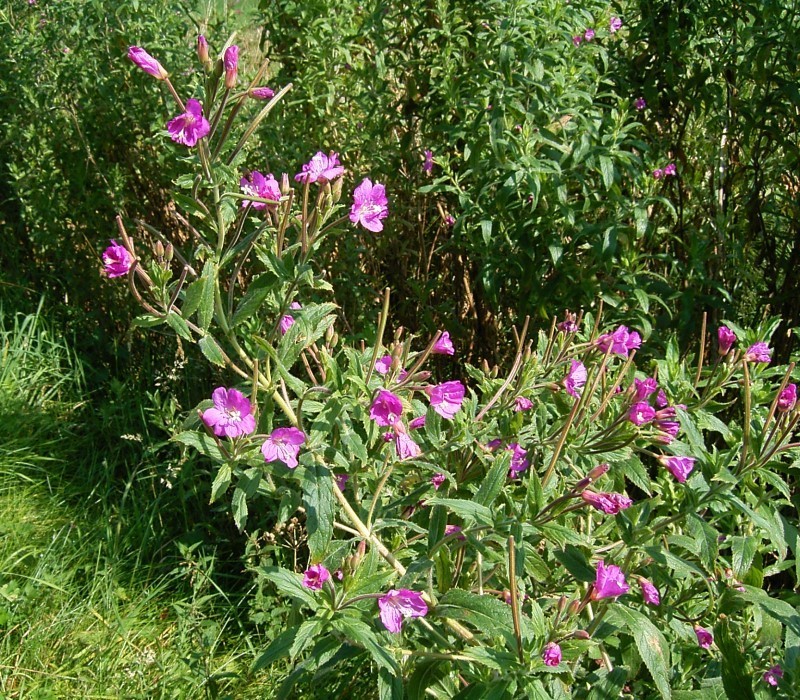
Epilobium is a large, near-cosmopolitan genus of flowering plants in the evening-primrose family (Onagraceae), traditionally containing roughly 197–200 species. Most members are herbaceous annuals or perennials, with a handful of subshrubs, and the genus is best known under the common names willowherbs, spike-primroses, and fireweeds. Plants vary from delicate alpine cushions a few centimetres tall to robust stoloniferous perennials reaching two metres, but the great majority sit in the 2–6 foot range.
The foliage is unmistakably willow-like: simple, narrow, linear to ovate or lanceolate leaves arranged opposite (occasionally alternate or whorled), often softly hairy and lightly toothed. Stems are typically erect and sometimes four-angled. The flowers are small to showy, actinomorphic, and carried in terminal racemes, panicles, or leafy spikes. Each bloom has four petals that are almost always notched at the tip, sitting above a long, slender inferior ovary; the colour palette runs from soft pink and rose through magenta, with a few species offering red, orange, or yellow forms. Eight stamens and a four-lobed stigma complete the floral plan.
After flowering, the ovary matures into the genus's signature fruit — a long, slim, four-valved capsule that splits lengthwise to release dozens to hundreds of tiny seeds. Each seed is tipped with a tuft of silky, white to tawny hairs (the coma), and the capsules essentially function as miniature catapults of windborne fluff, which is how willowherbs colonise new ground so quickly and so far from a parent plant. This combination of fast germination, light wind-dispersed seed, and tolerance of poor or recently disturbed soils makes Epilobium one of the most familiar pioneer genera of temperate floras worldwide.
Etymology
The genus name Epilobium comes from the Greek roots epi, meaning "upon," and lobos, meaning "lobe" — a reference to the position of the petals, which sit on top of the long, lobe-like inferior ovary that characterises the flowers of this group. The name was applied by Linnaeus when he formally established the genus in Species Plantarum in 1753.
Distribution
Epilobium is one of the most widely distributed flowering-plant genera, occurring on every continent except Antarctica. It is most diverse and abundant across the subarctic, temperate, and subantarctic zones of both hemispheres; in subtropical and tropical latitudes it persists only in cool montane refugia, such as the high cordilleras of the Andes and the alpine grasslands of the New Guinea Highlands. North America hosts a substantial share of the genus, with species found across most of the continent except the hottest deserts, and the European Alps and surrounding lowlands support a particularly rich willowherb flora — Switzerland alone recognises around twenty species and subspecies, ranging from the lowland Epilobium hirsutum and E. parviflorum to high-elevation specialists such as E. alpestre, E. anagallidifolium, and E. fleischeri.
Ecology
Willowherbs are quintessential pioneers. Their tiny, plumed seeds drift on the wind for great distances, allowing the genus to colonise freshly disturbed ground — burned forest floors, river gravels, road cuts, abandoned fields, demolition sites — within a single season, often forming dense monodominant stands. In Britain, rosebay willowherb (Chamaenerion angustifolium) characteristically dominates mesotrophic soils in regenerating woodland and heath, while great willowherb (E. hirsutum) tends to anchor wet grassland communities alongside stinging nettle. Most species are shade-intolerant and gradually retreat as taller perennials and woody plants close the canopy, making Epilobium populations cyclical and patchy at the landscape scale. The abundant nectar and pollen attract bees and other pollinators, and the genus is generally classed as a useful nectar source for honey production.
Cultivation
Epilobium are easy plants to grow but can be very weedy: their wind-borne seed and rapid clonal spread make them notorious volunteers in container nurseries, where herbicide control is reported to be poor. In garden settings, most species prefer full sun to part shade and a free-draining soil, with moisture preferences varying by species — some, such as E. hirsutum and E. palustre, thrive in wet ground, while others tolerate stony, dry, or alpine substrates. Common pests under cultivation include slugs, snails, spider mites, aphids, whiteflies, mealybugs, and Japanese beetles. The taller, spreading species are usually best confined to wild or naturalistic plantings where their tendency to seed about is a feature rather than a problem; compact alpine species are more amenable to rock gardens and troughs.
Taxonomy notes
Epilobium was established by Linnaeus in Species Plantarum (1753, p. 347) and is the type genus of one of the major lineages within the evening-primrose family, Onagraceae (order Myrtales). The modern circumscription, shaped largely by Peter H. Raven's twentieth-century revisions, absorbed several formerly separate genera — including Boisduvalia, Chamaenerion, and Zauschneria — although Chamaenerion (housing fireweed and its relatives) is still treated as a distinct genus by some recent authors. Estimates of species number vary somewhat by treatment: Wikipedia cites approximately 197 species, the SEINet generic description gives around 200, and GBIF currently lists 605 descendant taxa (including infraspecific names and synonyms) under the genus.
History
Fireweed, long included in Epilobium (as E. angustifolium) and now often segregated as Chamaenerion angustifolium, has the best-documented cultural history of the group: it became an icon of the British home front during the Second World War, when it carpeted London bomb sites with sheets of magenta flowers, earning the popular name "bombweed." It has since been adopted as the floral emblem of Yukon, of Hedmark in Norway, and of Southern Ostrobothnia in Finland.
Cultural uses
Fireweed and its close relatives have a long record of human use across the boreal world. Young shoots, leaves, and roots are edible and are reported to be rich in provitamin A and vitamin C; in northwestern North America the plant has been used as a sweetener and as a flavouring in candies, jellies, ice cream, and syrup. The abundant nectar produced by the showy pink racemes makes fireweed a valuable honey plant in northern latitudes. Several Epilobium species — particularly E. parviflorum — also have a tradition of herbal use directed at prostate and bladder complaints, and extracts remain a common ingredient in commercial men's-health herbal supplements.










