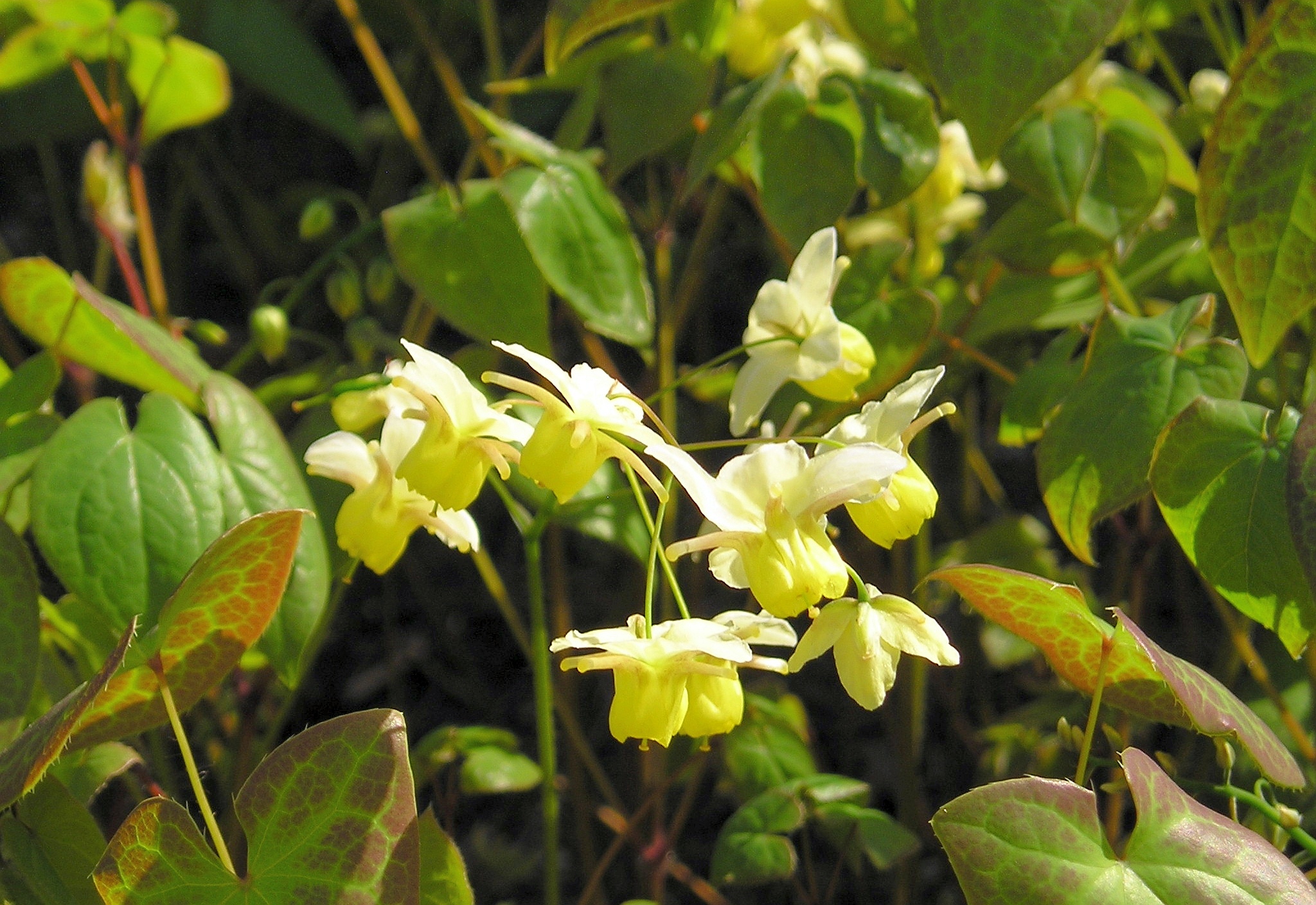
Epimedium is a genus of roughly 60–100 flowering plants in the family Berberidaceae (order Ranunculales), commonly known as barrenwort, bishop's hat, fairy wings, or horny goat weed. The great majority of species are native to China, with a smaller contingent distributed across the rest of Asia and a handful of species reaching the Mediterranean region.
Plants are herbaceous perennials that spread by underground rhizomes, forming low, spreading clumps or tufted rosettes. Leaves are typically compound, most often divided into three leaflets with distinctively spiny margins; depending on the species they may be deciduous or persist through winter, making some species effectively evergreen. In spring, plants produce loose racemes or panicles of delicate four-parted flowers. Each bloom consists of four small outer sepals that fall as the flower opens, four larger, petal-like inner sepals often brightly coloured in white, yellow, pink, or violet, and four true petals that frequently bear elongated nectar-producing spurs. The characteristic silhouette of a flower with long spurs is the origin of the common name "bishop's hat." There are four stamens.
The genus was formally described by Carl Linnaeus in 1753, based on the European species Epimedium alpinum. The name is a Latinization of the Greek epimedion, a plant of uncertain identity mentioned in Pliny's Natural History (xxvii.57); its original meaning remains unclear.
Epimedium has been cultivated in Western gardens for 100–150 years, initially through a limited set of European and Japanese species and hybrids. The recent exploration of Chinese flora has dramatically expanded the palette available to gardeners, with many newly described species proving surprisingly adaptable to temperate garden and container conditions beyond their native habitats. The cultivar Epimedium 'Amber Queen' holds the Royal Horticultural Society's Award of Garden Merit.
Several species, notably Epimedium grandiflorum, have a long history of use in traditional Chinese medicine under the name yin yang huo (淫羊藿). The plants contain icariin, a flavonoid glycoside that acts as a weak PDE5 inhibitor in laboratory studies. Extracts are marketed in men's dietary supplements, though clinical evidence for efficacy in humans remains limited.
Etymology
The genus name Epimedium is a Latinized form of the Greek epimedion, a plant of uncertain identity referenced in Pliny's Natural History (xxvii.57). Carl Linnaeus applied the name in 1753 when formally describing the European species E. alpinum; the original Greek meaning is unknown.
Distribution
The great majority of Epimedium species are endemic to China. Smaller numbers occur elsewhere in Asia, and a few species extend into the Mediterranean region. Within China, diversity is highest in the southwest, particularly in Sichuan, Yunnan, and Guizhou provinces.
Cultivation
Some Epimedium cultivars and hybrids have been grown in Western gardens for 100–150 years, but the range available has expanded greatly with the introduction of new Chinese species discovered in recent decades. Most have proved more adaptable than expected, growing well in general garden beds and containers rather than requiring exact replication of native conditions. They thrive in dappled shade with humus-rich, moisture-retentive but well-drained soil. The cultivar 'Amber Queen' is an RHS Award of Garden Merit recipient.
Cultural Uses
Epimedium species, particularly E. grandiflorum, have been used in traditional Chinese medicine as yin yang huo (淫羊藿) for centuries. Modern phytochemical research has identified icariin as the principal active compound — a flavonoid glycoside that inhibits PDE5 in vitro at low potency. Extracts are sold in men's sexual health supplements in many markets, though controlled clinical trials supporting efficacy in humans are lacking.
Taxonomy
The genus belongs to family Berberidaceae, order Ranunculales. As of November 2024, Plants of the World Online recognises numerous species and naturally occurring hybrids; the exact species count continues to grow as botanical surveys of southwestern China document new taxa, some not yet formally named.










