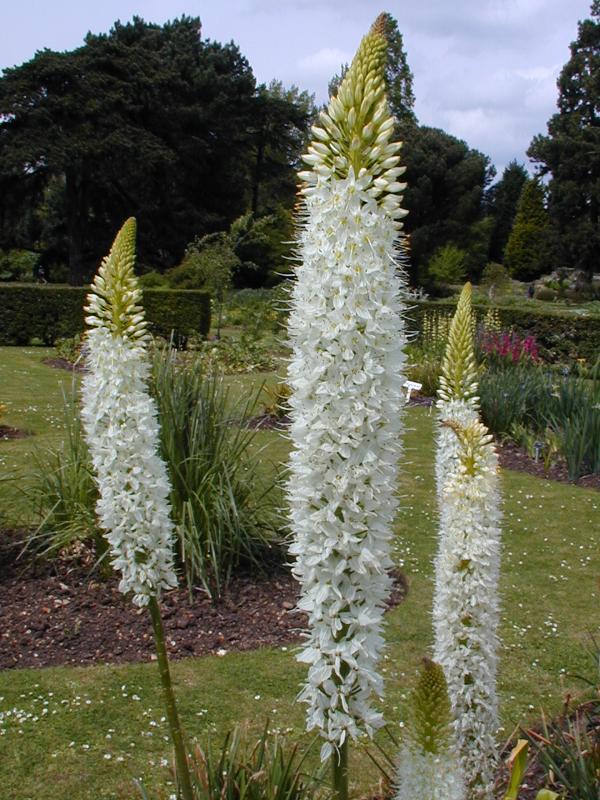
Eremurus, commonly known as foxtail lilies or desert candles, is a genus of deciduous perennial flowering plants in the family Asphodelaceae (order Asparagales). The genus was first described by Marschall von Bieberstein and published in Fl. Taur.-Caucas. 3: 269 (1819). Approximately 60–89 species are recognized, native to eastern Europe and temperate Asia — from Russia, Ukraine, and Turkey across Central Asia to Mongolia and western China.
Plants grow from a central crown bearing thick, finger-like fleshy roots that radiate outward in a starfish pattern. Basal rosettes of narrow, grey-green strap-like leaves emerge in spring, followed by tall, leafless flowering stems that can reach 3–10 feet (1–3 m) in height depending on species. Each stem carries a dense spike of 500–700 small, star-shaped flowers arranged in a bottlebrush formation, blooming from late spring through early summer. Flower colors span white, yellow, orange, salmon-pink, and red-orange; many selections are fragrant and highly valued as cut flowers.
The genus is widely cultivated in temperate gardens for its dramatic vertical presence. Plants thrive in full sun with well-drained, rich soil and a pH range of 6.0–8.0, becoming drought-tolerant once established. After summer flowering the foliage dies back; plants should be kept relatively dry during dormancy. Propagation is primarily by division — performed infrequently due to the brittle, disturbance-sensitive roots — or by seed, which germinates slowly and may take 3–5 years to produce flowering plants.
Etymology
The genus name Eremurus derives from the Greek words eremia (desert) and oura (tail), a reference to the plant's natural habitat and the long, tail-like flower spike. The common names foxtail lily and desert candle both echo these characteristics — the tapering spike resembling a fox's brush, and the upright stem evoking a burning candle in arid landscapes.
Distribution
Eremurus is native to eastern Europe and a broad arc of temperate Asia. Its range extends from Russia and Ukraine westward into Turkey, and eastward through the Caucasus, Central Asia (particularly Turkestan and the steppes and foothills of Kazakhstan, Uzbekistan, Tajikistan, Kyrgyzstan, and Afghanistan), and into northwestern China, Mongolia, and the Himalayan foothills. One species, Eremurus thiodanthus, is endemic to the Crimean Peninsula. The genus reaches its greatest species diversity in Central Asia. Plants typically grow in open, sunny habitats such as sandy hills, rocky slopes, steppes, and semi-desert environments — consistent with their tolerance of summer drought and winter cold.
Ecology
Eremurus flowers are rich nectar sources that attract a range of pollinators, including bumblebees, hawk moths, butterflies, and hummingbirds. The tall, prominent spikes make the blooms accessible to a wide variety of visitors. Plants are adapted to open, sun-exposed habitats with periodic drought; they become dormant after summer flowering and rely on their fleshy root crowns to survive dry periods. Slugs and snails are attracted to the emerging foliage in spring and are the primary pest concern.
Cultivation
Eremurus is grown as an ornamental perennial in temperate gardens, valued for its striking vertical flower spikes. Plants require a position in full sun (at least 6 hours daily) and well-drained, organically rich soil; heavy or poorly drained soil causes crown and root rot, particularly over wet winters. In colder climates, covering the crown with sharp sand or grit after planting helps protect it from excessive moisture.
The recommended planting method is to set the rhizomatous crown 6–8 inches deep with the central bud facing upward, spreading the roots outward flat in the prepared hole; alternatively, planting atop a mounded cone of soil allows roots to drape naturally. Tall-growing species may need staking in exposed sites. Plants perform best in USDA hardiness zones 5–9 (UK zone 6), where the winter cold needed to break dormancy is available. After flowering, foliage dies back and plants should remain relatively dry until the following spring.
Several species and cultivars have received recognition: cultivar 'Joanna' holds the Royal Horticultural Society's Award of Garden Merit, and hybrids in the Eremurus × isabellinus group (such as 'Cleopatra' and 'Romance') are widely grown for their reliable performance and range of flower colors.
Propagation
The preferred propagation method for Eremurus is division of the root crown, carried out after the foliage has died back completely in late summer or autumn. Because the roots are brittle and resent disturbance, division should be performed infrequently — ideally no more than once every 6 years — and replanted promptly without allowing the roots to dry out.
Propagation by seed is possible but slower and less reliable. Seeds require cold stratification and germinate slowly, typically taking 1–12 months at 15°C. Seedlings will not flower for 3–5 years. Seed-raised plants show natural variation and may not match parent cultivars.
Cultural Uses
In Armenia, young Eremurus leaf rosettes harvested in early spring are sold as a leaf vegetable in local marketplaces, representing a traditional culinary use of the genus. Additionally, the roots of certain species contain dextrose from which a glue or adhesive substance can be extracted, a limited traditional industrial application documented from Central Asian range states.
Taxonomy
Eremurus M.Bieb. was formally described by Friedrich August Marschall von Bieberstein and published in Flora Taurico-Caucasica 3: 269 in 1819. The genus belongs to the family Asphodelaceae (order Asparagales, class Liliopsida), and its type species is Eremurus spectabilis. Three names are recognized as synonyms: Ammolirion Kar. & Kir. (1842), Henningia Kar. & Kir. (1842), and Selonia Regel (1868). GBIF records 89 descendant taxa, while estimates based on accepted species counts range around 60+.










