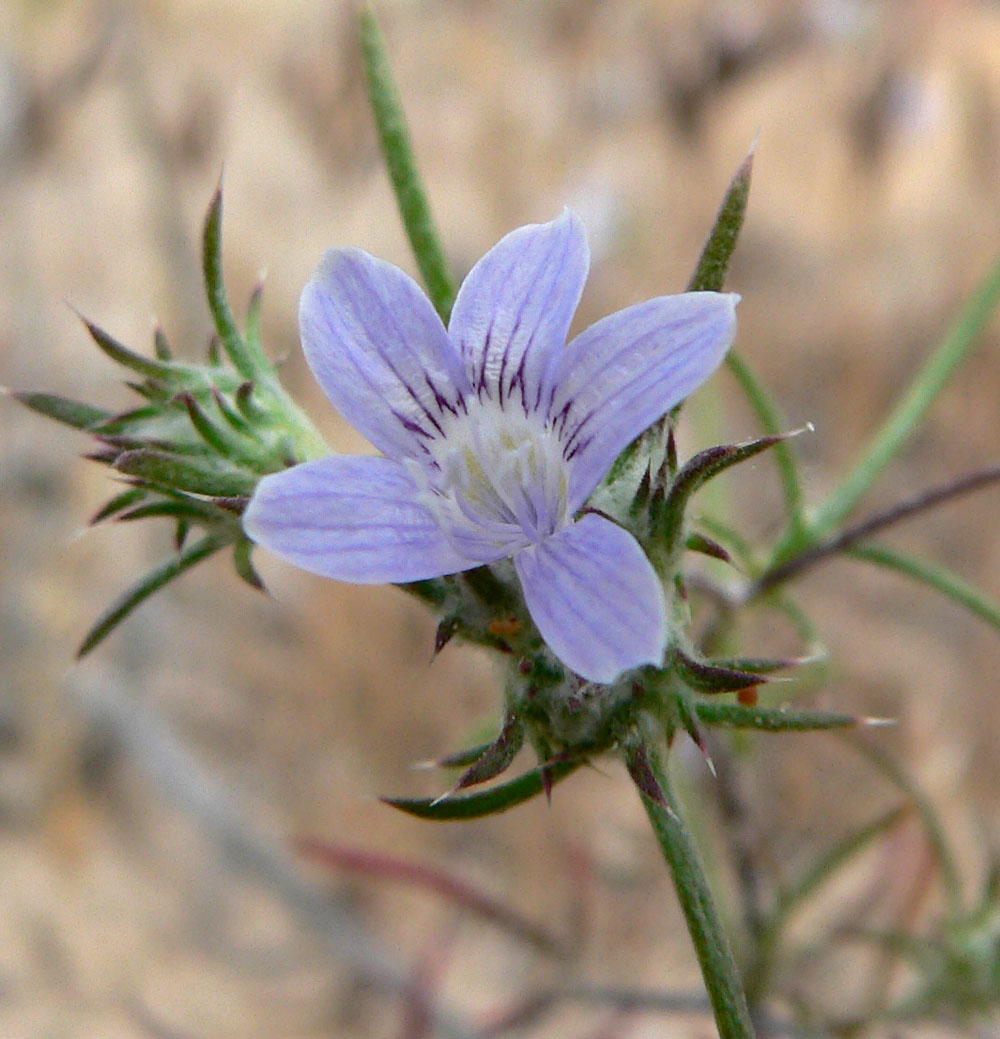
Eriastrum is a genus of flowering plants in the phlox family (Polemoniaceae), collectively known as woollystars. The roughly 18–20 species are native to western North America, concentrated in the arid and semi-arid landscapes of the southwestern United States and northwestern Mexico, with a center of diversity in California, Arizona, and Nevada.
The plants are typically annual herbs with solitary to much-branched stems, erect to somewhat prostrate in habit. Leaves range from simple to deeply pinnately lobed, often with spinulose (spine-tipped) margins. The most distinctive characteristic of the genus is the inflorescence: flower heads wrapped in a fine, cottony web of woolly white fibers that inspired both the common name and the scientific one. Flowers are actinomorphic to slightly irregular, with petals that range from white through shades of lavender to deep sapphire blue. The fruit is an ellipsoid to ovoid capsule containing one to several seeds per locule.
The woolly inflorescence — the feature that unites the genus visually — reflects the Greek roots of the name: erion (wool) and aster (star). Individual species occupy a range of desert and semi-desert habitats, from sandy flats and washes to rocky slopes and volcanic soils.
Etymology
The genus name Eriastrum derives from two Greek words: erion, meaning wool, and aster, meaning star. The name references the woolly white fibrous mesh that wraps around the flower heads of most species, creating a distinctive starry, cottony appearance in the inflorescence.
Distribution
Woollystars are native to western North America. Approximately 14–20 species (depending on taxonomic treatment) occur across the southwestern United States and northwestern Mexico, with the greatest diversity in California, Arizona, Nevada, and adjacent areas. The genus is documented from arid and semi-arid zones in the Arizona–New Mexico region and across the Mojave and surrounding desert systems.
Ecology
Eriastrum species occupy arid and semi-arid habitats of western North America. Plants are predominantly annual, completing their life cycle in a single growing season and typically found on sandy flats, desert washes, rocky slopes, and other open, dry substrates. The woolly inflorescence mesh may serve a thermoregulatory or moisture-retention function in these harsh environments. Flower color ranges from white to deep bluish lavender, with pollination likely mediated by bees and other native desert insects attracted to the clustered heads.
History
Eriastrum was formally described as a genus by Elmer Wooton and Paul Standley in 1913, in their contributions to the U.S. National Herbarium. A major modern revision was provided by Dieter H. Wilken and J. Mark Porter in 2005, treating the genus within the Polemoniaceae account for Vascular Plants of Arizona.
Taxonomy
Eriastrum was established by Wooton & Standley in 1913, based on material from the American Southwest, and published in contributions to the U.S. National Herbarium. It is placed in the family Polemoniaceae (phlox family), order Ericales. The number of accepted species varies by source: Wikipedia lists 18, GBIF recognizes 19 accepted taxa (with 43 total descendant records including synonyms and doubtful entries), and SEINet documents 20 names on its portal. The 2005 treatment by Dieter H. Wilken and J. Mark Porter in Vascular Plants of Arizona is a key modern taxonomic reference for the genus.










