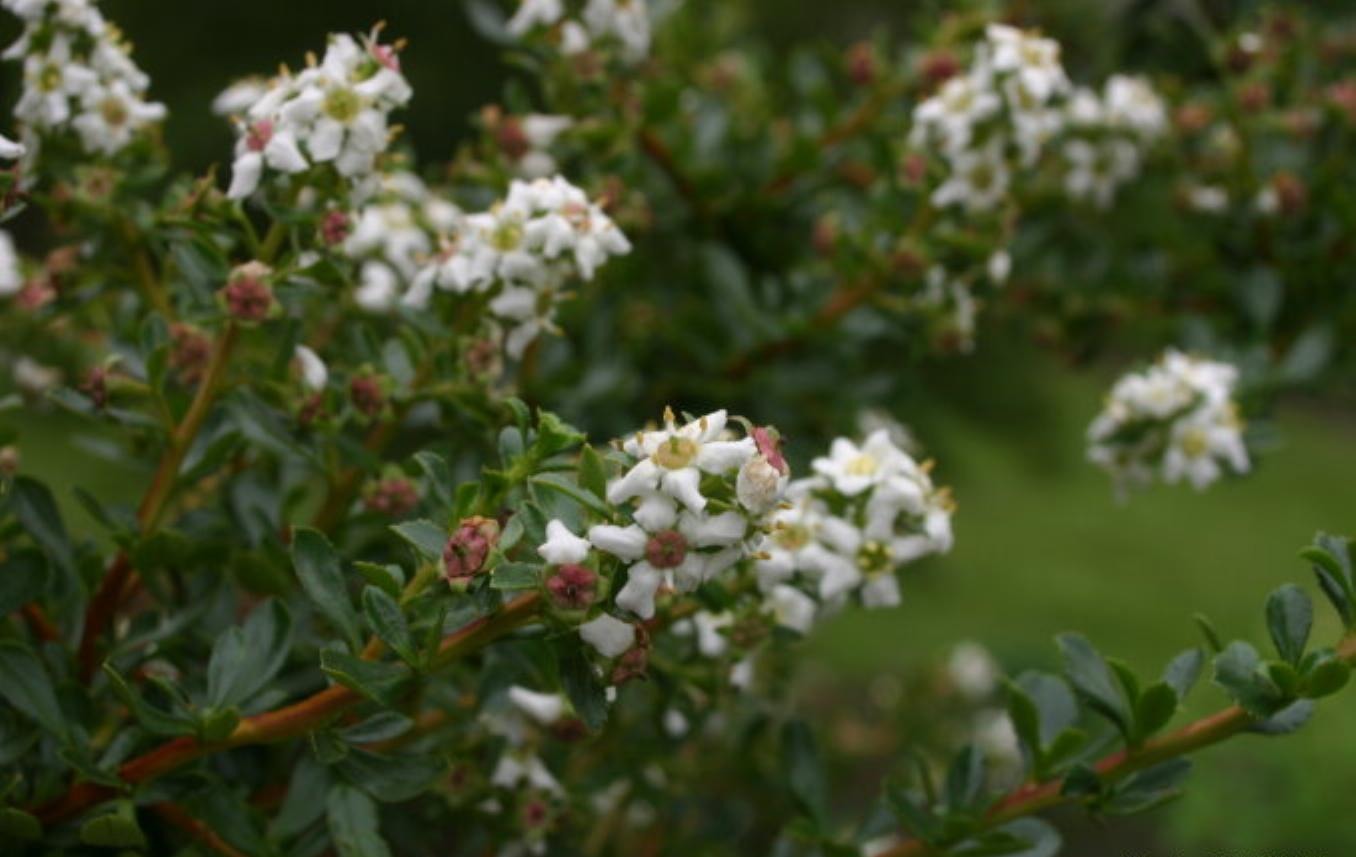
Escallonia (Escallonia Mutis ex L.f., 1781) is a genus of evergreen shrubs and small trees in the family Escalloniaceae, order Escalloniales. The genus encompasses approximately 40–45 accepted species — GBIF records 89 descendant taxa across accepted species and infraspecifics — and was named by the Colombian botanist José Celestino Mutis.
Plants are typically fast-growing, adding around 30 cm per year, and reach mature heights of 1.5–3 metres. Branches arch gracefully, clothed in small, oval, glossy green leaves. From late spring through autumn (June to October in the Northern Hemisphere), plants bear masses of small, tubular flowers in shades of white, pink, or deep crimson, often with a light honey fragrance. The flowers are hermaphroditic and are highly attractive to honey bees and bumblebees, making escallonias valued for pollinator gardens.
The genus is native to South America — with its core distribution in the Andes and adjacent regions including Brazil (São Paulo, Rio de Janeiro, Paraná) and southern South America more broadly. In cultivation, escallonias are grown throughout temperate regions worldwide, particularly prized for their tolerance of exposed coastal conditions and maritime salt spray. They are widely planted as hedging and windbreak shrubs in USDA hardiness zones 7–10. Multiple cultivars have been awarded the Royal Horticultural Society's Award of Garden Merit, including 'Apple Blossom', 'Iveyi', 'Pride of Donard', 'Peach Blossom', and 'Crimson Spire'.
Etymology
The genus name Escallonia honours Antonio Escallón, an 18th-century Spanish botanist and student of José Celestino Mutis, who collected plants in New Granada (present-day Colombia). The formal name Escallonia Mutis ex L.f. was published in 1781 by Carl Linnaeus the Younger (L.f.), based on Mutis's collections, giving the authorship attribution "Mutis ex L.f."
Distribution
Escallonia is native to South America, with its centre of diversity in the Andes mountain chain. The genus extends from Venezuela and Colombia south through Ecuador, Peru, Bolivia, and Argentina to Chile, with outlier populations in southern Brazil (documented states: São Paulo, Rio de Janeiro, Paraná). Several species are associated with high-altitude shrubby vegetation (e.g. E. myrtilloides, E. polifolia), while others occur at lower elevations in matorral and forest edges. In cultivation, escallonias have naturalised in parts of western Europe and coastal temperate regions globally.
Taxonomy
Escallonia was formerly placed in various families including Grossulariaceae and Saxifragaceae before molecular studies established Escalloniaceae as a distinct family. The order Escalloniales was formally recognised under the APG system and sits within the asterid clade of eudicots. GBIF lists the genus as taxonomic status ACCEPTED with 89 documented descendant taxa; other authorities cite approximately 41 currently valid accepted species, while SEINet documents 36 — the variation reflects ongoing taxonomic revision and differing species concepts between authorities.
Ecology
Escallonias are notably tolerant of exposed maritime environments and thrive in coastal conditions where salt-laden winds discourage most other shrubs, making them valued as natural windbreaks. They prefer open, sunny positions and succeed in well-drained soils ranging from light to heavy, tolerating mild drought; they cannot grow in shade. In their native Andean range, they often form dense thickets in high-altitude scrub. The flowers provide a significant source of pollen and nectar, particularly attractive to honey bees and bumblebees.
Cultivation
Escallonias perform best in any fertile, free-draining soil and require full sun to flower well; they will not bloom in shade. They are hardy to approximately -10°C (USDA zones 7–10, UK hardiness zone 8) but can be damaged or killed by prolonged exposure to severe frost-laden winds; wall protection is beneficial in colder districts. Established plants resent root disturbance and should be sited permanently while young.
As hedging plants, they respond well to light clipping after flowering to maintain shape. Spring pruning should be restricted to removing frost-damaged wood to preserve the season's flowers. Wet summer conditions can predispose plants to escallonia leaf spot disease. Besides their use as hedges and windbreaks, escallonias are planted in mixed borders, coastal gardens, and as specimen shrubs. Several cultivars carry the RHS Award of Garden Merit: 'Apple Blossom' (bicolour pink-white), 'Iveyi' (white), 'Pride of Donard' (pink), 'Peach Blossom' (pale pink), and 'Crimson Spire' (deep red).
Propagation
Escallonias are propagated by seed or by cuttings, with vegetative methods being the most reliable. Seeds should be sown in early spring in a cold frame. Half-ripe stem cuttings taken in July–August root readily in frames. Mature hardwood cuttings taken in winter achieve success rates of approximately 95%. Plants raised from cuttings reproduce cultivar characteristics true-to-type, making this the preferred method for named selections.

