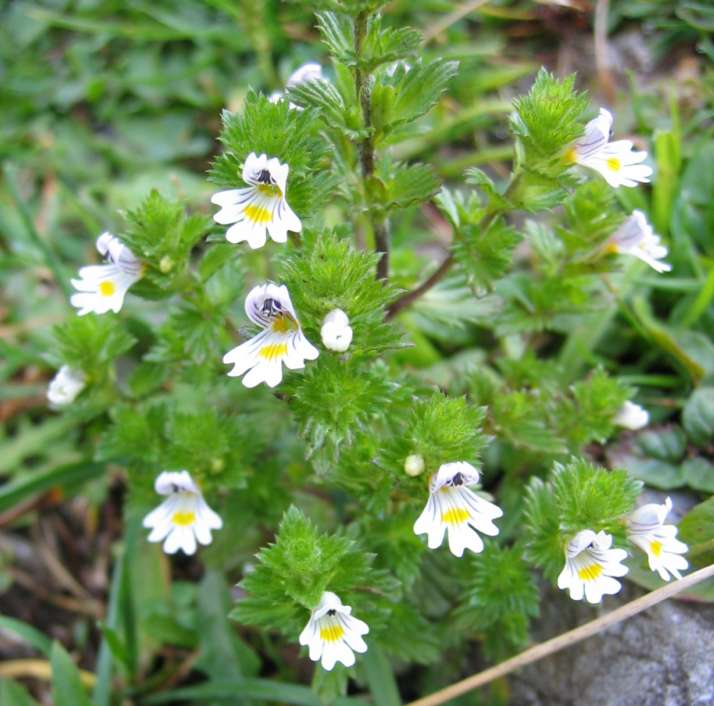
Euphrasia L. — commonly known as eyebright — is a large genus of about 217 accepted species of small herbaceous flowering plants in the family Orobanchaceae (order Lamiales). Previously placed in Scrophulariaceae, the genus was reclassified into Orobanchaceae following molecular phylogenetic work that united the hemiparasitic and holoparasitic plants of tribe Rhinantheae.
Plants are typically annuals, though some perennial species occur, and remain small in stature — usually no taller than 20 cm. Flowers are zygomorphic (bilaterally symmetrical), with a distinctively lip-shaped lower petal. Flower color varies across the genus from white and blue-white to purple and violet, with yellow guide markings on the lower petals that serve as visual cues for bee pollinators. The plants are hermaphroditic and self-fertile, with flowering typically occurring from July through September in the Northern Hemisphere.
The defining ecological trait of Euphrasia is hemiparasitism: species attach to the roots of neighbouring plants — most commonly grasses, clovers (Trifolium pratense), and plantains (Plantago spp.) — and extract water and mineral nutrients from their hosts while still photosynthesising independently. This strategy enables the plants to colonize nutrient-poor grasslands that would be challenging for fully autotrophic herbs.
The genus has a cosmopolitan distribution, occurring across Macaronesia, northwest Africa, Eurasia, Australia, New Zealand, subarctic North America south to the northern United States, and from Peru through to southern South America. Within this range, habitats centre on alpine and sub-alpine meadows with regular snowfall, moist grasslands, and chalky or limestone-rich pastures. Switzerland alone hosts at least 18 species, reflecting strong subspecific diversification across Alpine elevational gradients.
Etymology
The genus name Euphrasia derives from the Greek euphrosyne, meaning "good cheer" or "gladness." It is thought to refer to the plant's long history as a remedy for eye complaints — clear sight being associated with a cheerful disposition. The common name "eyebright" directly echoes this tradition, reflecting the doctrine of signatures reasoning that the flower's small, bright, eye-like markings indicated its use for treating the eyes.
Distribution
Euphrasia has a remarkably broad natural distribution spanning multiple continents. POWO delimits its native range as Macaronesia through northwest Africa and across all of Eurasia, continuing to Australia, New Zealand, subarctic North America south to the northern United States, and from Peru through to southern South America. The genus is consequently one of the more geographically widespread among hemiparasitic angiosperms.
The core stronghold lies in European and Asian mountain systems, where alpine and sub-alpine meadows provide the combination of open, low-competition swards and diverse host grasses that eyebrights require. In Switzerland alone, at least 18 species have been documented, distributed across distinct elevational zones from lowland meadows to high Alpine habitats. The genus has also been introduced into several US states (Idaho, Illinois, Massachusetts, New York, Oregon, Pennsylvania, Vermont, Washington, and Wisconsin), likely through importation of pasture seed mixes.
Ecology
All Euphrasia species are hemiparasites: they bear chlorophyll and photosynthesize, but simultaneously parasitize the roots of neighbouring plants via haustorial connections. Common hosts include grasses, red clover (Trifolium pratense), and plantain (Plantago spp.). This partial dependency on host nutrition allows eyebrights to exploit nutrient-poor, species-rich grasslands and alpine meadows where competition from taller vegetation is limited.
Flowers are visited and pollinated by bees, with yellow nectar guides on the lower lip directing pollinators to the floral reward. Plants flower from July to September. They tolerate a wide range of soil textures (light to heavy) and pH from mildly acid to alkaline, with particular affinity for chalky and limestone-enriched substrates. In Alpine regions, subspecific differentiation tracks elevational gradients, indicating fine-scale ecological adaptation across climatic zones.
Cultivation
Euphrasia species are rarely cultivated, largely because their hemiparasitic nature makes them difficult to establish without suitable host plants. In garden or restoration settings, seed should be sown outdoors in early spring directly into short turf or grassland containing appropriate host species such as grasses, clover, or plantain. Plants favour moist soils in full sun to semi-shade, with chalky or limestone substrates preferred. USDA hardiness zones 5–9 are cited for the genus. It is noted that only forms bearing glandular hairs on the calyx possess medicinal properties, a distinction relevant to those growing the plant for herbal use.
Conservation
Several Euphrasia species have suffered significant decline. E. arguta was presumed extinct before its rediscovery in 2008; E. ruptura is documented as extinct. In Switzerland, multiple taxa are listed on National and Regional Red Lists (2016 and 2019 editions), and ex-situ conservation programs have been established for threatened species. The genus's dependence on specific host plants and low-competition grassland habitats makes it particularly vulnerable to agricultural intensification, fertilizer application (which favours competitive grasses), and land abandonment leading to scrub encroachment.
Uses & Folklore
Euphrasia has an exceptionally long history as a medicinal herb, centred almost entirely on the treatment of eye ailments — a tradition so persistent that it gave rise to the common name "eyebright." In medieval and early modern herbalism, the doctrine of signatures held that the flower's small, bright, eye-like markings indicated its affinity for the eye. Nicholas Culpeper (17th century) extended these claims, ascribing the plant to Leo and asserting it "strengthened the brain," relieved memory problems, and treated vertigo. During the Elizabethan era eyebright was infused into ales and medicinal wines.
Modern traditional uses persist in phytotherapy: preparations include eye washes, internal infusions, and poultices applied for blepharitis, conjunctivitis, eyestrain, catarrh, sinusitis, and hay fever. Pharmacologically, the plant is described as anti-inflammatory, astringent, digestive, and ophthalmic. However, a 2010 European Medicines Agency assessment concluded that therapeutic use "cannot be recommended" owing to lack of documented efficacy and hygiene concerns with direct ocular application; documented adverse effects of topical use include mental confusion, headaches, elevated eye pressure, redness, and swelling. Young leaves have occasionally been eaten raw in salads, with a slightly bitter flavour.
Taxonomy
Euphrasia L. was formally described by Linnaeus in Species Plantarum in 1753. The genus belongs to the family Orobanchaceae and the order Lamiales, placed within tribe Rhinantheae. It was historically accommodated in Scrophulariaceae, but molecular phylogenies established that hemiparasitic lineages including Euphrasia, Rhinanthus, and Pedicularis form a natural group better placed within Orobanchaceae alongside the holoparasitic broomrapes.
POWO recognises 217 accepted species; GBIF records approximately 541 descendant taxa inclusive of infraspecific ranks. Two heterotypic synonyms exist at genus level: Anagosperma Wettst. (1895) and Siphonidium J.B.Armstr. (1881). In Switzerland, the complex variation within E. rostkoviana has prompted an aggregate designation (E. rostkoviana aggr.), with subspecies including subsp. campestris and subsp. montana treated separately.
Propagation
Propagation is almost exclusively by seed. Seeds should be sown outdoors in early spring, scattered among established grass in moist soil — the presence of living grass hosts is essential for successful germination and establishment. Indoor cultivation without host plants is generally unsuccessful. No vegetative propagation methods are documented for the genus.










