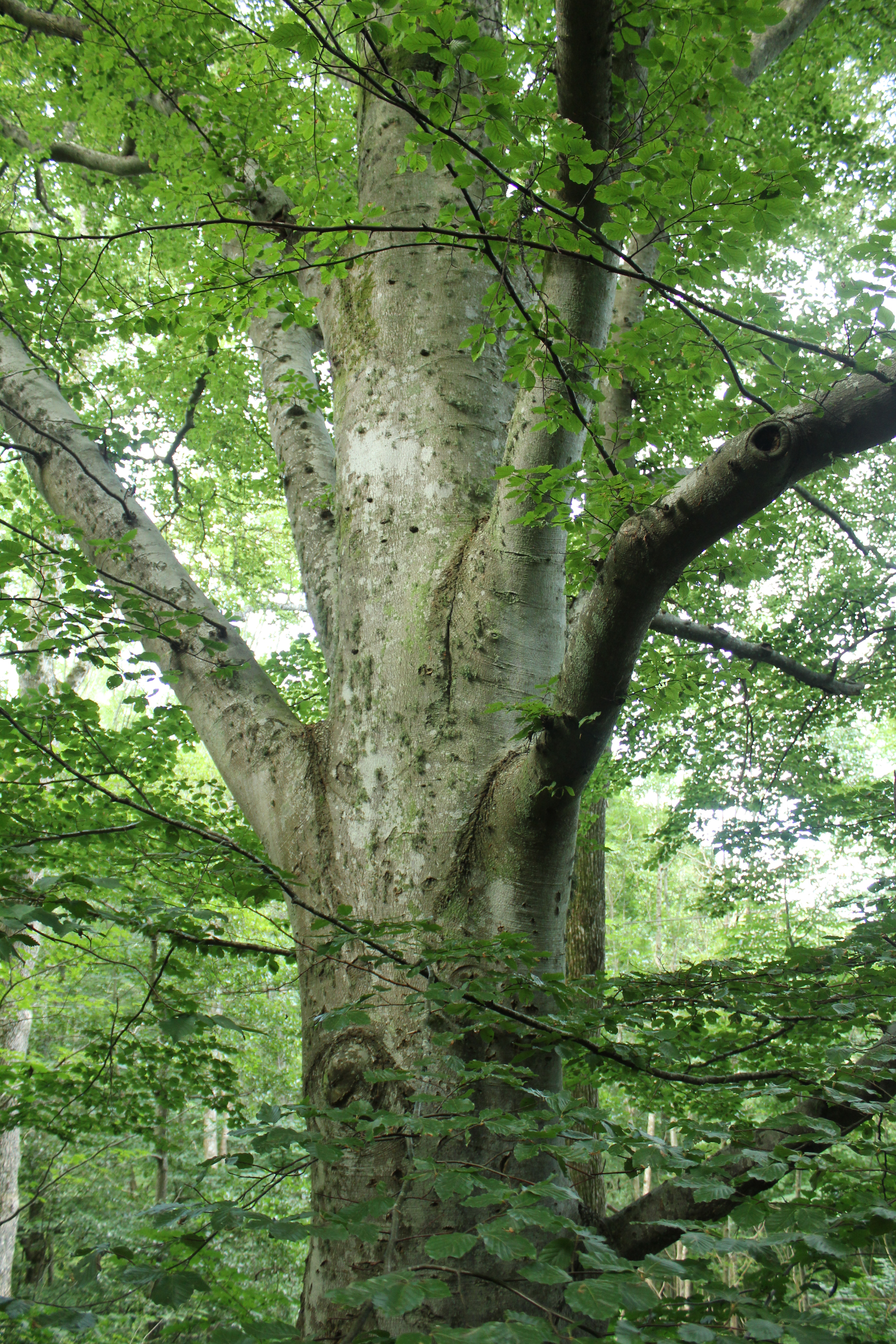
Fagus — commonly known as beeches — is a genus of deciduous trees belonging to the family Fagaceae, the beech and oak family. Named by Linnaeus and placed within the order Fagales, the genus comprises approximately 10–14 extant species depending on the taxonomic authority consulted. The genus is divided into two subgenera: Englerianae, restricted to East Asia, and Fagus, which spans Europe, western and eastern Asia, and eastern North America.
Beech trees are readily identified by their characteristically smooth grey bark, which remains unbroken even on old trunks, and by their elliptic leaves with prominent, straight parallel veins. The trees are monoecious — bearing both male and female flowers on the same individual. Male flowers are wind-pollinating catkins, while female flowers are borne in pairs and develop into the genus's distinctive fruit: small, three-angled nuts (beechnuts or mast) enclosed in a spiny four-lobed cupule.
The genus favours deep, well-drained soils with neutral to slightly acidic pH (6–7.5) and tolerates shade, wind, and cold. Despite their dominance in temperate forests, beeches are relatively shallow-rooted and susceptible to drought stress. In northern Europe the genus is a lowland species; in southern parts of its range it retreats to montane habitats, ascending to roughly 1,800 metres.
Beech trees are among the most ecologically and culturally significant trees in the Northern Hemisphere. The nuts — beech mast — have historically fed both wildlife and humans, and the dense, durable timber has long been prized for furniture, flooring, and construction. Beech wood also imparts distinctive flavour in the smoking of meats and in the production of German smoked beers.
Etymology
The genus name Fagus derives from Latin, itself tracing back to a Proto-Indo-European root shared with Greek phegos (a type of oak or edible-fruited tree) and the Old English word for beech. In the Germanic language family, the cognate developed a second meaning connected to writing: beech wood tablets were a common substrate for written records in early Germanic cultures, and this association gave rise to words meaning "book" in German (Buch) and other related languages. The Latin Fagus was formalised as the genus name by Linnaeus.
Distribution
The genus Fagus is native to temperate and subtropical zones of the Northern Hemisphere across three continents. In Europe, Fagus sylvatica dominates broadleaf forests from the British Isles and Atlantic coast eastward through central Europe. The Oriental beech (F. orientalis) extends into western Asia, including the Caucasus, Turkey, and northern Iran. In East Asia, species such as F. crenata (Japan), F. engleriana and F. sinensis (China), and F. multinervis occupy montane forests. Eastern North America is home to a single species, F. grandifolia. The genus is largely absent from western North America, south and southeast Asia, Africa, Australasia, and South America. Altitudinally the genus ranges from lowland plains in northern Europe to approximately 1,800 metres in southern parts of its range.
Taxonomy
Fagus L. is the accepted genus name, published by Linnaeus, and sits within the family Fagaceae, order Fagales, class Magnoliopsida, kingdom Plantae. GBIF records approximately 60 total taxa (including synonyms and infraspecific names) under the genus, with 10–14 extant species generally recognised depending on authority. The most recent treatments divide the genus into two subgenera: Englerianae, comprising species endemic to East Asia, and Fagus, encompassing species of Europe, western Asia, eastern Asia, and eastern North America. Western Eurasian representatives show morphological and genetic gradients suggesting ongoing gene flow or recent divergence, complicating delimitation of species boundaries in that group. A natural hybrid, Fagus ×taurica, is also recorded.
Ecology
Beech trees are characteristic dominants of temperate deciduous and mixed forests. They are strongly shade-tolerant, enabling regeneration under closed canopy, and can suppress competing vegetation through dense shade cast by their broad crowns. The preferred habitat is deep, well-drained, fertile soil with neutral to slightly acidic pH; the trees are sensitive to waterlogging and poorly tolerate compacted or highly alkaline substrates. Although generally wind-tolerant, beeches are vulnerable to drought due to their relatively shallow root systems.
Beech mast — the nuts produced in periodic high-yield years — represents a critical food source for a wide range of wildlife, including songbirds, woodpeckers, jays, squirrels, deer, wild boar, and bears. These mast years, which occur irregularly every few years, synchronise seed production across populations and are believed to overwhelm seed predators, increasing seedling establishment success. The nuts are also edible to humans and have historically served as a supplementary food and source of pressed oil.
Cultivation
Beech trees grow across USDA hardiness zones 3a–9b, accommodating a broad range of temperate climates in cultivation. They perform best in full sun to partial shade in moist, well-drained, fertile soils with high organic content and a slightly acidic to neutral pH. Once established, beeches tolerate dry soils, though prolonged drought stress can weaken trees. Spring growth flushes are sensitive to late frosts. Maintenance requirements are moderate; the trees are long-lived and develop large canopies, making them best suited to parks, estates, and large gardens rather than small urban plots. Fagus sylvatica and its many cultivars — including purple-leaved, weeping, and cut-leaved forms — are among the most popular large ornamental trees in temperate horticulture.
Propagation
Beechnut seeds offer the most reliable propagation method. Seeds should be collected fresh in autumn and sown immediately, or stored moist at cool temperatures (stratified) to break dormancy before spring sowing. Cold stratification of 3–4 months at near-freezing temperatures improves germination rates for stored seed. Vegetative propagation is possible through division of underground suckers during winter dormancy, though this is less commonly practised at scale. Ornamental cultivars are typically grafted onto Fagus sylvatica rootstocks to maintain true-to-type characteristics.
Uses
Beech has been one of the most economically and culturally important timber trees of the Northern Hemisphere. The dense, fine-grained wood is valued for furniture, flooring, plywood, tool handles, and general carpentry. Beech charcoal and wood are widely used in food smoking — imparting characteristic flavour to meats and cheeses — and beech chips are the traditional medium for lagering German Rauchbier. Beechnuts (beech mast) are edible raw or cooked, with a sweet, nutty flavour and significant starch and protein content; baked nuts develop a floury texture suitable as a potato or grain substitute. Historically, beech mast supported swine pannage in European forest systems, providing a significant autumn food supplement for livestock. Leaves contain tannin and have been used in folk medicine as astringents and tonics, including as topical treatments for headaches and fever. Bistre, a warm-brown pigment historically employed by draughtsmen and watercolourists, was produced by boiling beech wood soot. Early Germanic peoples used smooth beech wood tablets as a writing surface, a practice thought to link the genus etymologically to the concept of "book."

